
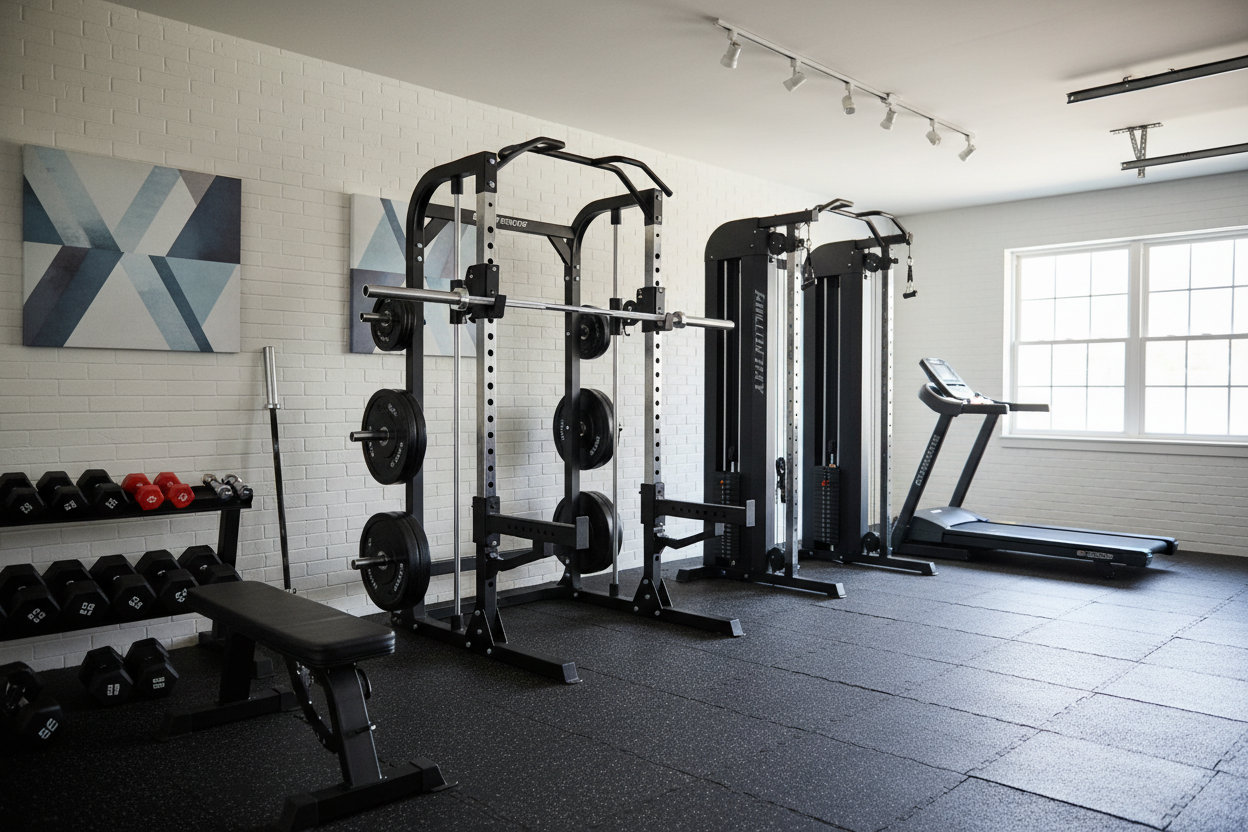
I spent years being a total rack snob. If it wasn't a 3x3-inch steel power cage bolted to the concrete, I didn't want it. Most combo machines I'd used were wobbly, plastic-filled junk found in three-star hotels. But after testing the latest engineering shifts, I have to admit: the best all in one home gym systems have finally grown up.
- Footprint: Modern rigs pack a power rack, functional trainer, and Smith machine into roughly 35-45 square feet.
- Steel Quality: Look for 11-gauge or 12-gauge steel; anything thinner will shimmy when you're racking 315 lbs.
- Pulley Ratios: 2:1 is standard for functional movements, but 1:1 is better for heavy lat pulldowns.
- Versatility: You can hit 95% of a commercial gym's exercise library without moving more than two steps.
The 'Hotel Gym' Stigma (And Why I Was Wrong)
We've all been there. You walk into a hotel gym, see a multi-station rig with '100 exercises' printed on the side, and realize the cables are sticky and the range of motion is designed for someone exactly 5'8' and not a half-inch taller. My initial home gym review mindset was rooted in those bad experiences. The pulleys were plastic, the cables frayed, and the ergonomics were an afterthought.
The shift happened when manufacturers stopped trying to make machines 'lightweight' for shipping and started using commercial-grade components. When you move away from nylon bushings and toward high-end bearings, the friction disappears. I recently did a workout equipment review on a system where the carriage moved so smoothly I actually had to check if I'd loaded the weight stacks. The 'wobble' is gone, replaced by the heavy-duty thud of real steel.
What Actually Separates a Good Multi-Gym from Cheap Junk
If you're scrolling through exercise machine reviews, ignore the flashy photos and look at the spec sheet. A fitness equipment review worth its salt starts with the frame. You want a unit built with 11-gauge steel. If the manufacturer doesn't list the gauge, it's probably 14-gauge (aka thin and shaky).
A legit home gym setup needs to feel anchored. When you're shopping for a Home Gym, check the weight of the actual unit. A 900-lb machine is going to be infinitely more stable than a 300-lb one. You also need to look at the weight stacks. Dual stacks are non-negotiable for functional training; otherwise, you're stuck doing one arm at a time like it's 1985.
The Smith Machine Integration That Changed My Mind
I used to hate Smith machines. They felt like dragging a metal pipe across a gravel driveway. But the integration in a modern Smith Machine Home Gym Station is a different beast. They now use commercial-grade linear bearings that glide on solid steel rods.
This is crucial for solo lifters. If you're going for a PR on bench or squats and your'e training alone in a garage, those safety catches are a literal lifesaver. The fitness machine reviews you see online often skip over the 'drag' factor, but in person, a high-quality Smith bar should move with a single finger. If it resists you, it's junk.
True Cable Crossovers vs. Narrow Pulley Stacks
The biggest mistake in gym equipment review history is thinking all cable machines are equal. If the pulleys are too close together, you can't get a proper stretch on chest flyes. You need width. The All In One Smith Machine With Cable Crossover S1 V4 is a prime example of getting the geometry right. It gives you the span of a commercial cable crossover without needing a 20-foot wall.
When reading reviews of fitness equipment, look for the pulley ratio. A 2:1 ratio means 100 lbs on the stack feels like 50 lbs in your hand. This is great for face pulls and lateral raises because it allows for micro-adjustments. If the machine is 1:1, the jumps between plates might be too heavy for smaller muscle groups.
Will an All-In-One Actually Save You Money?
Let's talk math. If you buy a high-end power rack, a separate functional trainer, a lat pulldown machine, and a Smith machine, you're looking at $5,000 minimum and a lot of wasted floor space. I've tried the modular route before—even wrote about how I recreated a pro setup with basic bodybuilding home gym equipment—but the footprint was a nightmare.
A new home gym rig that combines these into one footprint is usually 30% cheaper than buying the pieces individually. Plus, you only have one 'hub' to maintain. No more hunting for attachments across the garage; everything lives on the rack. For anyone doing a home gym machine reviews comparison, the space-to-utility ratio is the real winner here.
Final Verdict: What I'm Keeping in My Garage
The best home gym 2024 isn't a single barbell and a prayer. It's a unified system that handles everything from heavy triples to high-volume cable work. After doing dozens of home gym system reviews, I've realized that I don't miss my standalone power rack. The convenience of switching from a heavy squat to a cable row in ten seconds is addictive.
If you're serious about training, don't buy the cheapest exercise equipment for home reviews you find on a bargain site. Invest in the steel, the bearings, and the pulley width. It’s the difference between a machine you’ll actually use and a very expensive place to hang your laundry.
FAQ
Is an all-in-one gym better than a power rack?
It depends on your goals. If you only care about powerlifting, a rack is fine. But for bodybuilding and general hypertrophy, the cables and Smith machine on an all-in-one are superior for isolation work.
How long does it take to assemble?
Don't lie to yourself—it's a project. Expect to spend 4 to 6 hours. Get a real socket wrench set; the 'tools' included in the box are usually garbage.
Can I use my own Olympic plates?
Most high-end units use weight stacks, but many also include plate-loaded Smith bars or storage pegs. Always check if the machine uses 1-inch or 2-inch pegs before buying.
Share:
How Much Should a Real Weights Training Set Actually Cost?
The 'Boring' Truth About the Most Effective Exercise Equipment for Home