
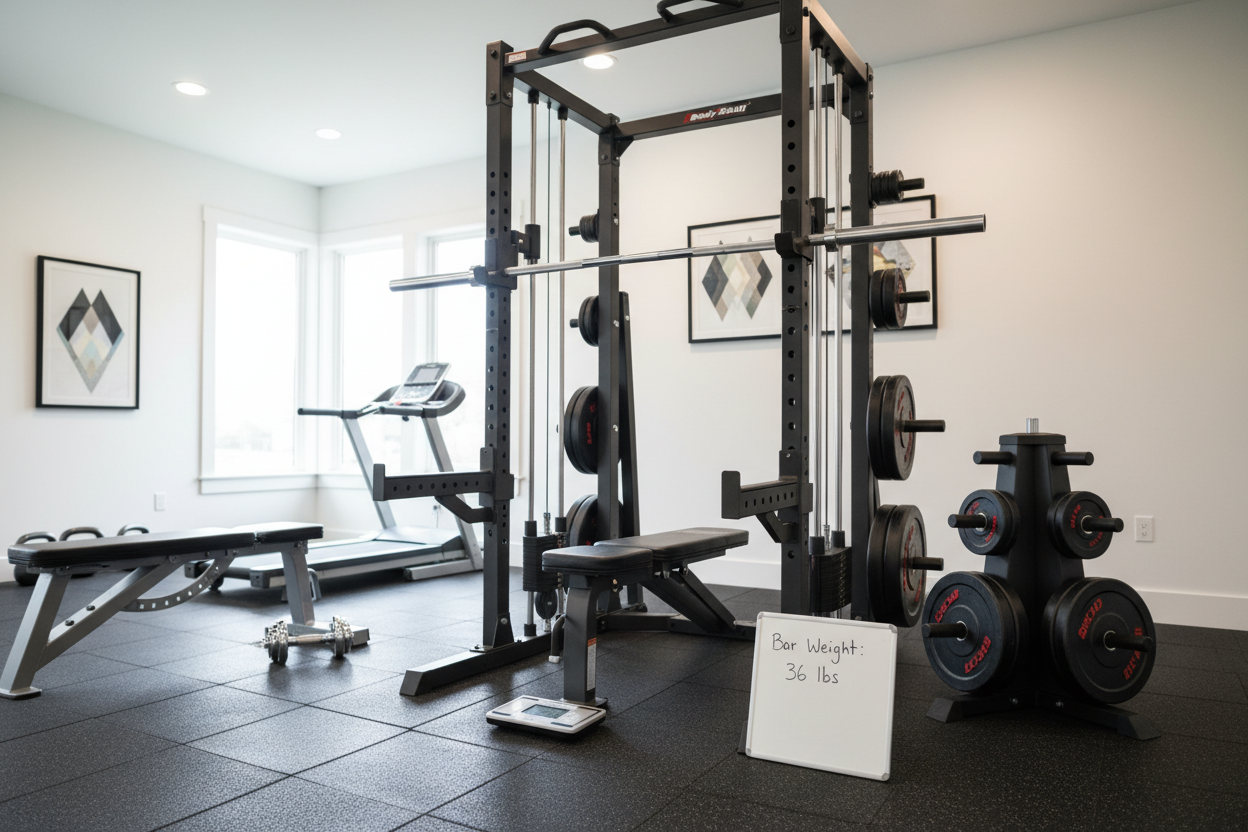
I was halfway through a heavy chest block when the realization hit me: my logbook was a total lie. One day I was hitting 225 for reps at the local commercial club, and the next day, 185 felt like a grinding max effort on my home rig. I knew the plates weren't the problem, so I finally did what any obsessed garage gym owner would do. I stripped the rack, grabbed my digital hanging scale, and found the actual body-solid smith machine bar weight.
- Series 7 GS348Q: Approximately 25 lbs (measured at 24.8 lbs).
- Powerline PSM144X: Approximately 32 lbs (due to the heavier carriage design).
- Counterbalance: Non-existent. What you lift is what you get.
- Maintenance Tip: Use dry silicone spray on the guide rods to keep that 25 lbs feeling consistent.
Why Body-Solid Rigs Feel So Different from Commercial Machines
If you've ever stepped off a Matrix or Life Fitness machine and onto a Body-Solid Series 7, you probably felt like someone secretly added a 25-pound plate to your lift. In big-box gyms, manufacturers use complex pulley systems and counterweights to make the bar feel nearly weightless. They want the real bar weight in smith machine racks to be as close to zero as possible so anyone can use them.
Body-Solid builds for the home and light commercial market. These rigs are direct-drive. There are no hidden weights behind the shroud pulling the bar up for you. When you unrack that bar, you are fighting the raw mass of the steel bar and the carriage it sits on. It feels heavier because it actually is.
The Hanging Scale Test: Getting the Real Numbers
I didn't want to rely on the manual, which is notoriously vague about the carriage mass. I looped a heavy-duty strap around the center of the bar on my GS348Q and hooked it to my calibrated scale. The reading fluctuated for a second before settling on 24.8 lbs. For the sake of your sanity and your training log, call it 25 lbs.
You have to account for the 'breakaway' friction too. Even with high-quality linear bearings, there is a slight resistance that doesn't exist with a free-weight barbell. On a cheap, unlubricated machine, that friction can add a perceived 5 to 10 lbs of resistance on the way up. On a clean Body-Solid unit, it's negligible, but it's why a 225-lb Smith press will always feel different than a 225-lb bench press.
Series 7 vs. Powerline: Does the Model Matter?
The Series 7 is the gold standard for Body-Solid. It uses high-end linear bearings that glide over the guide rods with very little drag. This keeps the starting weight consistent throughout the entire range of motion. If you have the Series 7, use 25 lbs as your base.
The Powerline PSM144X is a different beast. It uses a slightly different carriage and bushing system. When I tested a buddy's Powerline, the starting weight felt closer to 32 lbs. The carriage is bulkier and the friction is higher because it lacks the precision bearings of the Series 7. If you're on the Powerline, I'd round up to 30 or 35 lbs in your app.
Stop Overthinking the Plate Math (How to Actually Log It)
I spent weeks trying to calculate the exact friction coefficient of my guide rods before I realized I was wasting training energy. Tracking your progress on a Smith machine is about consistency, not absolute physics. If you decide the bar is 25 lbs, keep it 25 lbs forever. The goal is to see that total number go up over six months.
It’s much easier to track than a Freemotion smith machine bar weight, where cable tension and pulley ratios turn simple math into a calculus problem. With a Body-Solid rig, the resistance is linear. Pick a number, stick to it, and focus on the tension in your quads or chest instead of the digits on the scale.
Building a Complete Setup Around Your Fixed-Path Rig
Once you know your numbers, you need the right tools to actually use them. A Smith machine is only as good as the bench you put inside it. Because the bar path is fixed—usually at a 7-degree angle on Body-Solid units—you can't just 'adjust' your arm path. You have to move your body.
I highly recommend a sturdy adjustable weight bench that allows for micro-adjustments. When I'm doing incline presses, being two inches too far forward or back can wreck my shoulders because the bar won't move for me. Get a bench that locks into place and doesn't wobble, so that 25-lb starting weight stays stable while you're grinding out your final set.
My Personal Experience: The Lube Mistake
I learned the hard way that these machines need love. About a year in, my '25-lb' bar started feeling like it was sticking at the bottom of my squats. I sprayed some old WD-40 on the rods. Huge mistake. WD-40 is a degreaser, not a long-term lubricant; it actually attracted dust and turned the glide into a gritty mess. I had to scrub the rods with steel wool and switch to a dry silicone spray. Now, it's back to that smooth, predictable 25-lb resistance I measured on day one.
FAQ
Does the bar weight change if I'm using the 7-degree slant?
Technically, physics says the vertical force is slightly less on an incline, but for lifting purposes, the difference is so small it’s not worth calculating. Treat it as the full 25 lbs.
Should I count the weight of the safety stops?
No. The safety stops stay at the bottom of the rack. Only the bar and the carriage it’s attached to make up the starting resistance.
Can I swap the bar for a standard 45-lb Olympic bar?
No. The Smith machine bar is integrated into the carriage and bearing system. Swapping it would require custom fabrication and would likely ruin the safety of the machine.
Share:
Does a Power Cage With Smith Machine Make Sense for Your Garage?
Why the Reverse Leg Press on Smith Machine Isn't Just an Instagram Hack