
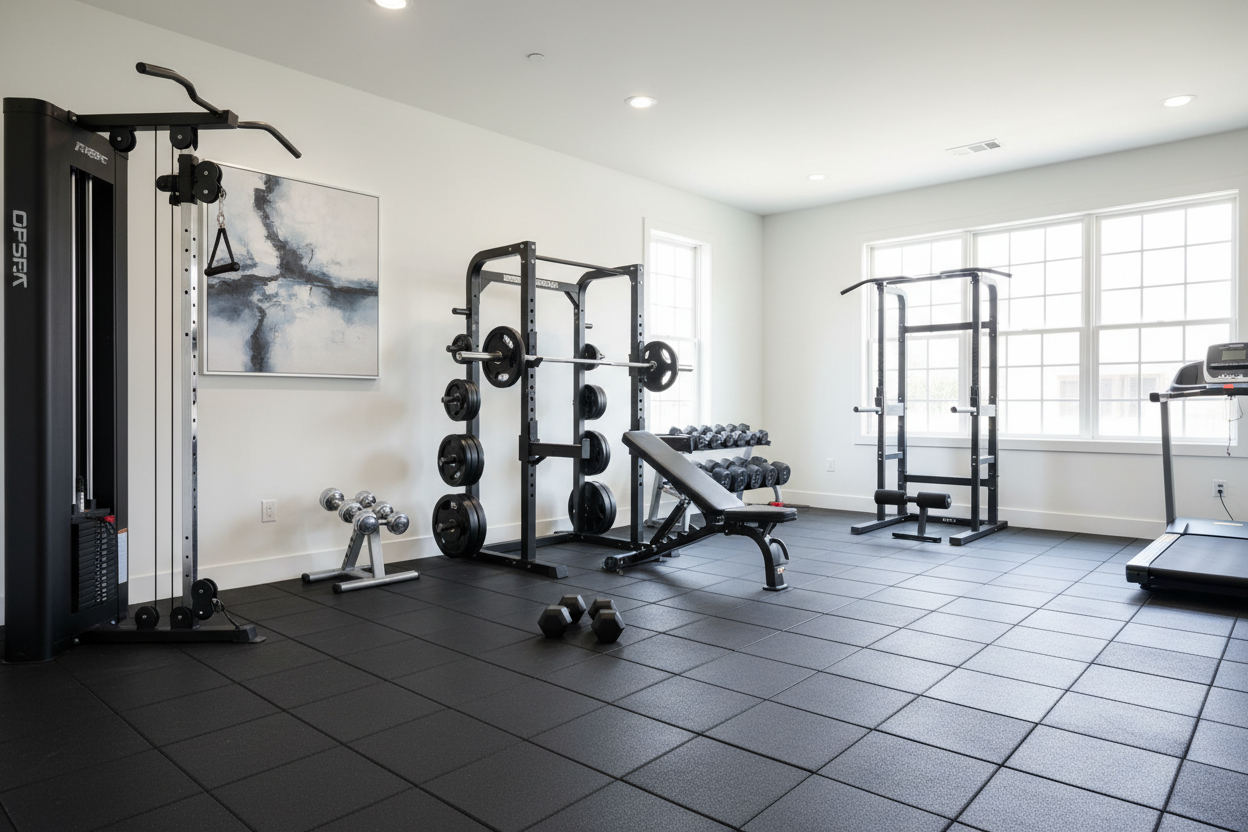
I remember the night I realized my 'minimalist' home gym was actually just a collection of excuses. I was doing my 50th push-up of the night, my wrists were screaming, and my chest looked exactly the same as it did three months prior. I had the bands, the adjustable dumbbells, and the pull-up bar, but I was spinning my wheels. I finally admitted that if I wanted real growth, I needed upper body workout machines for home that could actually handle heavy-duty resistance without the instability of a door-anchor setup.
Quick Takeaways
- Cables offer the highest ROI for your footprint by providing constant tension.
- Plate-loaded machines are superior for isolation if you have specific weak points like triceps or rear delts.
- Avoid 'all-in-one' units made of thin 1-inch tubing; they flex under heavy loads and feel cheap.
- A Smith machine/pulley hybrid is the smartest way to save space without sacrificing heavy pressing.
Why Push-Ups and Bands Aren't Enough Anymore
Bodyweight training is great for a foundation, but eventually, you hit a wall that calisthenics can't climb. Progressive overload is the law of the land. Once you can do 20 clean push-ups, adding more reps just builds endurance, not mass. Bands are even trickier because the resistance is lightest at the bottom of the movement—where your muscles are often in their strongest, most stretched position. You're missing out on the most productive part of the lift.
Serious lifters eventually reach a point where they need dedicated upper body exercise equipment for home to provide consistent, measurable resistance. When you're using a machine, you aren't fighting for balance or worrying about a band snapping. You can focus entirely on the mind-muscle connection and driving the weight to failure safely. If you've been stuck at the same shirt size for a year, it's time to stop pretending a piece of latex is going to give you a 45-inch chest.
The Free Weight Plateau (And Why I Switched My Setup)
I used to be a barbell purist. If it wasn't a bench press or a bent-over row, I didn't want it in my garage. But after years of heavy loading, my shoulders started to feel like they were full of dry sand. The fixed path of a barbell is unforgiving. I found myself cutting sets short not because my muscles were tired, but because my rotator cuffs were begging for mercy. I realized that my quest for 'functional' strength was actually just making me dysfunctional.
I eventually traded free weights for a full body workout machine approach for my accessory work. The switch wasn't about being lazy; it was about precision. Machines allowed me to isolate my lats and pecs without my lower back or shoulders becoming the limiting factor. My joints stopped aching, and my hypertrophy numbers actually started moving again because I could finally train to true failure without a spotter. Sometimes, the 'old school' way is just a fast track to an orthopedic appointment.
Cable Pulleys: The Non-Negotiable Upper Body Builder
If you only have room for one piece of gear, make it a functional trainer or a high-quality lat pulldown tower. Cables are the gold standard for upper body exercise equipment for home because they provide constant tension throughout the entire range of motion. Unlike a dumbbell fly where the tension disappears at the top, a cable fly keeps your pecs screaming from start to finish. Look for machines with at least 11-gauge steel and aluminum pulleys; plastic pulleys will degrade and get 'crunchy' within six months of heavy use.
A versatile home gym setup usually centers around a dual-pulley system. This allows for face pulls, cable crossovers, tricep pushdowns, and seated rows. I prefer a 2:1 ratio for functional trainers because it gives you a longer cable travel and finer weight increments, which is essential for smaller muscle groups. If you're doing heavy lat pulldowns, ensure the machine has a solid thigh pad—nothing ruins a set like your own body weight lifting off the seat before the stack moves.
When Plate-Loaded Isolation Machines Actually Make Sense
I used to think single-station machines were a waste of space until I tried to fix a lagging tricep with just dumbbells. The stability of a plate-loaded unit allows you to move significantly more weight than you ever could with free-standing movements. If you have the floor space—roughly a 4x4 foot area—a heavy-duty seated dip machine is a total cheat code for thick arms and lower chest development. It takes the stress off your wrists and puts it exactly where it belongs.
The key here is avoiding the wobbly multi-gyms you see at big-box retailers. Those machines try to do ten things and do all of them poorly. A dedicated plate-loaded lever machine feels 'locked in.' You want a unit that uses pillow block bearings at the pivot points. If the arm of the machine has side-to-side play when it's empty, it's going to feel like a disaster once you throw three plates on it. Stick to heavy steel and simple designs.
Is a Smith Rig the Ultimate Space-Saving Cheat Code?
The biggest hurdle for upper body workout equipment at home is the footprint. You want a chest press, a row, and a pull-up station, but you don't want to park your car in the driveway forever. This is where a Smith machine home gym station becomes the MVP. By integrating a guided barbell with dual cable pulleys and a pull-up bar, you effectively consolidate four machines into the space of one power rack.
I personally love a Smith machine for incline presses. You can set the safety stoppers and absolutely bury your chest without the fear of getting pinned. It allows for a level of intensity that's hard to replicate with a standard bench press when you're training solo. Look for a rig that uses linear bearings rather than bushings. Linear bearings provide that 'ice on ice' feel that makes the bar glide, whereas bushings can feel sticky and jerky, especially when the bar isn't perfectly level.
The Verdict on Floor Space vs. Muscle Gains
At the end of the day, your home gym should reflect your goals. If you just want to stay active, keep your bands. But if you want to actually change your physique, you need to invest in the right upper body workout machines for home. You don't need a 20-station commercial circuit. Start with a solid cable system or a Smith-hybrid. Measure your space twice, check the ceiling height for overhead presses, and buy the heaviest gauge steel you can afford. Your joints and your progress will thank you.
FAQ
Do I need a 1:1 or 2:1 cable ratio?
For most people, a 2:1 ratio is better for upper body work. It makes the weight feel half as heavy but gives you twice the cable length, which is vital for movements like chest flies or shadow boxing where you need a lot of travel.
Are home machines as good as gym machines?
If you buy 11-gauge steel with linear bearings, yes. If you buy the $200 'all-in-one' special from a department store, no. The difference is in the thickness of the steel and the quality of the pulleys.
How much floor space do I actually need?
A standard functional trainer needs about 5 feet of width and 4 feet of depth. However, you need to leave an extra 3 feet in front of it so you can actually perform the exercises without hitting a wall.
Share:
Can a Cheap Target Dumbbell Set Survive a Real Garage Gym?
Is a Universal Gym Weight Machine Actually Worth the Space?