
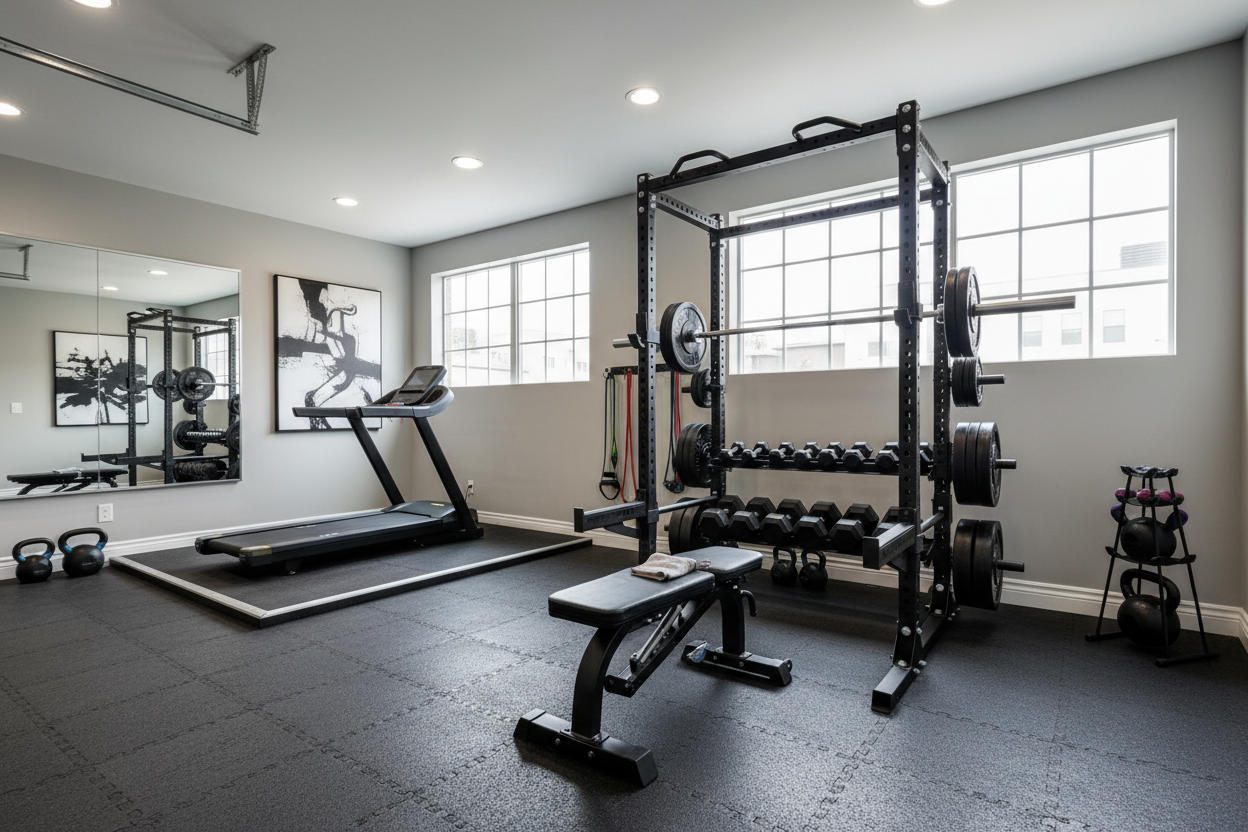
I remember the day I finally had enough. My local commercial gym jacked up their rates again while half the cable machines were held together by duct tape and hope. I spent all night scrolling through forums, convinced that building a home gym was the only way to keep my sanity. I almost bought one of those 'all-in-one' total body machines from a late-night infomercial, but luckily, a friend talked me off the ledge.
Quick Takeaways
- Prioritize the 'Iron Triangle': A rack, a barbell, and plates.
- Avoid 'all-in-one' cable machines early on; they lack the versatility of free weights.
- Invest in a rack with standard 2x3 or 3x3 steel tubing for future compatibility.
- Budget at least $300-$500 for flooring and lighting—the hidden costs.
The 'Buy Everything Now' Trap
Most people fail at making home gym spaces because they try to recreate a 40,000-square-foot commercial facility in a two-car garage. You see a sale on a 50-piece resistance band set or a plastic-coated kettlebell and think you're saving money. You aren't. You're just cluttering your floor with junk that won't help you hit a new deadlift PR.
When I ditched my membership to build a real gym at home, I realized that a phased approach is the only way to stay under budget. If you buy cheap, flimsy gear just to fill the room, you'll end up replacing it in six months. Start with the heavy stuff that lasts a lifetime.
Phase 1: The Non-Negotiable Iron Triangle
If you want to create a home gym that actually produces results, you need the three pillars of strength: a power rack, a 20kg barbell, and at least 300 lbs of plates. This is the foundation of every serious home gym build. Without these, you're just doing calisthenics in a fancy room.
Don't buy a 'standard' 1-inch barbell. You need an Olympic 2-inch sleeve bar with a decent knurl. I prefer a multi-purpose bar with a 28.5mm diameter. It’s stiff enough for squats but has enough whip for cleans. For plates, iron is cheaper and takes up less room on the bar, but if you're training on bare concrete, get bumpers to save your foundation.
Why Your Rack Dictates Everything Else
Your rack is the centerpiece of your gym build. A cheap squat stand might hold 300 lbs, but will it stay upright when you're gassed and slam the bar into the J-cups? Probably not. Look for 11-gauge steel. Avoid anything made with thin 14-gauge metal; it feels like a toy once you start moving real weight.
Pay attention to hole spacing. 'Westside' spacing (1-inch gaps through the bench zone) is a lifesaver for finding the perfect safety height. If the holes are spaced 3 inches apart, you'll find yourself either pinning the bar too high or dropping it too low on your chest during a failed bench press.
Phase 2: The Bench and the Adjustables
Once you can squat and pull, it's time to set up gym equipment for your upper body. A flat bench is fine, but a heavy-duty adjustable (FID) bench opens up incline presses and seated work. Look for one with a 1,000-lb capacity. If it weighs less than 60 lbs, it’s probably going to wobble when you're trying to concentrate on your form.
For dumbbells, don't buy a full rack of fixed weights unless you have a massive budget and a dedicated wing of your house. A pair of high-quality adjustable dumbbells—the ones that go from 5 to 80 lbs—saves about 15 square feet of floor space. That's room you'll need for your deadlift platform.
Phase 3: When to Actually Buy Specialized Machines
After six months of starting a home gym with the basics, you'll know where your weaknesses are. This is when you earn the right to buy specialized gear. If your goal is pure hypertrophy, adding a smith machine home gym station can provide the stability needed for high-rep failure sets that are hard to do safely with a naked barbell.
Similarly, if you're focused on glute development, a dedicated hip thrust machine is a massive quality-of-life upgrade. Trying to set up 400 lbs for hip thrusts in a power rack is a logistical nightmare. These machines are 'luxury' items, but they make your training significantly more efficient once the foundation is set.
The Unspoken Costs of Setting Up Your Space
Everyone forgets the 'boring' stuff when starting home gym equipment lists. You need flooring. Do not buy those interlocking foam tiles from the toy aisle; they will compress and tear. Go to a farm supply store and buy 3/4-inch horse stall mats. They are heavy, they smell like a tire fire for a week, but they are indestructible.
Lighting is another big one. Most garages have a single 60-watt bulb that makes the space feel like a dungeon. Spend $50 on some LED shop lights. If you can't see your form in the mirror, you're going to get hurt. Also, factor in a dehumidifier if you live in a damp climate, unless you want your brand-new barbell to be covered in surface rust by next month.
My Biggest Mistake
When I was first building your own home gym, I bought a 'bargain' barbell for $85. Within three months, the sleeves stopped spinning. Every time I did a clean or even a high-rep overhead press, the torque from the plates almost snapped my wrists. I ended up spending $300 on a quality bar anyway. Buy once, cry once. The cheap gear always costs more in the long run.
Home Gym FAQ
How much space do I really need?
At minimum, an 8x8 foot area for a rack and some breathing room. If you want a full platform and a bench, aim for 10x12 feet.
Should I buy used gear?
Yes, for plates and dumbbells. Iron is iron. But be wary of used racks and bars; if they're bent or the welds are cracked, they're scrap metal.
Is a home gym cheaper than a membership?
In the long run, yes. Usually, the break-even point is around the 18-to-24-month mark, depending on how much high-end gear you buy.
Share:
The Ugly Truth About Buying Real Gymnasium Equipment
The Mistakes I Made Buying a Leg Press Machine for Beginners