
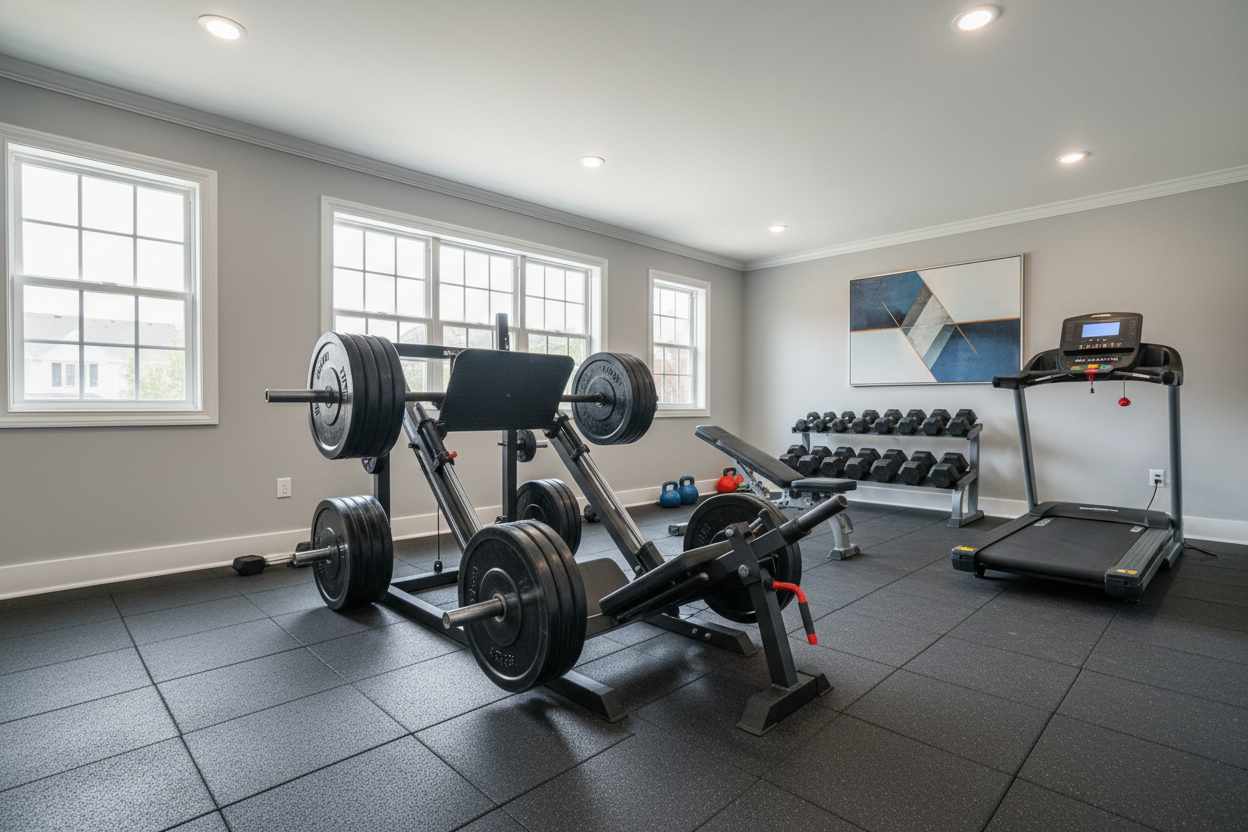
I spent three years trying to convince myself that walking lunges in my driveway were 'enough' for leg growth. They weren't. I wanted the heavy, soul-crushing volume of a sled, but my garage is basically a glorified storage closet where my car used to live. That is where the mini leg press machine enters the conversation—a piece of gear that promises the gains of a commercial gym without requiring you to park your truck on the lawn.
The skepticism is real, though. When you see something labeled 'mini,' you usually think of flimsy plastic or weight capacities that top out at two plates. I have loaded, dropped, and cursed at enough budget equipment to know that 'space-saving' often translates to 'unstable.' I wanted to see if a compact sled could actually survive a real leg day without feeling like it was going to fold under a 400-pound load.
Quick Takeaways
- Mini leg presses typically save 3-4 feet of floor length compared to commercial units.
- Look for linear bearings and solid guide rods; nylon rollers will fail under heavy loads.
- Range of motion is the biggest compromise—taller lifters (6'2"+) may find them cramped.
- Stability depends on the base width and the gauge of the steel frame.
The Reality of Leg Days in a Tiny Garage
If you are working with a 10x10 box, every square inch is a premium. I have been there, trying to figure out if I can squeeze a power rack and a bench into a corner while still having room to breathe. When you start looking at leg press and hip thrust machines, the dimensions are usually depressing. A standard commercial sled is about 8 to 9 feet long. In a residential garage, that is not just a piece of equipment; it is a permanent obstacle that dictates where everything else goes.
The frustration of limited space usually leads to people skipping heavy machine work entirely. You stick to squats and deadlifts, which are great, but sometimes your lower back is fried and you just want to blast your quads without a barbell on your spine. Trying to force a full-sized sled into a small room usually results in a logistical nightmare where you have to move three other things just to load the plates. A mini leg press is designed to solve that specific headache, cutting the footprint down to something manageable without theoretically sacrificing the ability to move heavy iron.
What Exactly Makes a Sled a 'Mini' Leg Press?
A mini leg press isn't just a shrunken toy version of the big guys. The primary difference is the track length and the angle of the carriage. While a commercial unit might have a 45-degree angle and a massive rail system, a mini version often uses a steeper or more vertical path to shave off horizontal distance. You are looking at a footprint of roughly 4 feet by 3 feet, compared to the massive 8x4 footprint of a standard unit.
The sled starting weight is another big differentiator. On a massive commercial machine, the empty sled might weigh 100 lbs or more. On a compact version, the sled is often lighter—around 35 to 50 lbs—which is actually a benefit for accessory work or rehab. However, the trade-off is the weight horn length. You might only have 10-12 inches of space per side to load plates. If you are using thick bumper plates, you are going to run out of room long before you hit the machine's structural limit. To get the most out of these, you really need thin cast iron or competition plates.
Will It Wobble When You Load Up the Plates?
This is the make-or-break question. I have tested 'mini' units that felt like they were made of coat hangers. The engineering specs you need to obsess over are the guide rods and the bearings. Cheap machines use nylon rollers that sit on the outside of the frame. These are fine for a 200-lb load, but the second you start pushing toward 400 or 500 lbs, those rollers compress, the friction increases, and the movement feels 'chunky.' It is a joint hazard because the resistance becomes unpredictable.
You want a mini leg press machine that utilizes solid steel guide rods and linear bearings. Linear bearings stay smooth regardless of how much weight you stack on. Also, look at the gauge of the steel. 11-gauge steel is the gold standard for a reason. If the frame is 14-gauge or thinner, you will feel the entire unit shift and flex when you lockout. A stable machine should feel like it is bolted to the earth, even if it is not. If you feel the base lifting when you press, that is a massive red flag for the unit's geometry and center of gravity.
When It Makes Sense to Upgrade to a Combo Unit
There is a tipping point where a standalone mini sled might not be the smartest play. If you find yourself wanting both a leg press and a hack squat, you are looking at two different footprints. In a small garage, that is a death sentence for your floor space. This is where I usually suggest looking at a compact 30 degree leg press combo. These units take up slightly more room than a mini press but give you two distinct movement patterns by just swapping a backpad or a footplate.
The 30-degree angle on these combos is a sweet spot. It provides enough resistance to feel heavy without requiring the massive overhead clearance of a vertical press. If you are serious about leg development and have the extra 12 to 18 inches of floor space, the combo unit usually offers better long-term value. You won't outgrow it as quickly as a basic mini sled, and the stability is typically a step up because the base is wider to accommodate the hack squat configuration.
Squeezing a Hack Squat Into the Mix
The beauty of modern dual-function machines is how they utilize the same track. By integrating a 3 in 1 hack squat combo machine into your gym, you effectively kill three birds with one stone: leg press, hack squat, and often a calf raise station. This efficiency is how you build a pro-level leg day in a residential footprint. Instead of having three separate machines taking up 100 square feet, you have one unit taking up about 25 square feet. For most garage gym owners, that is the only way to actually fit all the necessary tools for hypertrophy without moving to a commercial warehouse.
The Final Verdict: Space vs. Gains
So, is the compromise worth it? If you are a 6'5" powerlifter who needs to move 1,000 lbs for reps, a mini leg press machine is going to feel like a toy. You will hit the end of the track and bottom out the weight horns. But for 90% of home trainees, the answer is a resounding yes. The ability to safely push your quads to failure without a spotter is worth the slight loss in track length.
The key is not to buy the cheapest thing on the market. Spend the extra money on a unit with 11-gauge steel and linear bearings. You want a machine that challenges your muscles, not your nerves. If you choose correctly, you get a piece of gear that handles heavy plates and fits in the corner, leaving you enough room to actually park your car—or, more likely, buy more gym equipment.
Personal Experience: My First 'Mini' Mistake
I once bought a compact leg press from a big-box retailer because it was on sale for $300. It looked fine in the photos, but the first time I loaded three 45-lb plates on each side, the guide rods literally bowed inward. Every rep sounded like a screeching owl because the plastic rollers were screaming under the pressure. I ended up selling it for half what I paid two weeks later. The lesson? If the shipping weight of the machine is less than the weight you plan to put on it, you are going to have a bad time. Don't cheap out on the frame; your knees will thank you.
FAQ
Is a mini leg press safe for heavy lifting?
Yes, provided it uses high-quality linear bearings and at least an 11-gauge steel frame. The danger comes from cheap units that flex or use thin nylon rollers that can crack under heavy loads.
How much weight can a compact leg press usually hold?
Most high-quality compact units are rated for between 400 and 600 lbs. Always check the manufacturer's spec sheet, and remember that using iron plates allows you to fit more weight on the horns than bulky bumpers.
Can tall people use a mini leg press?
It depends on the specific model. If you are over 6'2", you may find that you hit the 'top' of the track before your legs are fully extended. Look for units with adjustable footplates to help mitigate this.
Share:
Stop Guessing: A Real Guide to Exercise Equipment and Names
The Fragile, Expensive Reality of Smart Fit Dumbbells