
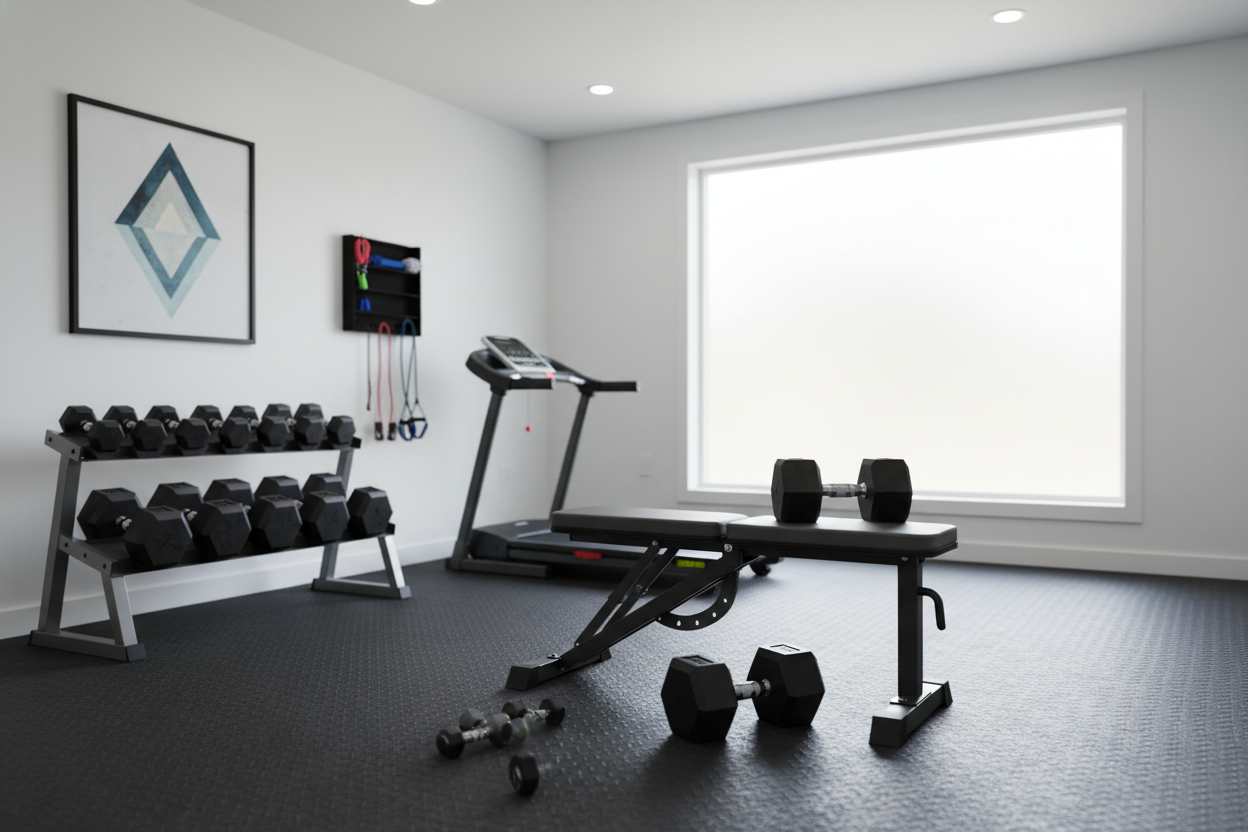
I remember staring at my studio apartment's 600 square feet and wondering if I could actually train for real there. I’d just moved, my gym membership was $150 a month, and I had a pair of 50lb dumbbells but nowhere to sit. I bought a portable weight lifting bench that looked great in the renders, only to have it feel like a pool noodle the second I tried a heavy row. It’s a common trap: sacrificing structural integrity for the sake of a closet-friendly footprint. You want to train, but you don't want your equipment to collapse while you have 80 lbs of iron hovering over your face.
Quick Takeaways
- Look for 14-gauge steel at a minimum; 11-gauge is the gold standard for heavy lifters.
- Avoid 'suitcase' folds that have a hinge in the middle of the actual back pad.
- Check the footprint width; a narrow base is a recipe for tipping during rows.
- A 600-lb static weight capacity is the baseline for safety when you factor in your body weight plus the dumbbells.
The Dark Age of Folding Gym Equipment is Over
For a long time, 'portable' was code for 'trash.' If you bought a bench that could fold up, you were basically buying a glorified lawn chair with some black vinyl stapled to it. These things would shake if you sneezed, and the idea of doing a heavy incline press on them was laughable. I’ve seen frames made of steel so thin you could probably dent them with a firm thumb-press. It made people think that if you wanted to lift heavy, you needed a 100-pound commercial beast bolted to the floor.
But the engineering has finally caught up to the home gym boom. We are seeing a new breed of stowable gear that uses clever geometry instead of just adding raw mass. You can now find units that fold down to 10 inches tall but can still support a combined load of half a ton. The shift happened when manufacturers realized that garage gym owners weren't just doing cardio; they were doing high-volume strength work. The modern portable bench uses reinforced pivot points and high-tensile locking pins that keep the frame rigid, even when you're moving max loads. It’s about working with the physics of the load rather than just trying to out-bulk it with heavy iron.
The Anatomy of a Frame That Won't Fold Mid-Press
When you’re shopping for a weight bench that needs to be moved around, the frame is everything. You aren't just looking at the weight capacity listed on the box—that's often a 'static' rating, meaning what it can hold if nothing is moving. When you're dropping 90-pound dumbbells onto your chest, that's dynamic force. You need a frame that can handle the shock. I always check the steel gauge first. Most 'budget' portable benches use 16-gauge steel, which is basically paper. You want at least 14-gauge, or better yet, 11-gauge steel tubing. That’s the difference between a bench that feels like a rock and one that feels like a trampoline.
Then there’s the locking mechanism. On a portable unit, the hinge is the weakest point. If the bench uses a cheap pop-pin that doesn't fully thread into the frame, it’s going to wobble. I prefer a 'ladder' style adjustment for the backrest because it’s faster, but for a truly portable fitness bench, a solid pull-pin with a secondary screw-down knob is the safest bet. This eliminates the 'play' in the frame. If you can grab the top of the bench and wiggle it more than half an inch side-to-side, it’s not built for heavy dumbbell work. You also need to look at the base stabilizers. A 'T-frame' base is okay, but an 'H-frame' base—where the feet extend wide at both the front and back—is much less likely to tip when you're leaning over for a one-arm row.
Why Your Hinge Placement Ruins Your Arch
One thing most people overlook is the 'pad gap.' On many portable weight benches, the hinge that allows the bench to fold sits right where your lower back or butt is supposed to be. If that gap is more than two inches wide, you’re going to hate it. When you’re trying to set a solid arch for a bench press, your shoulder blades need to be pinned and your lumbar needs support. If you're constantly sliding into a hole in the middle of the bench, your form goes out the window. I’ve trained on benches where the gap was so big I felt like I was sitting on two separate stools. It’s a literal pain in the ass.
Height is the other factor. A lot of portable benches sit higher than the standard 17.5 inches because of the folding hardware underneath. If a bench is 20 inches tall, and you’re not six-foot-four, your feet won't be flat on the floor. Without 'leg drive,' your power output on presses will drop by 10 to 15 percent. You want a bench that maintains a standard competition height even while being stowable. Look at the pad thickness too. High-density foam (at least 2.5 inches) is necessary so you don't bottom out and feel the steel frame against your spine when you're holding heavy iron. If you can pinch the foam and feel the board underneath, keep looking.
Programming a Brutal Portable Bench Workout
Just because you’re using a portable setup doesn't mean your workouts have to be 'light.' In fact, a dumbbell-only routine on an adjustable weight bench can be significantly more taxing than a standard barbell session because of the stabilization required. I like to start with a heavy incline press. Using the 30-degree or 45-degree setting on a solid adjustable unit allows you to target the upper pecs in a way a flat bench just can't. Because you don't have a rack, you're forced to master the 'kick-up'—getting those dumbbells from your knees to your shoulders—which is a skill in itself.
After presses, I move into chest-supported rows. This is where a portable bench really shows its worth. By lying face down on the incline, you eliminate all the momentum from your legs and lower back, forcing your lats and traps to do 100% of the work. It’s a humbling exercise. You can also use the bench for Bulgarian split squats by hooking your back foot over the seat. This is a love-to-hate movement that builds massive leg strength without needing a squat rack. Finish off with seated curls or overhead extensions. The key is to utilize the angles. A portable bench workout isn't a compromise; it’s a focused way to hit muscles from positions you usually ignore in a crowded commercial gym.
The 3 Specs That Define a Real Portable Fitness Bench
Before you hit 'buy' on that portable fitness bench, you need to run it through the gauntlet. First, check the 'folded dimensions.' It sounds obvious, but I’ve bought 'portable' benches that were still four feet long when folded—hardly space-saving. You want something that can slide under a bed or stand up in a closet. Second, look at the weight. A bench that weighs 30 lbs is easy to carry, but it’s going to move when you’re lifting. I look for the sweet spot around 45–60 lbs. It’s heavy enough to stay planted but light enough to move with a handle.
Third, check the 'wobble test' in reviews. If multiple people mention the bench feels 'sketchy' at high inclines, believe them. A real portable fitness bench should feel like a single piece of steel when it’s locked in. I personally prefer benches with transport wheels. Even if it folds, you don't want to be lugging a 50-lb awkward shape across your apartment floor after a leg day. If you want to see the ones that actually passed my 'living room test,' I tested every workout bench portable enough to fit under a bed and found only a handful that didn't make me fear for my safety.
Personal Experience: My 'Folding' Disaster
I once tried to save $50 by buying a generic bench that advertised a 500-lb capacity. I was doing a set of seated shoulder presses with 60-lb dumbbells. As I leaned back to get into position, the locking pin—which was just a cheap spring-loaded piece of plastic—sheared off. The backrest slammed down to the flat position while I was mid-rep. I didn't get hurt, but I learned a valuable lesson: your life is worth more than the $50 you save on a cheap hinge. Since then, I only trust benches with steel-on-steel contact points and thick adjustment pins. If the adjustment mechanism looks like it belongs on a toy, it probably does.
FAQ
Can I do bench presses with a barbell on a portable bench?
Technically yes, if you have a separate squat stand. However, make sure the bench is wide enough to stay stable when you're racking the bar. Most portable benches are better suited for dumbbell work where the weight is centered over the frame.
How do I stop my bench from sliding on hardwood floors?
Most portable benches come with rubber end caps, but they can be slippery. I always recommend placing a small piece of horse stall mat or a heavy-duty yoga mat underneath to lock it in place and protect your floors.
Are 'flat-only' portable benches better than adjustable ones?
Flat benches are usually more stable because they have fewer moving parts and no hinges. If you only do flat presses and rows, a folding flat bench is a tank. But for most home gym owners, the versatility of an incline/decline model is worth the slight trade-off in rigidity.
Share:
Why Your Incline Workout Bench Leaves Your Head Hanging Off
I Finally Found a Used Belt Squat Machine (Here's the Catch)