
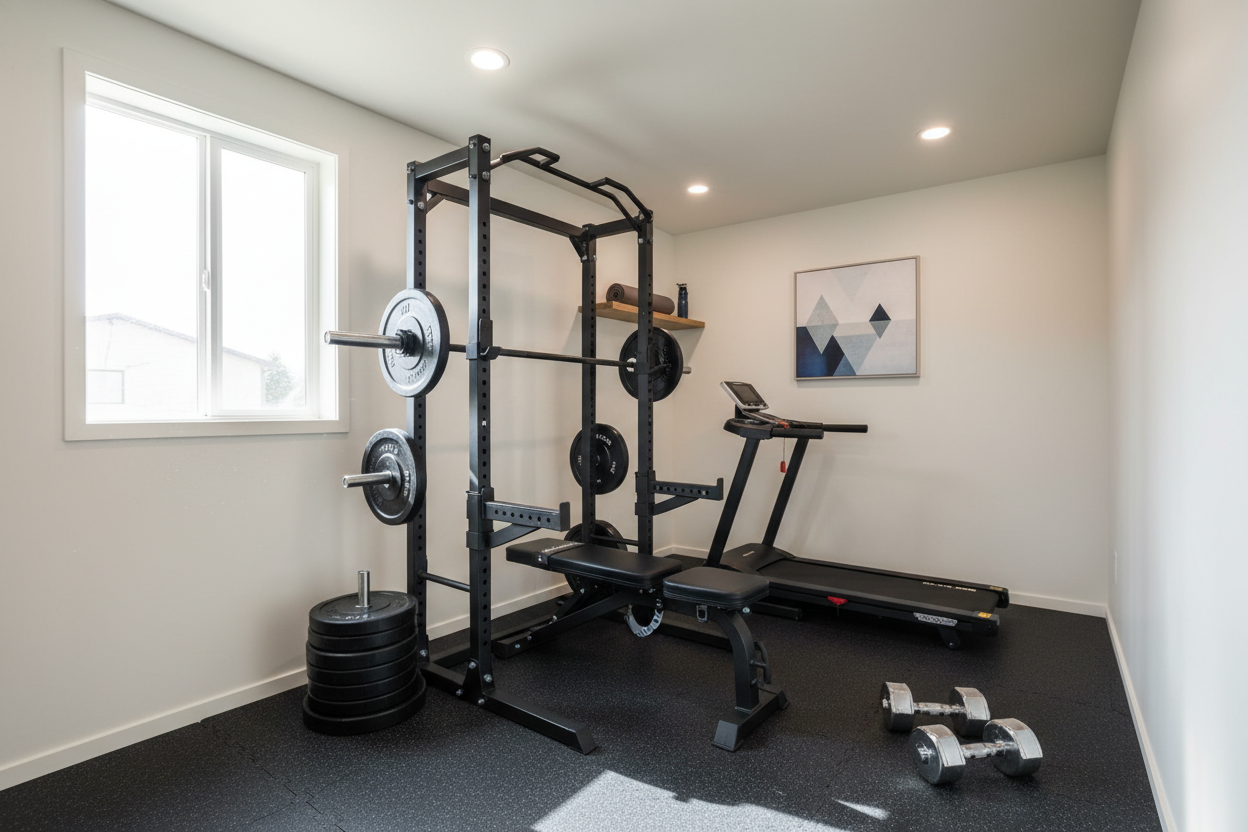
I remember the first time I tried to overhead press in a studio apartment with seven-foot ceilings. One aggressive rep later, I was picking drywall out of my hair and explaining to my landlord why the ceiling fan was missing a blade. Building a tiny house gym presents the same chaotic energy, but with the added risk of actually snapping a floor joist or blowing out a window with a stray barbell sleeve.
Quick Takeaways
- Barbell math is your biggest enemy; a standard 7.2-foot bar needs at least 9 feet of width to be functional.
- Floor loading matters more than equipment footprint if you are on a trailer or loft.
- Verticality is the only way to survive; if it doesn't fold or mount to a stud, it doesn't belong.
- Cables offer more hypertrophy per square inch than any other equipment category.
The Brutal Physics of a Tiny House Gym
Let’s talk raw numbers. A standard Olympic barbell is 86 inches long. If your tiny house is the standard 8.5 feet wide, you have exactly 7 inches of clearance on either side of the bar. That is a terrifyingly small margin for error when you are re-racking a heavy set of squats. You aren't just fighting for floor space; you are fighting the literal geometry of the room.
Then there is the weight. Most tiny houses are built on trailers or raised foundations with specific point-load limits. Dropping a 405-lb deadlift isn't just loud; it’s structural suicide in a micro-dwelling. I have seen guys crack subfloors because they thought a thin rubber mat was enough protection. You need to understand the 5 Rules for Building an Indoor Home Gym That Won't Ruin Your House before you turn your living room into a crater.
Designing a Tiny House With Gym Space (Without Going Insane)
You have to zone your space like a submarine commander. Every square inch must serve two masters. If your lifting area isn't also your walkway or your dining space, you are wasting room. I'm a huge fan of 'disappearing' equipment—racks that hinge back against the wall and benches that fold flat enough to slide under a sofa.
When you start browsing for a Home Gym, ignore the massive six-post power cages. You need a slim-profile wall rack or, better yet, a high-quality functional trainer. The goal is to keep the center of the room clear. If you can't do a burpee in the middle of your floor without hitting a piece of iron, your layout has failed.
The Only Gear Worth Its Footprint in a Micro Dwelling
Stop buying single-use machines. I don't care how much you love the leg extension; it’s a parasite in a small house. You need multi-functional anchors. This is where you have to be honest about your training. If you are a bodybuilder, you need cables. If you are a powerlifter, you need a rack. If you want both, you have to get creative.
If you have one dedicated corner—roughly 4 feet by 5 feet—the All In One Smith Machine With Cable Crossover S1 V4 is the smartest play. It replaces a squat rack, a cable crossover, and a pull-up station in a single footprint. I’ve tested plenty of these, and having the Smith bar for stability in tight quarters is actually a safety win when you don't have room to bail on a failed lift.
Wall-Mounted Cables vs. Free Weights
If I only had 20 square feet, I’d take a wall-mounted pulley system over a barbell eight days a week. Pulleys allow you to keep the weight stack tight against the wall, and the constant tension means you don't need 300 lbs of iron plates cluttering the floor. A set of adjustable dumbbells that go up to 80 lbs and a wall-mounted cable tower can handle 90% of your accessory work without ever getting in the way of your morning coffee.
The 'Spillover' Strategy: Taking the Iron Outside
Sometimes the math just doesn't work inside. If your tiny house with gym aspirations involve heavy sandbags or axle bars, move them to the deck. I keep my high-impact gear—like my 150-lb sandbag and my farmer's walk handles—in a weather-proof deck box. It keeps the dust and the floor-shaking impact outside where the ground doesn't care if you drop things.
My Personal Experience: The 'Shin-Banger' Mistake
I once tried to squeeze a full-sized flat bench and a set of fixed hex dumbbells into a 100-square-foot shed. It was a disaster. I spent more time stubbing my toes and maneuvering around the rack than I did actually lifting. I eventually sold the fixed weights for a pair of high-end adjustables. The lesson? If a piece of gear doesn't have at least three different uses, it's taking up space it hasn't earned. Don't let your ego about 'real' gym equipment ruin your living space.
FAQ
Is it safe to deadlift in a tiny house?
Only if you have reinforced flooring and use crash pads. Standard tiny house subfloors aren't designed for the localized impact of 300+ pounds hitting the ground from waist height. Use 2-inch thick stall mats at a minimum.
How do I stop my gym from smelling up a small house?
Active ventilation is non-negotiable. If you don't have a dedicated window or an exhaust fan in your gym zone, the humidity from your breath and sweat will lead to mold and a permanent locker-room scent in your curtains.
What is the best floor protection for a tiny house gym?
Skip the cheap foam tiles from the big-box stores. They compress and slip. Get 3/4-inch horse stall mats. They are heavy, they stay put, and they actually protect the wood underneath from heavy dumbbell drops.
Share:
Stop Trusting Your Face to a Budget 200lb Dumbbell Set
I Tracked Down the Exact Anytime Fitness Elliptical for My Garage