
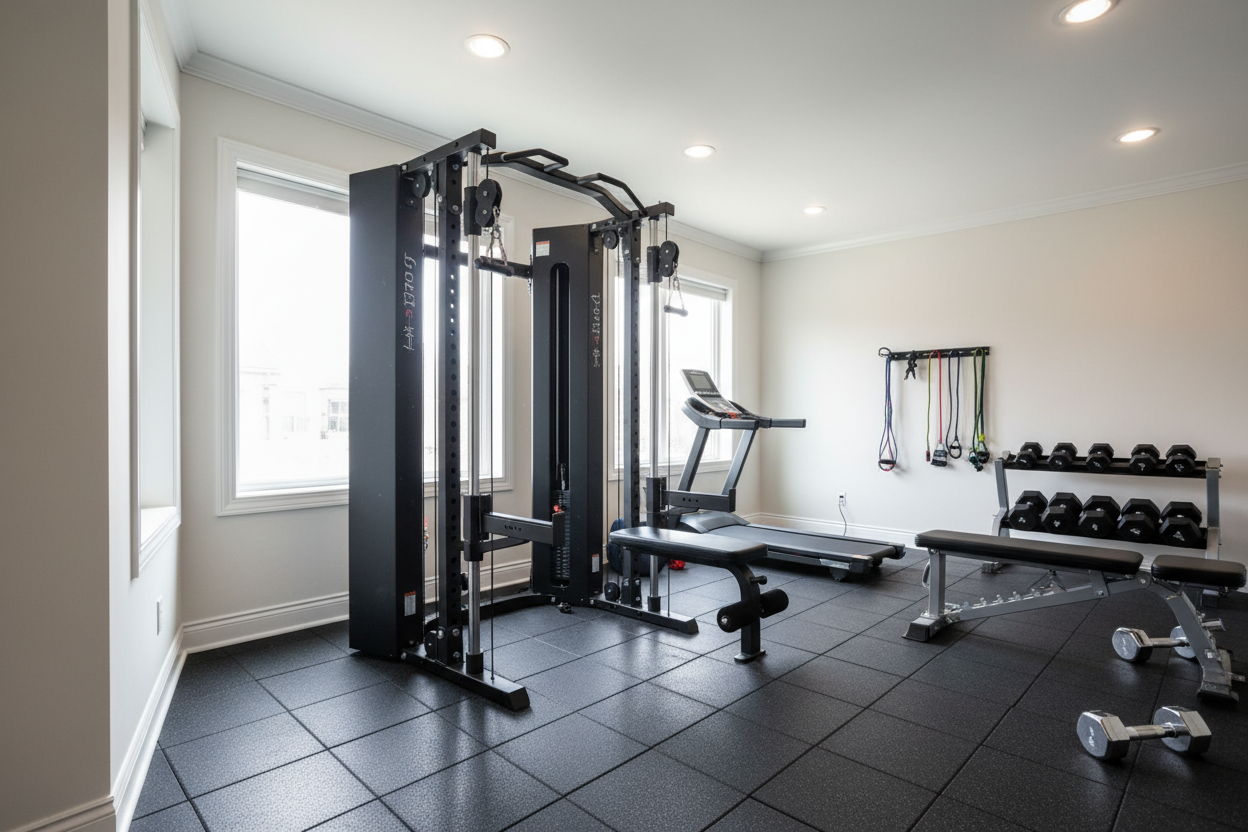
I remember staring at my garage floor with a tape measure, realizing that my dream of a full commercial-style setup was physically impossible. You can't fit a dedicated leg press, a squat rack, and a 5-foot wide cable crossover in a single-car bay without losing the ability to actually walk around. That is usually when the smith machine with pulley enters the chat as a potential savior for the space-starved lifter.
Quick Takeaways
- Space Savings: You get a fixed-path barbell and dual cables in the footprint of one rack.
- Pulley Ratios: Most hybrids use a 2:1 ratio, meaning 100 lbs feels like 50 lbs but offers more cable travel.
- Smoothness: Look for linear bearings on the Smith bar; bushings usually feel like dragging a sled through sand.
- Height Matters: Avoid units under 82 inches if you want to do full-range lat pulldowns.
The Garage Gym Space Dilemma
The math of a home gym is brutal. A standard power rack takes up a chunk of floor, but once you add the 'safety zone' for loading plates, you've eaten half a room. If you then try to squeeze in a standalone smith machine, you are effectively killing your floor space for anything else, like stretching or plyo work.
The hybrid machine tries to solve this by stacking the functions. By integrating cable pulleys into the uprights or a rear frame, you get the stability of a guided barbell for heavy benching or split squats, plus the versatility of cables for isolation work. It sounds like a win-win, but the execution often separates the high-end rigs from the 'Amazon specials' that shake when you touch them.
Do the Cables Actually Feel Smooth?
This is the dealbreaker. If the cables are choppy, you won't use them. Most hybrid units, like a high-quality smith machine with cable crossover, utilize a 2:1 pulley ratio. This is standard for functional trainers because it allows for a longer cable reach—essential for chest flyes or walking out a triceps extension—without the weight stack slamming into the top.
The engineering challenge is the routing. Cheap machines run cables through tight angles and plastic pulleys, creating friction that makes 40 lbs feel 'crunchy.' You want aluminum pulleys and coated aircraft-grade cables. When the routing is done right, the resistance is constant from the start of the rep to the peak contraction, which is exactly what you need for hypertrophy work.
The Hidden Perks of a Hybrid Rig
Beyond just saving floor space, there is a massive efficiency boost to your training. I’ve found that when I replaced 5 pieces of gear with one consolidated unit, my workout density shot up. You can go from a heavy set of Smith machine overhead presses directly into cable lateral raises without taking a single step.
It also opens up 'hybrid' movements. You can use the Smith bar as a stabilizer or a foot anchor for cable rows. For someone following a high-volume bodybuilding split, the ability to superset compound movements with cable isolations in the same 4x6 foot area is a massive luxury that most commercial gym goers don't even have.
What to Check Before You Spend Your Cash
Don't get blinded by shiny chrome. Check the gauge of the steel first; 11-gauge is the standard for anything that claims to be 'heavy duty.' If the machine weighs less than 400 lbs total, it’s probably going to walk across the floor when you do heavy cable rows. Look for a wide base and bolt-down options if you're a heavy hitter.
Weight Stacks vs. Plate-Loaded Carriages
This is where the price fluctuates wildly. A selectorized weight stack is pure convenience—you move a pin and go. A plate-loaded system uses a trolley that you slide your own Olympic plates onto. While a power cage with smith machine that uses plates is significantly cheaper, remember that you'll be constantly stripping and loading plates between every exercise. If you have the budget, go selectorized.
Cable Travel and Upright Height
I’ve seen guys buy 'compact' machines only to realize they can't get a full stretch on lat pulldowns. If the top pulley is only 75 inches off the ground, anyone over 5'8" is going to bottom out the weight stack before their lats are fully stretched. Measure your reach. You want a machine that allows the pulley to sit well above your head height when seated.
Is This the Right Move for Your Setup?
If you are a powerlifter who only cares about the 'Big Three,' this isn't for you. But if you're a garage lifter who wants to look like they actually lift, the cable/smith combo is a powerhouse. It handles the 'meat and potatoes' movements and the 'icing' movements in one footprint. For those who already have a rack and just need the cables, a wall-mounted cable station might be the smarter, slimmer play. But for a total gym overhaul, the hybrid is king.
My Personal Experience
I once bought a budget plate-loaded combo that looked great in photos but was a nightmare in practice. The Smith bar had about an inch of 'slop' before the safety hooks would catch, and the cables felt like they were rubbing against sandpaper. I eventually sold it for half what I paid and invested in a unit with linear bearings and a solid 2:1 ratio. The lesson? Buy the high-end bearings once, or buy the cheap bushings twice.
FAQ
Can I do pull-ups on these machines?
Almost every hybrid smith machine includes a multi-grip pull-up bar at the top. Just make sure your ceiling height allows for your head to clear the top of the frame.
How much weight can the cables handle?
Most quality units are rated for 200–300 lbs per stack. Remember, with a 2:1 ratio, a 200 lb stack provides 100 lbs of actual resistance.
Do I need to lubricate the guide rods?
Yes. A light coat of silicone spray on the Smith and pulley guide rods every few months keeps the movement buttery smooth and prevents the 'chatter' that happens when metal gets dry.
Share:
I Put the Sunhome Smith Machine Through a Month of Hell
Is There Actually a Reliable Smith Machine to Free Weight Ratio?