
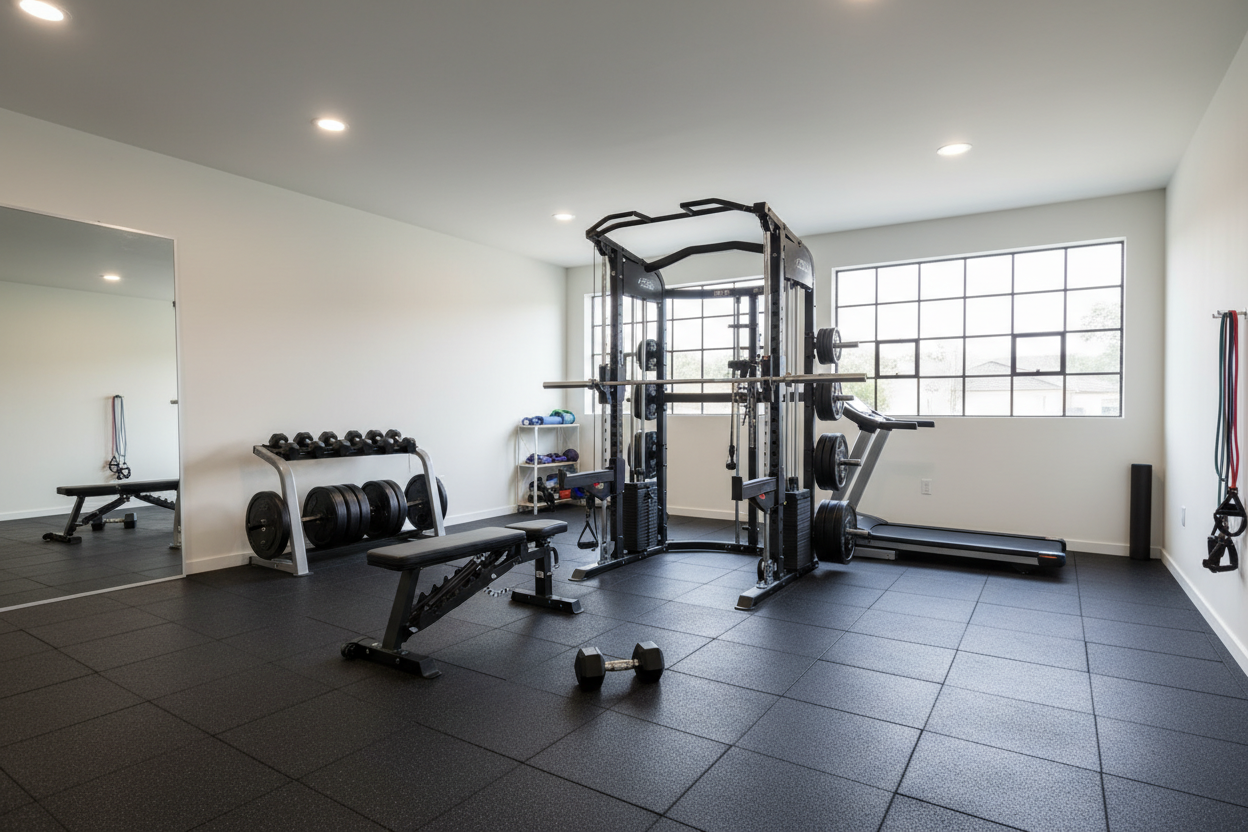
I remember staring at my monthly gym bill after they hiked the 'maintenance fee' for the third time in two years. I spent hours scrolling through forums, trying to figure out if I could actually fit a real workout into my 10x12 garage space without it feeling like a storage unit. If you are tired of the commute and the crowded racks, finding the best complete home gym is the only way to reclaim your time and sanity.
Quick Takeaways
- Prioritize 11-gauge or 14-gauge steel frames to prevent frame sway during heavy lifts.
- A 2:1 pulley ratio is superior for functional movements and provides longer cable travel.
- Dual independent weight stacks are essential for correcting muscle imbalances.
- Always account for 'working space'—you need room to load plates and move around the machine.
Why Most Massive Multi-Rigs Are Just Expensive Coat Racks
Most people see a machine with 50 attachments and think they are getting a steal. In reality, you are usually buying a jack-of-all-trades that masters exactly zero. When you are upgrading your home gym setup, you need to look past the shiny plastic shrouds and focus on the skeleton of the machine.
A machine that tries to do everything often ends up with cables that catch and a frame that shakes when you are pushing 200 pounds. I have seen guys drop three grand on a rig only to realize the leg extension feels like it is grinding through gravel. The best machines focus on doing five or six movements perfectly rather than 50 movements poorly.
The Non-Negotiable Specs for a Unified Training System
If the manufacturer does not list the steel gauge, run away. You want a frame built from at least 14-gauge steel, though 11-gauge is the gold standard for anyone planning to lift heavy. When scouting for the best universal home gyms, check the bearings. Cheap bushings feel like dragging a sled through sand; you want high-grade linear bearings or sealed pulleys for that 'butter-smooth' feel.
Look at the weight capacity too. If a rig is capped at 200 lbs and you are already benching 225, you will outgrow that 'universal' solution in a month. You need a system that respects the principle of progressive overload, meaning it should have the overhead to handle your strength gains for the next five years, not just the next five weeks.
Pulley Ratios and the Cable Column Test
The best resistance home gym isn't just about the weight on the stack; it's about how that weight moves. A 1:1 ratio means 100 lbs feels like 100 lbs, which is great for heavy lat pulldowns but makes the cable travel too short for lunges or crossovers. A 2:1 ratio (where 100 lbs feels like 50 lbs) gives you double the cable length, which is vital for athletic movements and flyes.
In my experience, a dual-ratio system is the sweet spot. You want the heavy pull of a 1:1 for your back days, but the versatility of a 2:1 for everything else. If the cables feel 'stretchy' or jumpy when you pull them, the pulleys are likely plastic garbage that will snap under a real load.
Why You Actually Want a Guided Barbell
Training alone in a garage can be sketchy if you are pushing your limits on bench or squats. A Smith machine home gym station provides a built-in spotter that won't flake on you. The best multi gym options integrate this guided bar without sacrificing the 'free weight' feel, provided they use high-end rods and bearings.
I used to be a free-weight purist until I tore a minor muscle trying to bail on a solo squat. Now, I appreciate a guided system for high-volume hypertrophy work where I just want to torch the muscle without worrying about the bar crushing my windpipe. It lets you go to absolute failure safely.
The Hidden Trap of the 'Universal' Weight Stack
Single-stack machines are the bane of my existence. They force your body into weird angles and make unilateral work impossible. After testing the best all in one home gym, I realized that dual independent stacks are the only way to go. You need to be able to work each arm independently to ensure your dominant side isn't doing 70% of the work on every rep.
This is the hallmark of a true best universal gym. If you are stuck with one central stack, you are limited to bilateral movements. That is fine for a while, but eventually, your left side will start lagging, and you will be back on the market looking for a real solution. Buy the dual stacks once and save yourself the headache.
Will These Rigs Actually Fit in Your Garage?
Manufacturers love to give you the 'footprint,' but they conveniently forget about the 'working area.' You need at least two feet of clearance on either side to actually load plates onto the bar. If the machine is 4 feet wide, you actually need 8 feet of clear space to use it properly.
If you are chasing the best at home gym, measure your ceiling height twice. Those pull-up bars sit higher than you think, and there's nothing worse than hitting your head on a joist during a max-effort set. I once had to cut a hole in my drywall ceiling just to finish a set of chin-ups because I didn't account for the 'head clearance' spec.
Personal Experience: The 'Bargain' Blunder
I once bought a 'bargain' multi-gym that claimed a 500-lb capacity. The first time I tried a heavy row, the whole unit tipped forward because the base wasn't deep enough. I had to bolt it to a piece of 3/4-inch plywood just to keep it from moving. Learn from my mistake: the weight of the actual machine matters. If the rig weighs less than you do, it’s going to move when you lift heavy.
FAQ
Is a 1:1 or 2:1 ratio better?
2:1 is better for versatility and cable travel; 1:1 is better for pure heavy lifting like lat pulldowns. Most high-end functional trainers use 2:1.
Do I really need a Smith machine?
If you train solo and want to push to failure safely on compound lifts, a Smith machine is a massive asset. It’s a built-in spotter.
How much ceiling height do I need?
Most rigs need at least 84 inches, but aim for 90+ inches so you can actually get your chin over the pull-up bar without hitting the ceiling.
Share:
I Built a Bulletproof Men's Weights Set for Under $500 (Here's How)
You Don't Need $5K: Building the Best Home Gym Under $1000