
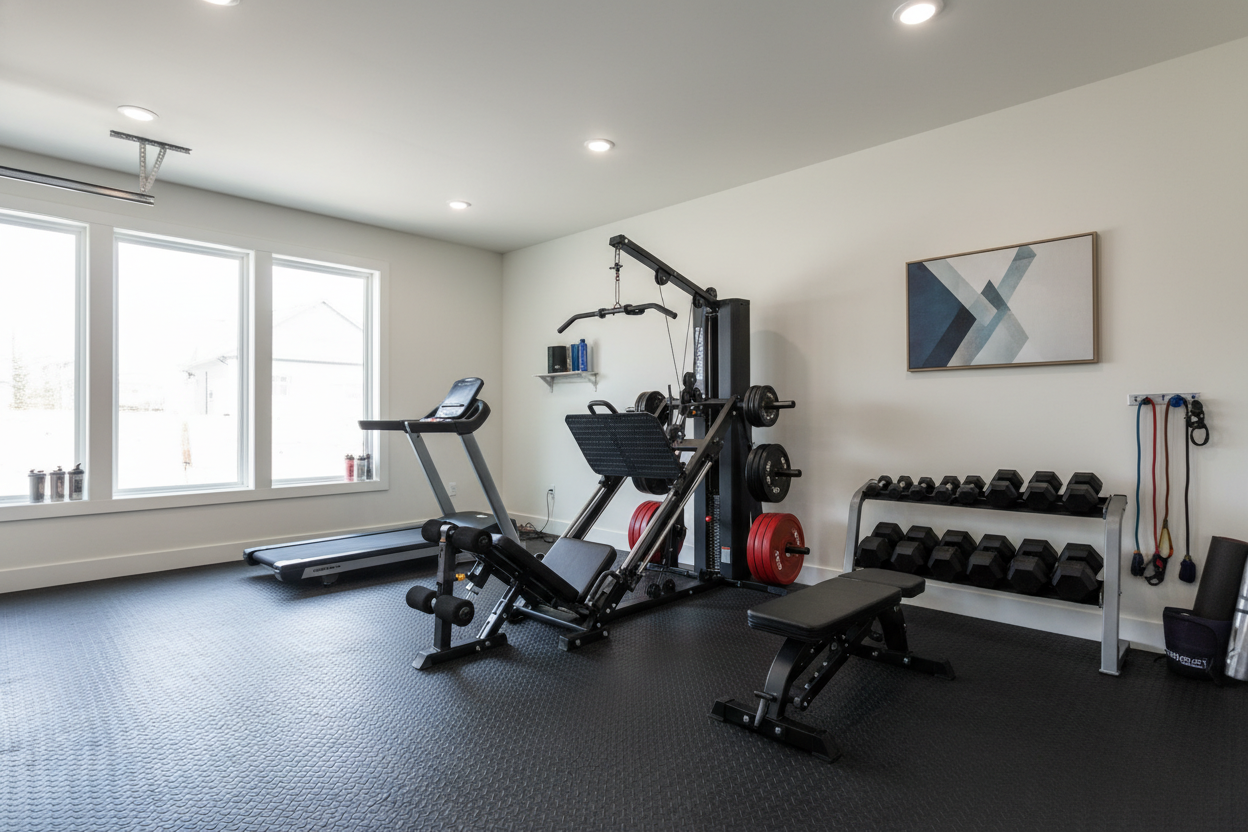
I spent three years trying to build respectable quads in a 1-car garage that also houses my lawnmower and a mountain of holiday decorations. Most people think you need a 5,000-square-foot commercial facility to see real growth, but I am here to tell you that finding the best home gym for legs is more about smart geometry than raw square footage. I’ve scrolled through every Amazon listing and Craigslist ad at 2 AM, and most of what you see is just shiny junk that won't help you squat a plate.
Quick Takeaways
- Prioritize stability over 'functional' instability for hypertrophy.
- Avoid 150-lb weight stacks if you actually want to grow.
- A Smith machine is a valid choice for solo leg destruction.
- Check linear bearings before buying anything used.
- Vertical or 30-degree sleds save your floor space.
Why Training Legs at Home Usually Sucks (And How to Fix It)
Training legs at home usually sucks because you are fighting physics with sub-par equipment. When you are building a home gym, the temptation is to buy a bunch of light dumbbells and hope for the best. But your legs are the strongest muscles in your body; they need heavy, stable resistance that a flimsy folding bench just cannot provide. Most home setups lack the biomechanical stability required to push your quads to absolute failure without your lower back giving out first.
The fix is simple: you need to stop thinking about 'total body' machines and start looking for dedicated lower body stability. If you are doing goblet squats with a 50-lb dumbbell forever, your quads are going to stay the same size. You need a way to load 300, 400, or 500 pounds safely. This means either a rock-solid rack or a machine that locks you into a specific plane of motion so you can focus entirely on the leg drive rather than balancing.
The Truth About the 'Universal' Leg Setup
You see them everywhere: the all-in-one home gym with leg press worth the space is a rare beast. Most 'universal' setups use plastic pulleys and 150-lb weight stacks that you will outgrow in three months. If you are looking for a universal gym with leg press, you have to be careful about the leverage. Often, a 200-lb stack on a poorly designed machine feels like 100 lbs because of the pulley ratios. It is frustrating to max out the machine on day one.
A universal home gym with leg press often tries to do too much in one footprint. The leg press attachment is usually an afterthought—a small plate tucked off to the side with a narrow footrest that kills your knees. If you are serious about mass, look for a machine where the leg press is a primary station, not a bolt-on. The engineering cues you want are heavy-gauge steel and oversized footplates that allow for different foot positions to hit your quads or hamstrings specifically.
The Core Foundation: Racks and Rails
Every leg day needs a heavy compound movement. For most, that is the squat. However, when you are training solo in a garage, a Smith machine home gym station is actually a secret weapon for hypertrophy. While the 'functional fitness' crowd hates on fixed paths, being able to grind out that 12th rep without worrying about a 315-lb bar crushing your windpipe is how you actually grow. It allows for a level of intensity you just cannot safely reach with a barbell and no spotter.
If you prefer free weights, a power rack with 11-gauge steel is the minimum. You want something that does not wobble when you re-rack 400 lbs. I have used the cheap racks that shake when you breathe on them, and it ruins your mental focus. Whether you go with guided rails or a traditional rack, the goal is the same: absolute confidence that the equipment will hold the weight so you can focus on the burn.
Navigating the Used Market for Leg Sleds
Do not waste $2,000 on home gym equipment with leg press just because it looks heavy-duty in a grainy Facebook Marketplace photo. When you find a home gym with leg press for sale, you need to inspect it like a mechanic. Check the linear bearings. If the sled hitches, grinds, or feels 'crunchy' when you slide it, you are looking at a massive headache. I once bought a used sled that felt like it was sliding on sandpaper; no amount of lithium grease could save those warped rails.
Look for signs of rust in the guide rods and check if the footplate is bent. A warped footplate means the previous owner was likely overloading one side, which ruins the alignment of the entire machine. If the seller won't let you load it up and do a few test reps, walk away. A bad leg press is worse than no leg press at all because it will eventually lead to an injury that keeps you out of the gym for months.
Squeezing a Heavy Sled into a Tight Footprint
In a tight space, look at a compact 30-degree leg press hack squat combo. These hybrids give you two heavy hitters in the footprint of one. By angling the sled at 30 degrees, you save about two feet of floor length compared to a standard 45-degree sled. This is the difference between keeping your car in the garage or parking it on the street. These machines are engineered to provide the heavy loading capacity of a commercial unit without the massive footprint.
The hack squat option is vital because it targets the quads in a way that a standard press cannot. When you can switch from a leg press to a hack squat in thirty seconds, you can perform high-intensity supersets that absolutely torch your legs. This kind of efficiency is what turns a small garage into a legitimate temple of iron. You do not need twenty machines; you need two or three that actually work.
Personal Experience: My Biggest Mistake
I once bought a cheap 'all-in-one' that promised a leg press, lat pulldown, and chest press in a 4x4 area. It was a disaster. The leg press was a cable-driven plate that wobbled so much I felt like I was doing a circus act. I ended up selling it for a 40% loss two months later. Now, I only buy equipment that has a dedicated, weight-bearing sled. If it uses a cable for the leg press, I don't buy it. Period.
FAQ
Can I build big legs with just a squat rack?
Yes, but it is harder. A rack is great for the main lift, but a leg press or hack squat allows you to isolate the quads without your lower back or core being the limiting factor. If mass is the goal, you want both.
Is a Smith machine better than a power rack for legs?
Neither is 'better,' but they serve different purposes. A rack builds raw strength and stability. A Smith machine is superior for hypertrophy because you can place your feet further forward to emphasize the quads without falling over.
How much weight capacity do I really need?
For a leg press, aim for a machine rated for at least 500 lbs. You might think that is a lot now, but with the leverage of a sled, you will be surprised how quickly you can move heavy weight compared to a barbell squat.
Share:
The Brutal Math Behind Buying a Dumbbells Set for Your Gym
Is a 30 lb Neoprene Dumbbell Actually Worth the Money?