
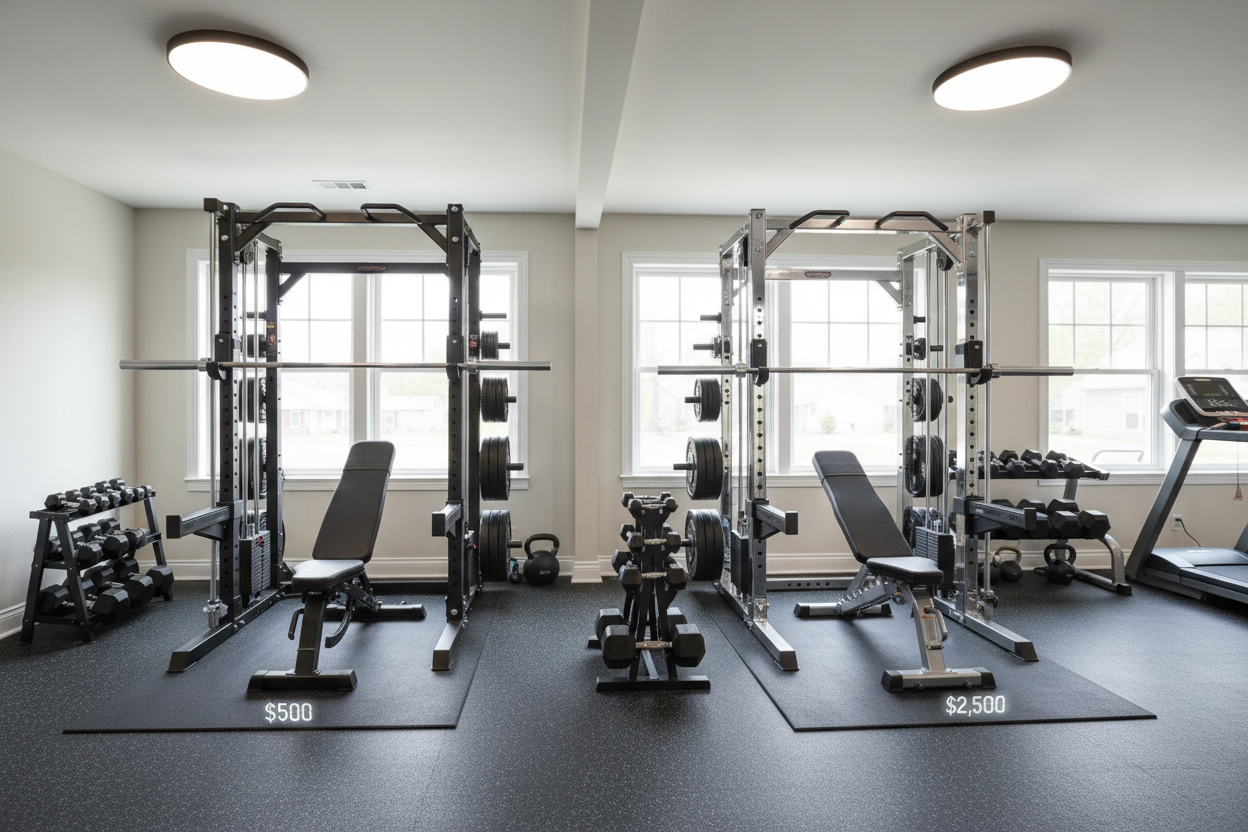
I remember the first time I looked at outfitting my garage. I saw one smith machine cost listed at $450 on a random Amazon listing and another that looked identical for $3,800 on a commercial site. It makes no sense until you actually get under the bar and feel the difference between 'smooth as butter' and 'gritty as a beach towel.'
Trying to figure out how much does a smith machine cost is a headache because the term 'Smith Machine' now covers everything from a basic squat rail to a massive all-in-one cable sanctuary. I’ve spent years loading these things to failure and I can tell you exactly where your money goes—and where it’s being wasted.
- Budget ($500-$1,000): Expect nylon bushings, thinner 14-gauge steel, and a bit of a 'stutter' when the bar moves.
- Mid-Range ($1,500-$2,500): This is the sweet spot. You get linear bearings, 11-gauge steel, and integrated pulley systems.
- Premium ($3,000+): Commercial grade. Counterbalanced bars, massive weight stacks, and overbuilt frames that won't budge.
- Hidden Fees: Don't forget that shipping, flooring, and the actual iron plates can add another $800 to your total instantly.
The Sticker Shock is Real (But It Doesn't Have to Be)
Walking into a commercial gym, you’re usually using a $4,000 piece of equipment designed to survive 18 hours of abuse a day. When you start shopping for a home version, that price tag is terrifying. But here’s the secret: you aren't running a 24-hour fitness franchise. You don't need to pay for a lifetime warranty meant for 500 members.
The price variance usually comes down to three things: the bearing type, the steel thickness, and the 'extras' like pull-up bars or cable crossovers. If you just want a fixed path for heavy presses, you can save a fortune. If you want a machine that replaces five other pieces of gear, the price climbs fast.
The $500 to $1,000 Tier: Budget Rigs and Attachments
In this bracket, you’re mostly looking at 'residential' machines. The steel is usually 14-gauge, which is fine for most, but it will feel a little light if you’re repping out 400-lb squats. The biggest trade-off here is the movement. Instead of high-end bearings, these often use plastic or nylon bushings. They’re noisier and have more friction.
If you decide to go this route, you have to be careful. You need to navigate a smith machine sale with a skeptical eye. Look for wide base stabilizers and check the weight capacity. If the max capacity is only 300 lbs, you’re going to outgrow it faster than you think. These are great for high-rep hypertrophy work, but they aren't built for powerlifting PRs.
The $1,500 to $2,500 Tier: The Garage Gym Sweet Spot
This is where I tell most of my friends to shop. At this price point, the plastic bushings disappear and are replaced by linear ball bearings. This is what gives the bar that 'weightless' feel as it glides up the chrome rails. You’re also moving into 11-gauge or heavy-duty 12-gauge steel territory, meaning the rack won't wobble when you're doing pull-ups.
For about $2,000, you can usually find an all-in-one Smith machine with a cable crossover. This is the ultimate space-saver. Instead of just a Smith bar, you get functional trainer pulleys, a landmine attachment, and a dip station. When you realize a standalone cable machine costs $1,000 on its own, this mid-tier price starts looking like a massive bargain.
The $3,000+ Tier: Commercial Grade and Absolute Overkill
Unless you’re opening a personal training studio or you’ve got a massive budget, this tier is usually overkill. These machines are absolute tanks. They feature counterbalanced bars—meaning the bar itself feels like it weighs zero pounds because of an internal weight system. It’s great for high-precision bodybuilding, but it’s a luxury, not a necessity.
In this range, you’re paying for dual 200-lb or 300-lb selectorized weight stacks. You’re looking at a full body multi training station that weighs 800+ lbs. It’s a 'buy it once and leave it in your will' kind of purchase. The knurling on the bars is usually better, the powder coating is thicker, and every movement feels silent. It’s beautiful, but it won't necessarily make you stronger than the $2,000 version.
Three Hidden Costs You're Probably Forgetting
The machine itself is only half the battle. First, there’s shipping. A Smith machine is heavy, and unless the company offers 'free shipping,' you might be looking at a $200-$400 freight bill just to get it to your driveway. Then there’s the flooring. Don’t put 500 lbs of steel directly on your garage concrete; you need at least 3/4-inch rubber stalls mats.
Finally, remember that most Smith machines are plate-loaded. To perform effective Smith machine exercises like heavy shrugs or lunges, you’re going to need a few hundred pounds of iron. If you don't already own Olympic plates, budget at least $1.50 to $2.00 per pound. That 'cheap' $600 machine suddenly costs $1,200 once it’s actually ready to use.
So, Which Price Bracket Actually Makes Sense for You?
If you’re a casual lifter just looking for some safety while training alone, the $800-$1,000 range is plenty. If you’re serious about building a home gym that replaces a commercial membership, save up for the $1,800-$2,200 range. That's where you get the best ROI in terms of durability and smoothness.
I personally went for a mid-tier rig because I couldn't stand the 'catchy' feel of cheap bushings during overhead presses. It was worth every extra penny. If you’re ready to pull the trigger, take the time to compare home-grade Smith machines side-by-side. Look at the footprint, the bearing type, and the warranty. Your joints will thank you later.
How much does a smith machine cost on average?
For a reliable home gym model, expect to spend between $1,500 and $2,200. While you can find units for $500, they often lack the smooth linear bearings found in higher-end models.
Are expensive Smith machines safer?
Not necessarily safer, but more stable. High-end machines use thicker steel and wider bases, which prevents the unit from shifting or tipping when racking heavy weight at the top of the rails.
Why are some Smith machines counterbalanced?
Counterbalancing uses a pulley system to offset the weight of the bar (usually 15-25 lbs). This allows for very light starting weights, which is great for rehab or isolation work, but it adds significantly to the cost.
Share:
I Tested the Quietest Exercise Machine While My Family Slept
Can a Budget Rig Survive Heavy Lifting? My Marcy Smith Machine Review