
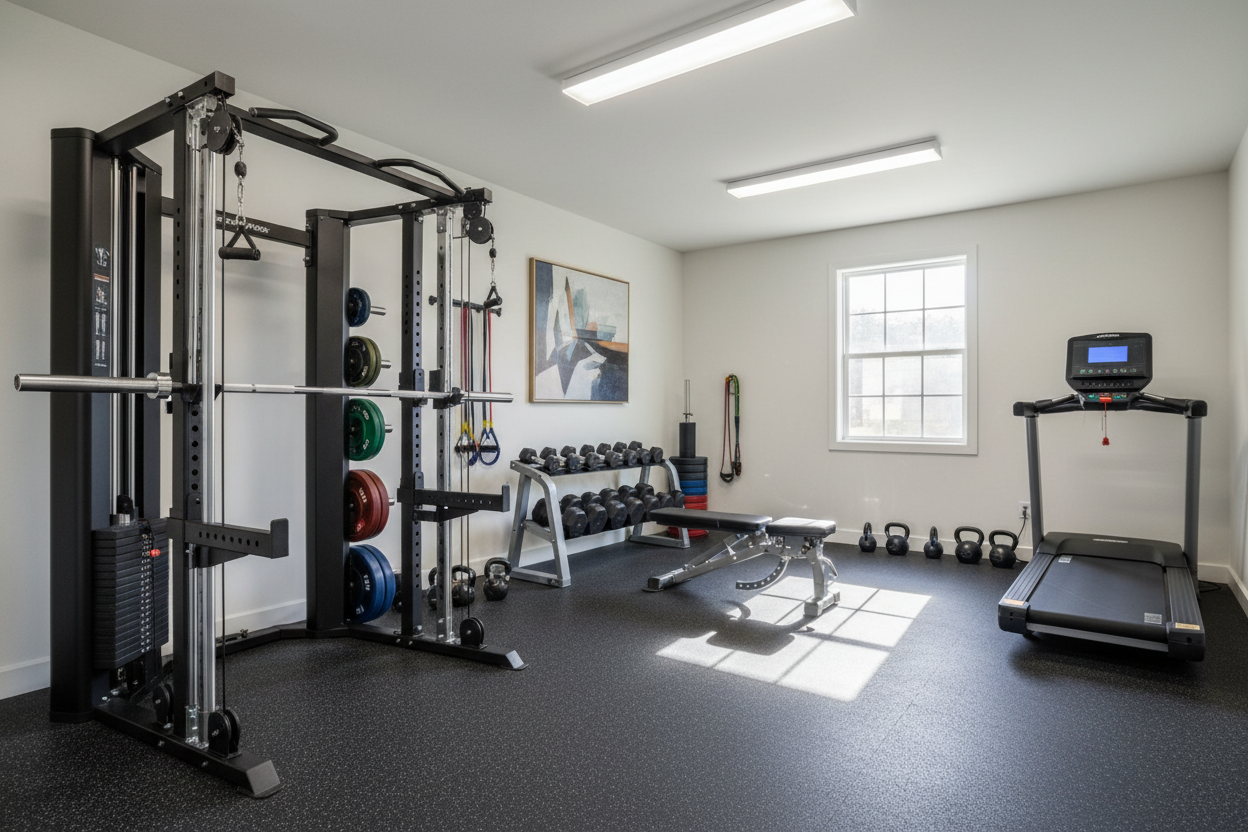
I have spent way too many late nights scrolling through equipment listings, squinting at pixelated photos of home gym gear. You see a weight lifting machine for sale that looks like it belongs in a hardcore metro gym, but the price tag suggests it belongs in a toy store. It is a trap I have fallen into myself, and it usually ends with a wobbly piece of metal taking up space in the garage.
Quick Takeaways
- Steel gauge is king; 11-gauge is the gold standard, while 14-gauge is better suited for clothes hangers.
- Aluminum pulleys beat plastic every single time for smoothness and long-term durability.
- Verify the 'working area'—machines often require 2-3 feet of clearance beyond their base dimensions for plate loading.
- Plate-loaded machines are usually the best value for home users who already own Olympic plates.
Stop Buying 300-Pound Coat Racks
Flashy powder coating and 'gym-quality' decals hide a lot of sins. I once bought a 'heavy duty' cable setup that felt like it was made of recycled soda cans the moment I tried to row more than 100 pounds. The whole frame groaned, and the pulleys stuttered like a bad internet connection.
If the machine weighs less than you do, it is going to slide across the floor during your first heavy set. Stability comes from mass and footprint. When you are looking at a weight machine for sale, the shipping weight is often the most honest spec on the page. If it is light enough for one person to carry the box easily, it is probably not going to handle your top sets.
The 'Commercial Grade' Lie (And How to Actually Verify It)
In the marketing world, 'commercial grade' is a term that has lost all meaning. To a real manufacturer, it means 11-gauge steel (about 3mm thick) and 3x3 inch tubing. To a budget brand, it just means they painted it black. If the listing does not explicitly state the steel gauge, assume the worst.
Check the pulley materials. Cheap machines use nylon (plastic) pulleys that develop flat spots over time. You want aluminum pulleys with sealed bearings. Also, look for cable tensile strength—you want to see '2,000-lb rated aircraft cable.' If you are browsing a universal weight machine for sale, pay close attention to the pivot points. Bronze bushings are okay, but pillow block bearings are what you really want for a smooth, friction-free lift.
Plate-Loaded vs. Weight Stacks: The Home Gym Dilemma
Finding a weight machine on sale with a built-in 200-pound stack sounds like a win until you see the shipping invoice. Weight stacks are convenient, but they are expensive to ship and hard to move if you ever rearrange your gym. They also have a 'ceiling'—once you max out the stack, the machine is useless for progression.
Plate-loaded machines are the smart play for most garage gyms. They utilize the Olympic plates you already have, making the machine itself much cheaper. A chest press machine with independent arms is a prime example of this. It provides a better chest pump than almost any cable-based home unit because the leverage curve is fixed and predictable, allowing you to move serious weight without a spotter.
Will It Actually Fit Your Body? (The Biomechanics Test)
The biggest issue with budget machines is 'fixed' geometry. If the seat does not move or the handles are at a weird angle, you are forcing your joints to follow the machine's path rather than your own. This is a fast track to tendonitis. Look for adjustable seat heights and multiple grip options.
Converging and diverging movement paths are another sign of a high-quality build. On a press, the handles should move slightly toward each other as you extend. An assisted weight machine is only helpful if the pivot point aligns with your natural range of motion. If you are taller than 6'0 or shorter than 5'4, read the user reviews specifically to see if people your size find the range of motion usable.
Build Your Base Before Buying a Machine
I love a good isolation machine, but they are the 'extra credit' of a home gym. Before you dedicate 20 square feet to a leg extension, make sure your essentials are bulletproof. You need a rack, a bar, and a solid adjustable weight bench before you start adding specialized machines.
A bench and a rack allow for hundreds of movements. A machine usually does one or two. I have seen too many people buy a fancy functional trainer only to realize they do not have a flat surface to do a proper dumbbell press. Get your foundation sorted first, then use machines to target weak points or add volume without the fatigue of free weights.
The Used Market Checklist for Any Weight Machine for Sale
If you are hunting for a used weight machine for sale on local marketplaces, you can find incredible deals on old commercial iron. But you have to be a detective. Run your hand along the cables—if you feel any 'kinks' or see the plastic coating peeling, they need to be replaced immediately.
Check the upholstery for 'sweat rot' or cracks, which are expensive to fix. Most importantly, load the machine and move it through the full range of motion. If it catches, hitches, or makes a grinding sound, the bearings are shot. A little surface rust on the frame is fine and easily sanded off, but internal rust in the weight stack rods is a dealbreaker.
Personal Experience: My Biggest Gear Mistake
Early in my lifting career, I bought a cheap lat pulldown because it was 40% off. It looked great in the photos. In reality, the guide rods were so thin they bowed when I used more than 150 pounds. The friction was so bad that the weight would 'hang' at the top. I eventually sold it for a loss and bought a unit with 2x3 inch steel and 11-gauge thickness. The difference in my back growth was immediate because I could actually focus on the muscle instead of fighting the machine.
FAQ
What is the best steel gauge for a home weight machine?
Look for 11-gauge or 12-gauge steel. Avoid 14-gauge or higher for any machine where you plan to lift heavy, as the frame will flex and the bolts will eventually loosen.
Are plate-loaded machines better than weight stacks?
Plate-loaded machines are more cost-effective and have a higher weight ceiling, but weight stacks are faster for drop sets and circuit training. For a garage gym, plate-loaded usually wins on value.
How do I know if a machine will fit in my space?
Always add 24 inches to the manufacturer's width and length specs. You need room to walk around the unit and space to slide plates onto the sleeves without hitting your walls or other equipment.
Share:
I Traded My Fragile Dials for Loadable Dumbbells (Here Is Why)
Stop Letting Pinterest Ruin Your Gym at Home Design