
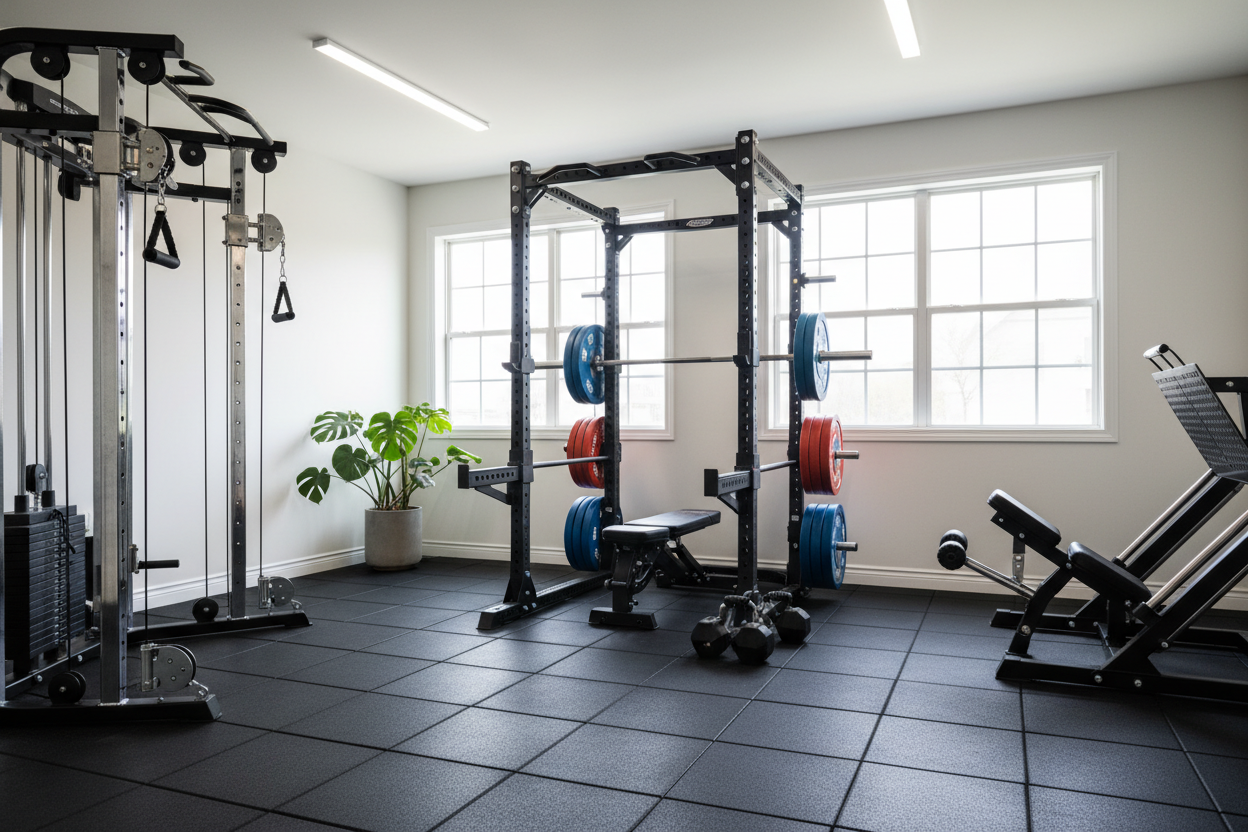
I spent three months scouring local listings for a power rack and a decent barbell, convinced that the gym machines were just overpriced coat racks for people who did not want to work hard. I wanted that raw, garage-gym aesthetic. No cables, no cams, just iron and gravity.
Six months into my 'pure' barbell journey, my elbows felt like they were filled with sand and my progress on accessory lifts hit a wall. I realized that while the barbell is king for the big three, it is a blunt instrument for everything else. I needed the precision I used to get from the commercial floor.
- Barbells are great for strength, but machines win for isolation.
- Constant tension from cables prevents joint shear during accessory work.
- Space-saving functional trainers can replace a dozen single-use units.
- Training to failure is significantly safer without a spotter on a fixed path.
The 'Barbells Only' Phase of Garage Lifting
When I first started building my home gym, I was a total barbell snob. I thought that if you could not do it with a 45-pound bar, it was not worth doing. This elitism is common among new home lifters, but it ignores the reality of recovery. Relying solely on free weights means every single session is a high-tax event for your central nervous system and your joints.
The lack of strength training equipment at the gym style isolation eventually caught up to me. My lower back was always fried from stabilizing heavy rows, leaving me too exhausted to actually hit my lats. I realized that the strength training machines at the gym were not for 'lazy' people; they were tools for strategic volume that my garage setup simply could not provide.
What Free Weights Just Can't Replicate
The weights machines in the gym offer something a barbell never can: a manipulated resistance curve. When you do a dumbbell fly, there is zero tension at the top of the movement. When you use a cable machine or a chest press unit, that tension is constant from start to finish. This is the secret sauce for hypertrophy that most garage lifters miss out on.
Furthermore, exercise machines in the gym allow you to push your muscles to absolute mechanical failure. If I am doing a set of hack squats and my legs give out, I just engage the safety. If I do that with a 315-pound barbell on my back in a cramped garage, things get dangerous fast. Using weight training gym machines gives you the psychological freedom to go harder than you ever would with a loose bar.
The 'Pull Towards You' Problem: Fixing Back Day
Back day is where the barbell-only approach usually falls apart first. Any gym machine pull towards you—think lat pulldowns or seated rows—provides a vertical or horizontal plane of motion that is incredibly hard to mimic with a bar. To get a decent stretch on your lats with a barbell, you are usually bent over at a 45-degree angle, putting massive stress on your lumbar spine.
I found that without exercise machines gym enthusiasts take for granted, my back development stalled. Adding a simple high-low cable pulley allowed me to get that deep stretch and peak contraction without my lower back acting as the limiting factor. It is the difference between feeling a 'general' fatigue and feeling a specific muscle group actually burn.
How to Consolidate Different Workout Machines at the Gym
The biggest hurdle to bringing commercial utility home is the footprint. You cannot fit 15 different workout machines at the gym into a standard two-car garage. You have to be smart. Instead of buying a dedicated leg press, a dedicated chest press, and a dedicated row, I looked for multi-functional units that combine these movements.
A Smith machine home gym station is often the smartest pivot for a small space. It gives you the fixed-path safety of weight training machines at gym facilities while still allowing you to use your existing Olympic plates. It effectively replaces a half-dozen single-use machines by providing a stable platform for everything from shoulder presses to calf raises.
Building the Ultimate Hybrid Setup
My current setup is a hybrid that respects both worlds. I still have my power rack for the heavy compounds, but I have flanked it with a functional trainer. This allows me to integrate the weight training machines at gym routines I used to love directly into my home sessions. I start with the heavy iron, then move to the cables for the high-volume 'pump' work that builds actual size.
If you are feeling stuck, do not let barbell elitism ruin your gains. I realized I was not alone in this; I missed the weight machines at the gym so I built my own is a sentiment shared by many lifters who eventually realize that variety is the key to longevity. Stop worrying about what looks 'hardcore' and start buying the tools that actually let you train the way you want.
FAQ
Are machines better than free weights for beginners?
They are safer for learning movement patterns and building a base level of strength without the risk of dropping a weight. However, a mix of both is usually the best way to develop coordination and muscle simultaneously.
Do I need a huge garage to fit gym machines?
No. Modern functional trainers and plate-loaded towers often have footprints as small as 3x4 feet. You can get 80% of the commercial gym experience in a very tight corner if you choose multi-functional gear.
Why do my joints hurt more with free weights?
Free weights require your stabilizer muscles to work overtime. While this is good for 'functional' strength, it can lead to overuse injuries if you do not have enough variety to offload those stabilizers occasionally using fixed-path machines.
Share:
Saving Your Shoulders: Smith Machine Press Mistakes to Avoid
Does the Hawaii Chair Work? I Investigated the Infomercial Legend