
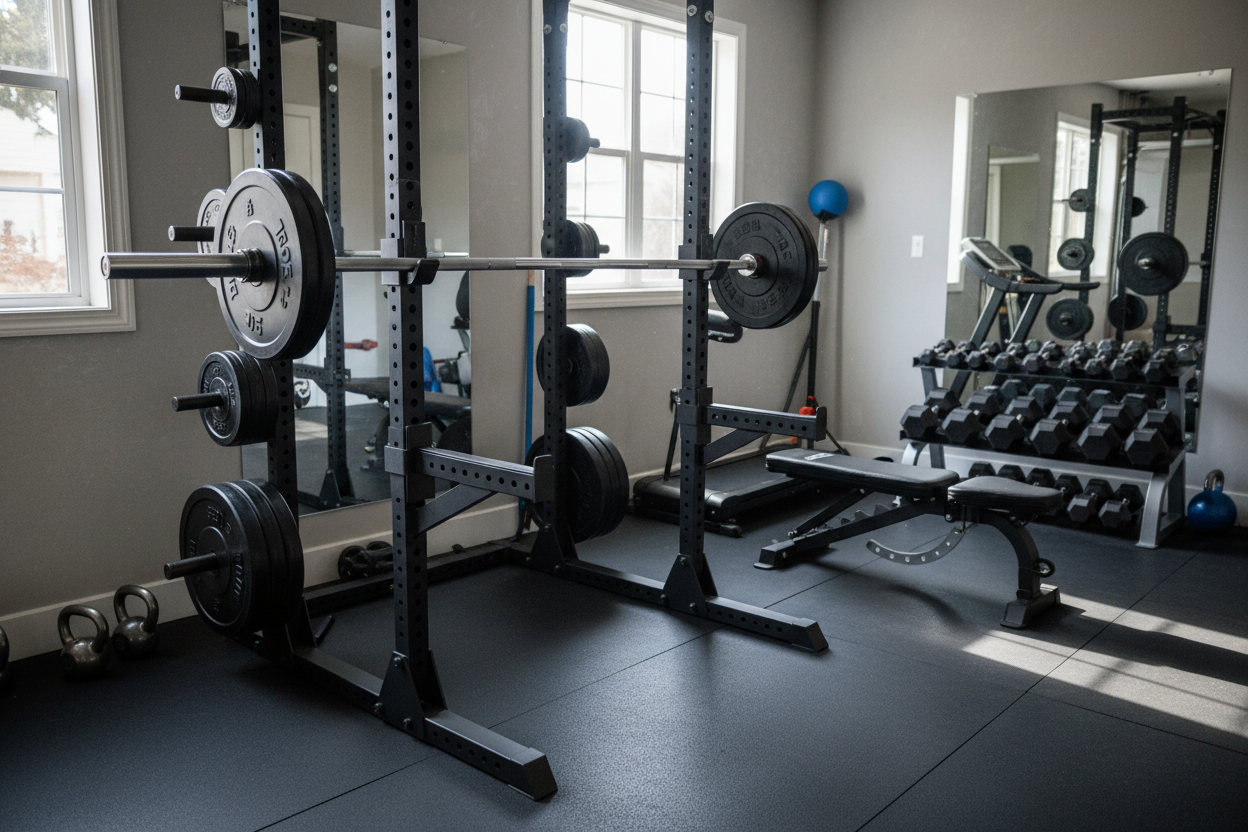
I remember standing in my cold garage three years ago, surrounded by a pile of cheap resistance bands and a pair of adjustable dumbbells that rattled like a bucket of bolts. I had just cancelled my expensive commercial membership and realized I had no idea how to actually train without a cable crossover machine. I was scrolling through forums at midnight, nearly convinced I needed a $3,000 multi-gym just to get a decent chest pump.
Then I bought a real barbell at home. That single piece of steel changed everything. It stripped away the fluff and forced me to get back to the basics that actually build muscle and strength. If you are starting a home gym, stop looking at the fancy machines and start looking at the bar.
- Skip the Gimmicks: A high-quality barbell is more versatile than any cable machine.
- Safety First: Invest in horse stall mats to protect your concrete slab.
- Spec Check: Look for at least 190,000 PSI tensile strength for long-term durability.
- Space Matters: You need about 7 feet for the bar, plus 2 feet on each side for loading.
The Commercial Gym Illusion
Commercial gyms want you to think you need 50 different machines to target every 'head' of your deltoids. It is a distraction. When you transition to a home barbell gym, you quickly realize that heavy-duty compound movements are the only things that move the needle. A heavy squat or a clean-and-press hits more muscle groups in ten minutes than an hour on a circuit of machines.
Using a barbell for home workout sessions forces you to stabilize the weight yourself. There are no tracks or pulleys to guide you. This builds real-world strength and core stability that machines simply cannot replicate. I found that my accessory lifts actually went up once I ditched the machines and focused entirely on the best barbells for home gym setups.
Will Dropping Weights Actually Destroy My Garage Floor?
This is the biggest fear for anyone setting up a home gym barbell. You imagine a heavy deadlift cracking the concrete and leaving you with a massive repair bill. Here is the reality: concrete is strong, but it is brittle. If you drop iron plates directly onto it, you will eventually see pitting and cracks.
To run a serious home barbell gym, you need two things: bumper plates and horse stall mats. Don't buy those 'puzzle piece' foam mats from a big box store; they are basically yoga mats with an ego and will compress to nothing under a 225-lb load. Get 3/4-inch thick rubber mats. Combined with bumper plates, which are designed to bounce, you can drop weights all day without stressing about your foundation.
The Anatomy of a Buy-It-For-Life Bar
Don't be fooled by 'best barbell' lists that only rank by price. You need to look at the metallurgy. The best bars for home gym environments are usually made from alloy steel with a high tensile strength. I look for a minimum of 190,000 PSI. Anything lower and you risk the bar taking a permanent bend (a 'set') if you leave it loaded or drop it unevenly.
You also need to understand the difference between a standard 1-inch bar and a real Olympic Barbell. Those cheap 1-inch bars you see at garage sales are dangerous; they have low weight capacities and the sleeves don't rotate. A real Olympic bar has 2-inch sleeves with bushings or bearings that allow the weights to spin. This spin is crucial because it prevents the inertia of the plates from wrenching your wrists during a lift.
Why 'Weight Limits' Are a Massive Scam
You will see cheap bars advertised with a '1,000 lb weight limit.' This is usually a static limit, meaning the bar can hold that weight while sitting perfectly still on a rack. The moment you move it, physics takes over. I have seen '1,000 lb' bars bend permanently under a 315 lb squat because the yield strength was trash. Ignore the marketing fluff and look for the PSI rating. That is the only number that tells you if it is the strongest barbell in your price bracket.
The Truth About Knurling Patterns
Knurling is the sandpaper-like texture on the bar. If it is too passive, the bar will slide out of your hands the moment you sweat. If it is too aggressive, it will cheese-grate your shins during deadlifts. For most people, a medium 'volcano' knurl is the sweet spot. Also, if you plan on squatting, ensure there is a center knurl. It grips your shirt and keeps the bar from sliding down your back. Just be careful with bare steel; it feels amazing but will rust in a week if your garage is damp. Look for zinc or chrome finishes instead.
Sizing Up Your Space (Can You Fit a 7-Footer?)
A standard Olympic bar is 86 inches long. That is just over 7 feet. However, you cannot just have a 7-foot wide room. You need 'loading clearance.' I learned this the hard way when I set up too close to my lawnmower and couldn't slide a 45-lb plate onto the sleeve without hitting the handle. You need to account for The Barbell Math Secret to Small Home Gyms Design to ensure you have at least 11 feet of total width to move comfortably.
If you are truly cramped, a compact barbell set might seem tempting, but they often have shorter sleeves. This means you can't fit enough plates on the bar as you get stronger. Stick to the full-size bar if you have the room; it is the best home barbell investment you can make for long-term progress.
My Top Pick for a Daily Driver
If you want one bar that can do it all—from heavy powerlifting to high-rep Olympic movements—you need a versatile daily driver. I have tested dozens, and for most people, the 20Kg Olympic Barbell Pb01 is the best barbell weight set centerpiece you can find. It balances a high tensile strength with a reliable spin, making it a top rated barbell for any garage setup.
Personal Experience: The 'Bargain' Blunder
When I first started, I bought a $60 bar from a local sporting goods store. I thought I was being smart. Three months in, the chrome started flaking off in tiny, needle-like shards that got stuck in my palms. Every time I deadlifted, I ended up bleeding. Not from the effort, but from the equipment. I eventually threw it in the scrap bin and bought a quality bar. Save yourself the stitches—buy once, cry once.
FAQ
What is the best barbell for beginners?
A standard 20kg (44lb) Olympic bar with a medium knurl is best. It allows you to learn proper form with a piece of equipment that will grow with you as you add hundreds of pounds to your lifts.
Can I use a barbell at home without a rack?
You can do deadlifts, rows, and cleans, but you will be severely limited on squats and bench presses. If you are serious about a barbell home gym, a basic squat stand is a mandatory second purchase.
Is a 15kg bar only for women?
No. While 15kg bars are the standard for women's Olympic lifting because of the thinner shaft (25mm), they are also great for anyone with smaller hands or for technical work where a slightly lighter starting weight is beneficial.
Share:
Light Hand Weights Are Only Useless if You're Training Wrong
The Exact Order to Follow When Buying Gym Equipment for Home