
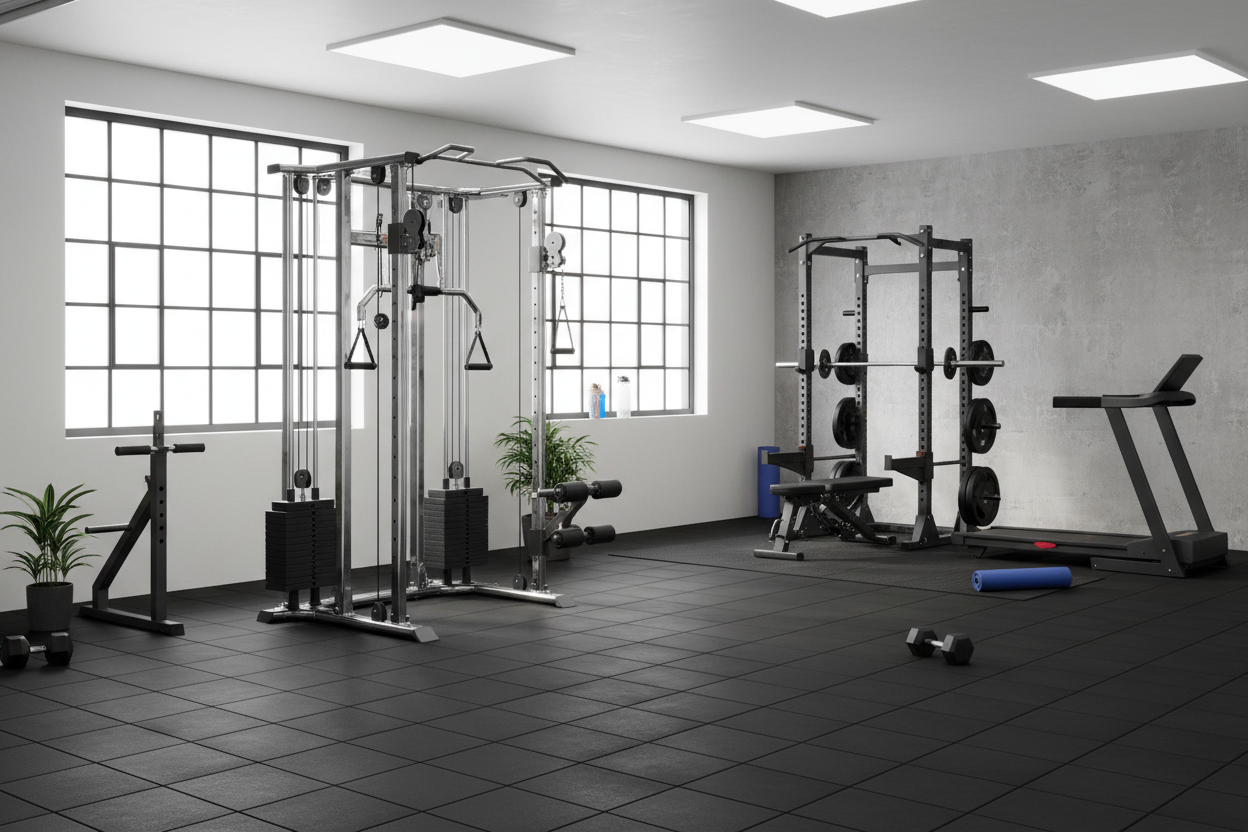
I remember standing in the middle of a 20,000-square-foot commercial facility, looking at a wall of selectorized equipment and feeling like I was in a museum of useless steel. Most of the gym machines look impressive, but they are often built for the gym owner's marketing budget rather than your actual muscle growth. I spent years rotating through every station because I thought variety was the secret sauce, only to realize I was spinning my wheels on gear that didn't fit my frame.
The truth is, most of that floor space is a trap. When I finally moved my training into my own garage, I realized I did not miss 80 percent of that gear. I only missed the pieces that actually offered a mechanical advantage over a standard barbell or dumbbell. If you want to stop wasting time, you need to know which exercise machines in the gym are worth the sweat and which ones are just expensive chairs.
- Functional trainers and cable columns are the gold standard for constant tension.
- Heavy-duty leg presses allow for massive volume without the spinal fatigue of a barbell.
- Most fixed-axis back machines are ergonomically flawed for the average lifter.
- A multi-functional Smith machine is the smartest way to bring commercial utility to a small home setup.
The Overwhelming Sea of Steel and Cables
Walk into any big-box gym and you are greeted by a maze of exercise machines gym owners buy to justify their membership fees. It is intimidating, and frankly, it is designed to be. These machines have a low barrier to entry—you just sit down and push. But just because a machine has a 300-lb weight stack and a shiny yellow lever does not mean it is effective for your specific goals. I have seen more people develop nagging shoulder pain from a chest press machine that forced them into a fixed, unnatural path than I ever have from a standard bench press.
The reality is that about 80 percent of the exercise machines in the gym are redundant. You will see five different chest press variations that all hit the same fibers. These machines are often designed for the 'average' person, which means if you are slightly taller, shorter, or have wider shoulders than the 1970s crash-test dummy they used for the blueprints, the machine will feel clunky. I wasted years trying to 'feel' my lats on a fixed-path row machine before realizing the pivot point was three inches too high for my torso. Don't be afraid to walk past the shiny stuff.
The 'Big Three' You Should Actually Wait in Line For
If the gym is packed, there are only a few stations worth the wait. First is the functional trainer. Cables provide constant tension throughout the entire range of motion, something gravity-based dumbbells simply cannot do. When you do a dumbbell fly, the tension disappears at the top. On a cable machine, that weight is pulling against you every single inch of the way. I will wait ten minutes for a cable station just to do face pulls or lateral raises properly.
Second is the heavy-duty leg press. While I will always advocate for the squat, the leg press is a tool for pure hypertrophy. It lets you bury your quads into the ground without your lower back giving out first. If you are chasing a pump and your legs are already shaky, the stability of a 45-degree leg press is unbeatable. Finally, look for a high-quality hack squat. If the machine uses a linear bearing system that feels like it is sliding on ice, it is arguably better for quad growth than a barbell squat because it stabilizes your torso and lets you focus entirely on the leg drive. These are the machines that actually earn their floor space.
Stop Wasting Your Time on These Specific Stations
I see lifters spending twenty minutes on the rotary torso machine or those 'inner-outer thigh' squeeze contraptions. Unless you are a high-level bodybuilder chasing a very specific aesthetic detail for a show, these are fluff. The leverage curves are usually terrible, meaning the weight feels heavy at the start and drops off to nothing at the peak contraction. You are better off doing lunges or planks. Most of these 'isolation' stations are just active rest that people use to look busy.
Back machines are the worst offenders. Most of them have fixed handles that do not allow your wrists to rotate naturally. This is exactly why I Skip 90% of the Back Exercise Machines at Gym (Here is Why). If you cannot adjust the grip or the seat height to fit your specific frame, you are just begging for an elbow or shoulder impingement. I once spent a month using a high-end seated row machine that looked like a piece of art, only to end up with a bicep tendon flare-up because the handles were set too wide. Stick to pull-ups, rows, and lat pulldowns with a swivel handle where you control the path.
How to Recreate the Best Commercial Stuff in Your Garage
When I started building a functional home gym, I had to be ruthless. I did not have room for a dedicated leg press, a pec deck, and a lat pulldown station. I needed one piece of equipment that could do the job of five. For most people, a high-end Smith machine home gym station is the ultimate compromise. Modern versions aren't just the rickety cages from the 90s; they often include integrated cable pulleys and pull-up bars that save you from buying three separate machines.
You can get 95% of the benefits of a commercial floor in a 6x8 foot footprint if you choose gear that prioritizes versatile tension. By using a Smith machine for your heavy presses and squats, you get the stability of a machine with the versatility of a power rack. I used to think I needed a massive commercial facility to see progress, but honestly, having a single cable column and a solid bar at home has led to better gains because I am not waiting 15 minutes for a teenager to finish texting on the leg extension. Focus on the mechanics, not the brand name on the steel.
What About Cardio? The Only Floor Model I Actually Missed
The cardio section of most gyms is a sea of boring treadmills that I wouldn't wish on anyone. If you are trying to save space at home, you do not need a 300-lb commercial treadmill that requires a dedicated circuit breaker. I found that a foldable upright exercise bike does more for my conditioning than a massive elliptical ever did. It tucks away in a corner when I am done, and the 16 levels of resistance are more than enough to get my heart rate into the 150s during a HIIT session. It is quiet, it is effective, and it doesn't turn your garage into a crowded fitness center.
FAQ
Are machines better than free weights for beginners?
Initially, yes, because they teach the movement pattern without the risk of dropping a bar. But do not get stuck there. Use them to build a base, then move to cables and free weights to build stability and core strength.
Which machine is best for fat loss?
No machine 'causes' fat loss—that is down to your diet. However, for sheer calorie burn, a high-intensity station like an air bike or a heavy sled is significantly more effective than a slow walk on a treadmill.
Can I build a pro-level physique using only machines?
You can. Many modern bodybuilders rely heavily on machines to minimize injury risk as they get stronger. The catch is you need high-quality machines with proper resistance curves, not the cheap, fixed-path units found in hotel gyms.
Share:
Stop Treating Your Multi Weight Machine Like a Barbell
How to Spot Junk When Browsing a Universal Weight Machine for Sale