
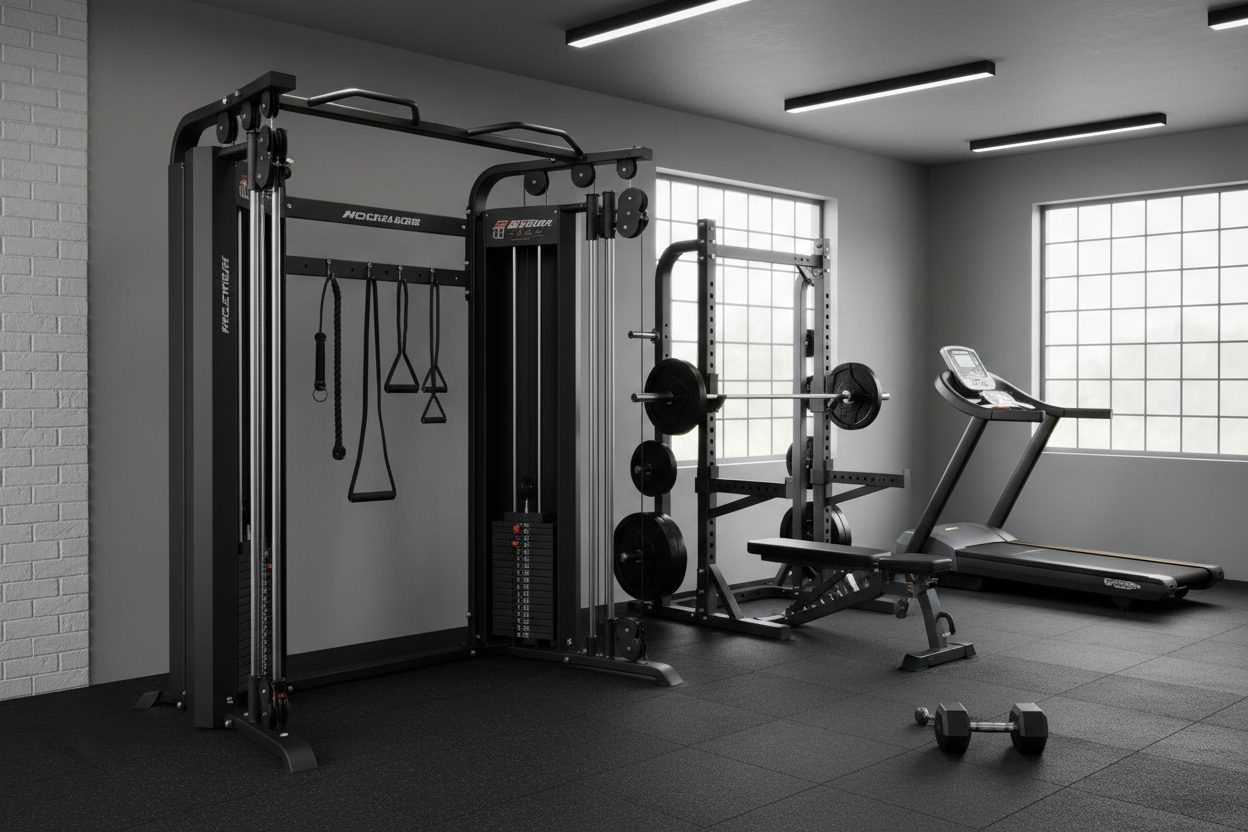
I’ve spent a decade chasing the 'perfect' setup. I’ve bought the $300 Amazon specials that arrived in boxes so thin the bolts were falling out. I’ve tried the resistance band 'gyms' that promise a chest like Arnold but offer the resistance of a wet noodle. If you want the best all around exercise machine, you have to accept one hard truth: light equipment is trash.
Real progress requires stability. If the rack shakes when you’re re-racking 225 pounds, you’re not training; you’re surviving. After testing dozens of rigs, I’ve found that the only way to truly replace a commercial membership is to bring the commercial steel home. You need mass to move mass.
- Stability: Needs at least 14-gauge steel to stop the wobbles.
- Versatility: Must handle heavy compounds and isolated cable work.
- Safety: A built-in spotter is mandatory for solo garage sessions.
- Footprint: Should fit in a standard 8x8 corner.
The Dark Secret of 'Do-It-All' Gym Equipment
The fitness industry loves selling you a dream packaged in a 50-pound box. They show you fitness models getting shredded on plastic pulleys and bungee cords. It’s a lie. Most 'do-it-all' rigs fail because they try to be light enough to ship via standard UPS while claiming they can handle a 300-pound squat. You can’t cheat physics.
When you strip away the marketing, most budget gear is just a collection of compromises. The cables are sticky, the frames are narrow, and the weight stacks are laughable. The Best All In One Exercise Machine Isn't an Infomercial Toy because real hypertrophy requires consistent, heavy tension—something a folding bench simply cannot provide. If you can pick the machine up with one hand, it’s a toy, not a tool.
What Actually Makes a Rig Truly Versatile?
A machine earns the title of 'versatile' when it doesn't force you to change your programming. If you have to skip leg day because your machine can't handle a heavy load, it’s a coat rack. You need three specific pillars to replace a commercial gym: dual adjustable pulleys, a heavy-duty rack, and a smooth fixed-path option.
Dual pulleys allow for functional movements like cable crossovers and lat pulldowns. A rack allows for the 'Big Three' lifts. But for many of us training alone, a fixed-path option like a Smith bar provides the safety net we need for max effort sets. Does the Best All In-One Workout Machine Actually Exist? It does, but only if you stop looking for a 'bargain' and start looking for a tank built from 2x2 or 3x3 steel tubing.
You Cannot Fake Heavy Iron
Cable ratios are where most people get tripped up when hunting for the best all around workout machine. A 2:1 ratio means 100 pounds on the stack feels like 50 pounds in your hand. This is great for crossovers and face pulls because it gives you more cable travel and smoother increments. However, if you're trying to do heavy rows or pulldowns, you need a machine that can actually hold enough weight to challenge you without bottoming out the stack.
Your legs will outgrow resistance bands in about three weeks. To build real strength, you need the capacity to load 400+ pounds on a bar. Heavy steel doesn't just feel better; it lasts. A 400-pound machine stays planted on your garage floor while a 100-pound rig slides every time you pull a cable. If you’re running a program like 5/3/1, you need equipment that respects the weight you're moving.
My Top Pick: The Functional Trainer and Smith Rack Hybrid
The solution isn't three different machines; it's one massive, integrated hybrid. The sweet spot is a unit that combines a power rack for free weights with a Smith Machine for guided lifts. This allows you to transition from heavy barbell squats to controlled chest presses without walking across the room or changing rooms. It’s about maximizing your square footage without sacrificing your PRs.
I’ve been putting the All In One Smith Machine With Cable Crossover S1 V4 through its paces. It’s a 400-pound beast that uses 14-gauge steel and linear bearings that actually glide. Unlike the friction-heavy plastic bushings on cheap gear, this feels like the equipment you’d find at a high-end club. It includes the cable crossover, the Smith bar, and the squat rack hooks. It’s the closest thing I’ve found to a 'one and done' purchase for a home gym.
Is This Heavyweight Setup Right for Your Garage?
Before you pull the trigger, check your floor. This isn't a piece of equipment you move around for fun. You need a dedicated space, preferably on a concrete slab or a proper lifting platform. If you’re living in a third-floor apartment with thin joists, a 400-pound machine plus your body weight and plates might be a conversation for your landlord. But for a garage or basement, it's the gold standard.
If you have the space and you're tired of the $80 monthly donation to a gym you hate driving to, this is the move. It’s an investment in steel that won't lose its value or break after a year of heavy use. Stop buying the cheap stuff twice and buy the heavy stuff once.
My Biggest Mistake
I once bought a 'compact' cable trainer because I wanted to save four square feet of space. It was so light that every time I did a standing row, the whole machine tipped toward me. I ended up having to bolt it to a piece of plywood just to keep it upright. I wasted $400 trying to save $400. Buy the heavy machine first; your shins and your sanity will thank you.
FAQ
How much ceiling height do I need?
Most of these hybrid machines sit around 80 to 84 inches tall. I recommend at least 7.5 feet of clearance so you aren't hitting your head during pull-ups or hitting the ceiling with your plates.
Is assembly a nightmare?
It’s a project. Budget about 4 to 6 hours and have a socket wrench set ready. Don't rely on the tiny flat wrenches they include in the box unless you want hand cramps and stripped bolts.
Do I need to grease the cables?
Yes. A little silicone spray on the guide rods once every few months keeps the action buttery smooth. If it starts squeaking or feeling 'crunchy,' you've waited too long.
Share:
I Downsized My Garage Gym to Just Free Weights and Bench
I Ditched the Machines to Train With Just Weights on Bench