
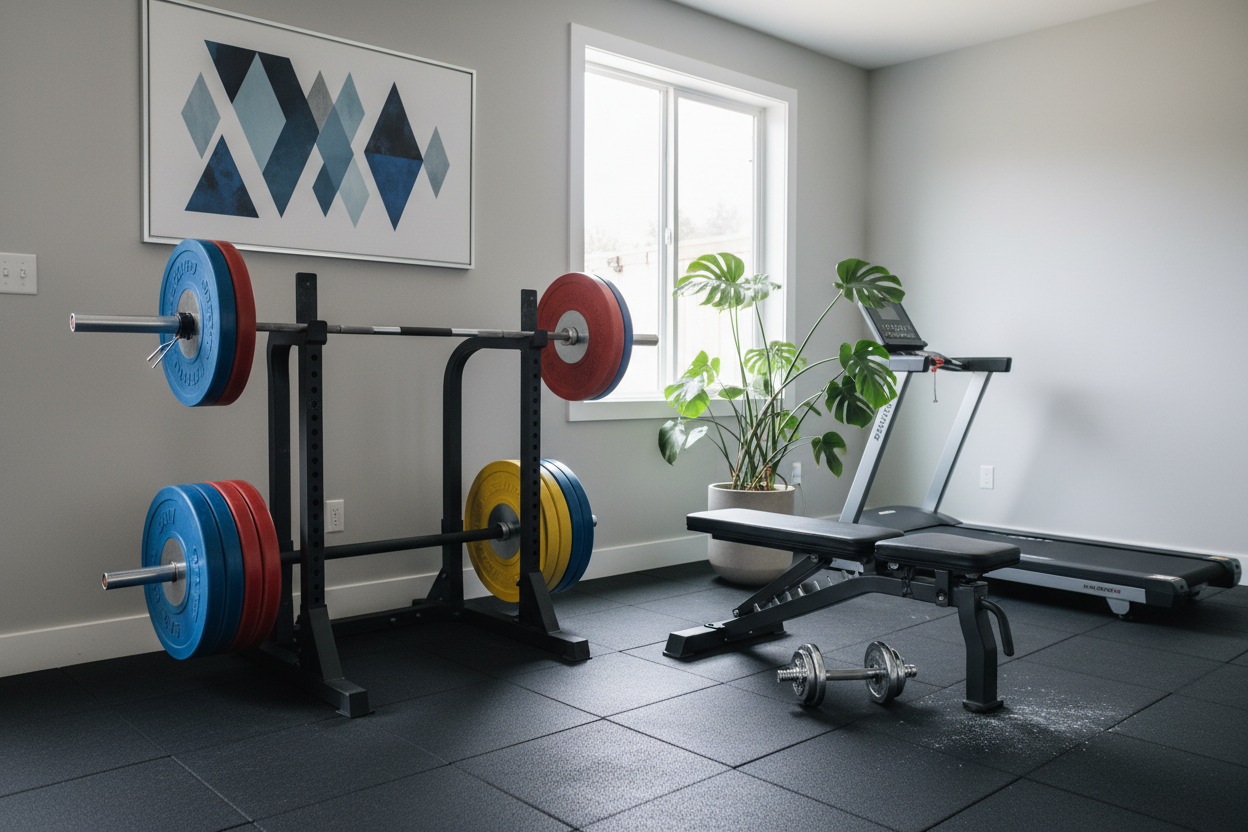
I remember staring at a $1,200 treadmill that I used exactly three times in six months. Meanwhile, I was still paying $60 a month to the local commercial box because I didn't have a way to squat or bench at home. It is the classic mistake when planning a home gym setup. You buy the stuff that feels 'healthy' instead of the steel that builds actual muscle.
- Prioritize Iron: Buy a rack and barbell before any cardio machines.
- Floor First: Get 3/4-inch horse stall mats to protect your foundation.
- Buy Once: A cheap bench is a safety hazard; invest in a high weight capacity.
- Incremental Growth: You do not need a full rack of dumbbells on day one.
The Cardio Trap (And Why I Fell for It)
Most people start an at home gym setup with a Peloton or a high-end NordicTrack. Unless you are a dedicated distance runner, this is usually a massive waste of square footage. Cardio is easy to do outside for free, but heavy resistance training requires infrastructure. I spent my first 'gym budget' on a rower that eventually became a very expensive place to hang my laundry.
A basic home gym setup should focus on the things you cannot easily replicate elsewhere. You can run in the park, but you cannot safely squat 300 pounds in your driveway without a rack. When you build your gym setup around a treadmill, you are essentially building a cardio studio, not a place to get strong. Start with the iron and add the lungs later.
The 'Core Four' You Actually Need to Buy First
If you have a 10x10 space, you have enough room for a world-class workout set up. You need a power rack, an Olympic barbell, weight plates, and a bench. That is it. For a simple garage gym, look for a rack made of at least 11-gauge steel. If the uprights are 2x2, it might feel a bit 'walky' when you re-rack a heavy set. Aim for 3x3 or 2x3 tubing if you can swing the extra cost.
The barbell is your most important touchpoint. Do not buy the cheap chrome bars found at big-box retailers; they have terrible knurling and will eventually permanent-bend under a heavy load. As you move toward a full home gym setup, your plates should be a mix of iron for the small increments and perhaps some bumper plates if you plan on doing Olympic lifts or deadlifts on a concrete floor.
Don't Cheap Out on Your Bench
Your workout set up at home lives or dies by the stability of your bench. I once bought a $90 bench that claimed a 500-lb capacity, but it wobbled every time I tried to hit a heavy set of presses. It was terrifying. A high-quality flat bench is often better for a simple home gym setup than a cheap adjustable one. If you go adjustable, make sure it has a minimal 'pad gap' so you aren't sinking into a hole during your heaviest sets.
Stop Avoiding Dumbbells Because of the Cost
Dumbbells are the most versatile pieces of home gym starter equipment, but they are also the most expensive per pound. You do not need a full 5-100 lb rack immediately. Start with a few key pairs or a high-quality adjustable set. If you prefer the feel of fixed weights, a rubber hex dumbbell set is the smartest investment you can make. They won't roll away on an uneven garage floor, and the rubber coating prevents the 'clanging' that wakes up the neighbors during 5 AM sessions.
For a perfect home gym setup, I usually recommend starting with a pair of 25s, 35s, and 50s. That covers about 80% of your accessory work. You can fill in the gaps as you get stronger, but those three sizes are the workhorses of any weightlifting set up.
When Is It Time to Buy the Fancy Stuff?
Once you have mastered the basics in your simple at home gym, the itch to buy machines will start. This is where people get into trouble with 'all-in-one' units that do twenty things poorly. If you train alone and want to push your limits safely, a Smith machine home gym station is a logical next step. It provides a fixed path and safety catches that a standard rack sometimes lacks for solo lifters.
However, be wary of buying a Marcy at home gym or similar budget stack machines too early. I made the mistake of replacing my free weights with a cheap cable machine once and regretted it within a month. The resistance curves on budget machines are often choppy and the weight stacks are usually too light for serious progress. Stick to your home gym full setup of free weights until you can afford a commercial-grade cable unit.
Getting Shredded Without the Commercial Clutter
You do not need thirty different isolation machines to look like a bodybuilder. In fact, most pro setups are surprisingly Spartan. By using basic bodybuilding home gym equipment like a landmine attachment and a set of resistance bands, you can hit every muscle group from every angle. A home gym guide should emphasize versatility over volume.
In my current home gym builds, I focus on 'multi-use' items. A rack with a pull-up bar and a dip attachment replaces three separate machines. This keeps your home workout setup clean and functional. Remember, the goal of a perfect home gym is to reduce friction so you actually train, not to recreate a cluttered commercial gym in your basement.
FAQ
How much ceiling height do I need for a power rack?
Most standard racks are about 82 to 92 inches tall. Measure your ceiling twice. If you have low ceilings, look for 'shorty' racks that sit around 72 inches, but keep in mind you might not be able to do standing overhead presses inside them.
What is the best flooring for a garage gym?
Skip the 'puzzle piece' foam mats. They tear and slide. Go to a farm supply store and buy 4x6 foot horse stall mats. They are 3/4-inch thick, indestructible, and will protect your subfloor from dropped weights.
Is a home gym actually cheaper than a membership?
Mathematically, yes—usually within 2 to 3 years. But the real value is the time saved. No commute and no waiting for the squat rack means your 60-minute workout actually takes 60 minutes.
Share:
I Drove to Fenton Just to Visit Show Me Weights (Worth It?)
I Finally Made Room for a Resistance Exercise Machine (Here's Why)