
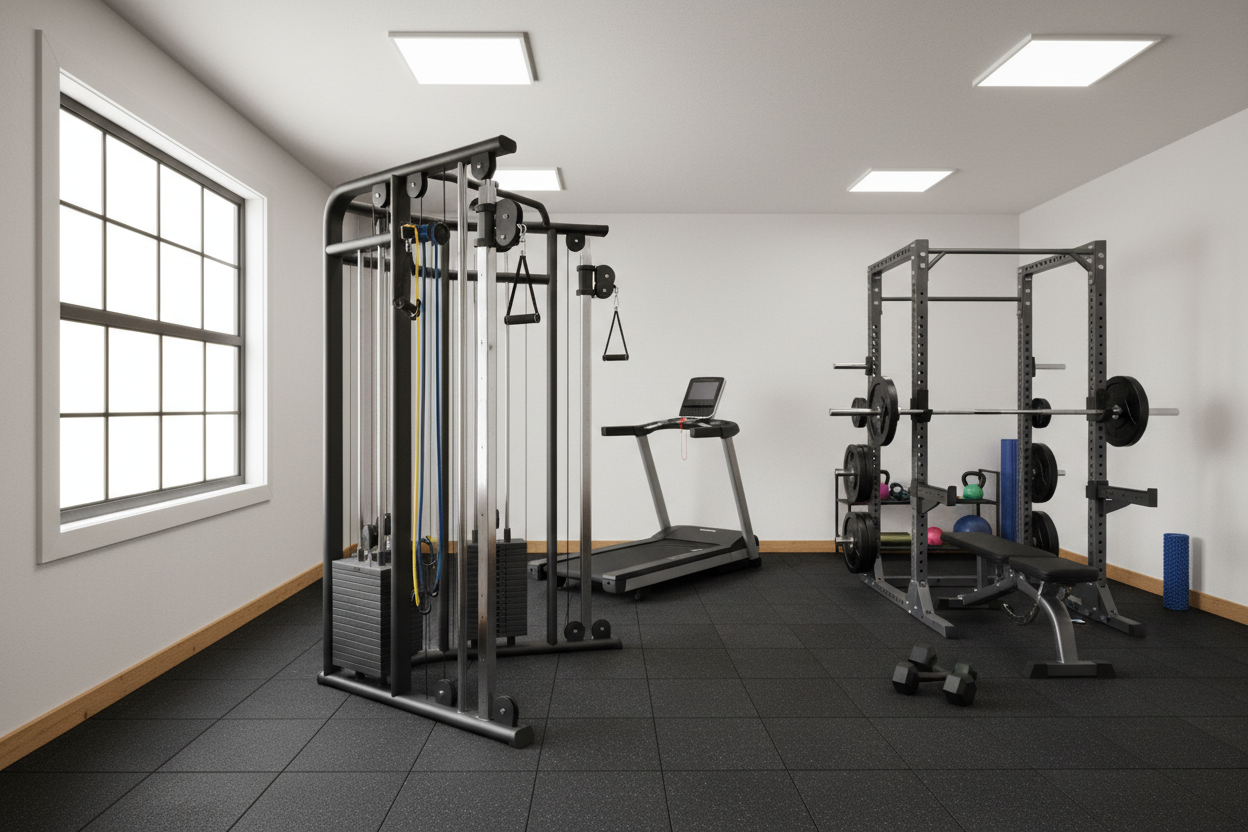
I remember the day I finally walked into my local LA Fitness and handed over my key tag for the last time. I was done with the $80 monthly fees, the broken air conditioning, and the guy who spent 20 minutes doing bicep curls in the only functional power rack. I went home, cleared out the mountain of cardboard boxes in my garage, and prepared to build my own sanctuary. I thought a barbell, a few plates, and a dream were all I needed to escape the machines gym ecosystem forever.
Quick Takeaways
- Replicating a commercial gym floor is a space-killer; focus on multi-use equipment.
- Independent arm movements are superior for joint health compared to fixed barbells.
- Smith machines are not 'cheating'—they are essential for safe, solo hypertrophy training.
- Isolation work for quads and hamstrings is nearly impossible to master with free weights alone.
- Constant cable tension beats dumbbells for shoulder and arm accessory work.
Why Replicating a Commercial Floor is a Terrible Idea
The biggest mistake new garage gym owners make is trying to buy every fitness machine for sale they used to enjoy. In a commercial facility, they have 10,000 square feet to fill. They can afford to have a standalone machine for your rear delts and another just for your calves. In a 20x20 garage, that kind of approach is a death sentence for your floor space. You have to be ruthless about what machines actually earn their keep.
When you start weight lifting with machines at home, you realize that most exercise machine in gym setups are designed for durability and ease of use for the masses, not necessarily for space efficiency. A commercial leg press might weigh 800 pounds and take up half a bay. Unless you're a professional bodybuilder, that’s a bad investment. You need to look for gym exercises machines that offer versatility. The goal isn't to have the most gym weight machines; it's to have the right ones that allow you to train hard without the 'commercial' footprint.
The 4 Pieces of Equipment at the Gym You'll Actually Crave
After six months of strictly barbell and dumbbell training, the 'new car smell' of my garage gym wore off. My joints started to ache. My progress on accessory movements stalled. I realized that working out machines provide something free weights can't: a fixed path of motion and a specific resistance curve. Here are the most popular gym machines I actually missed and eventually had to buy.
1. The Independent Arm Chest Press
Barbell benching is the gold standard for ego, but it's hell on the shoulders if you have any history of impingement. In a commercial setting, I always gravitated toward the plate-loaded chest press. The beauty of a gym training machine with independent arms is that it mimics a natural converging path. Your hands start wide and come together at the top, which is much more natural for the pec fibers.
To get that same feel at home, I looked for a Weight Bench Chest Press Machine Independent Arms Z1 Pro. It allows you to work around imbalances—if your left side is weaker, it can't hide behind the right side like it does on a standard bench press. Plus, the workout machine price for a hybrid bench like this is significantly lower than buying a standalone commercial unit.
2. A Smooth, Heavy-Duty Smith Rig
The Smith machine gets a lot of hate from the 'functional fitness' crowd, but those people usually aren't training alone in a basement. When you're weight lifting machines at the gym, you have the luxury of a spotter nearby. When you're at home, the Smith machine is your best friend. It’s one of the most versatile workout machines gym veterans use for high-volume hypertrophy.
Investing in a Smith Machine Home Gym Station changed my leg days and shoulder presses forever. It allows you to push to absolute failure on movements like Bulgarian split squats or incline presses without the fear of getting pinned. For a home setup, these workout machines in gym configurations often include pull-up bars and plate storage, making them a massive space-saver compared to a dedicated power rack and a separate Smith unit.
3. The Dedicated Leg Extension and Curl Combo
You can squat until you're blue in the face, but you'll never get that specific 'teardrop' quad development or hamstring thickness without isolation. This is where exercise machines at the gym really shine. Trying to do leg curls with a dumbbell squeezed between your feet is a recipe for a pulled muscle and a frustrated workout.
I eventually added a leg extension and curl station to my setup. It’s the only way to get that deep, burning contraction at the end of a session. Most weight machines in the gym for legs are huge, but finding a bench-integrated version allows you to keep your weight exercise machines gym quality high without sacrificing your ability to park a car in the garage.
4. A True Functional Cable Tower
Cables provide constant tension. If you do a lateral raise with a dumbbell, there is zero tension at the bottom of the movement. With gym strength machines that utilize pulleys, the weight is pulling against you through the entire range of motion. This is why strength training gym machines are non-negotiable for shoulder health and arm growth.
A functional trainer or a simple cable tower allows for face pulls, tricep pushdowns, and cable crossovers. These are the weight room machines that fill in the gaps that barbells leave behind. When looking at gym workout machines for cables, check the pulley ratio. A 2:1 ratio is smoother for movements like lateral raises, whereas a 1:1 ratio is better for heavy rows.
The Strength Machines at Gym Facilities You Can Ignore
Not everything is worth the workout machine price. You can safely ignore the massive hip adductor/abductor machines—you can replicate those with a $10 set of resistance bands. The standalone calf raise block is another waste of space; just use a wooden 4x4 or the edge of your rack. Many assisted weight machines for dips and pull-ups are also unnecessary once you have a few long loop bands for assistance. Don't let your garage become a graveyard for equipment at the gym that only does one thing.
How to Build Your Own Commercial Experience
My garage gym isn't just a place to lift; it's a finely tuned weight training equipment in gyms alternative. I spent too many months thinking I was a 'purist' for only using a barbell. The truth is, my joints felt like they were full of sand. I missed the weight machines at the gym because they allowed me to train hard while staying healthy. Once I added the strength machines at gym vets actually use—the Smith, the cables, and the leg isolation—my physique actually started to change again. Stop thinking you have to choose between 'hardcore' free weights and 'easy' machines. The best home gyms use both.
FAQ
Are home gym machines as good as commercial ones?
Usually, no. Commercial gym strength machines are built for 24/7 abuse. However, for a single user, high-end home units offer 95% of the feel at 20% of the cost and footprint.
Can I build muscle with only machines?
Absolutely. Weight lifting with machines provides more stability, which often allows you to recruit more motor units in the target muscle because you aren't worried about balancing the weight.
How much space do I need for a Smith machine?
Most home weight room machines like a Smith rig require an 8x8 foot footprint to account for the bar width and the space needed to load plates on the sides.
Share:
Stop Buying Pairs: When to Finally Get a Dumbbells Full Set
I Ordered From a German Fitnessgeräte Store (And Paid For It)