
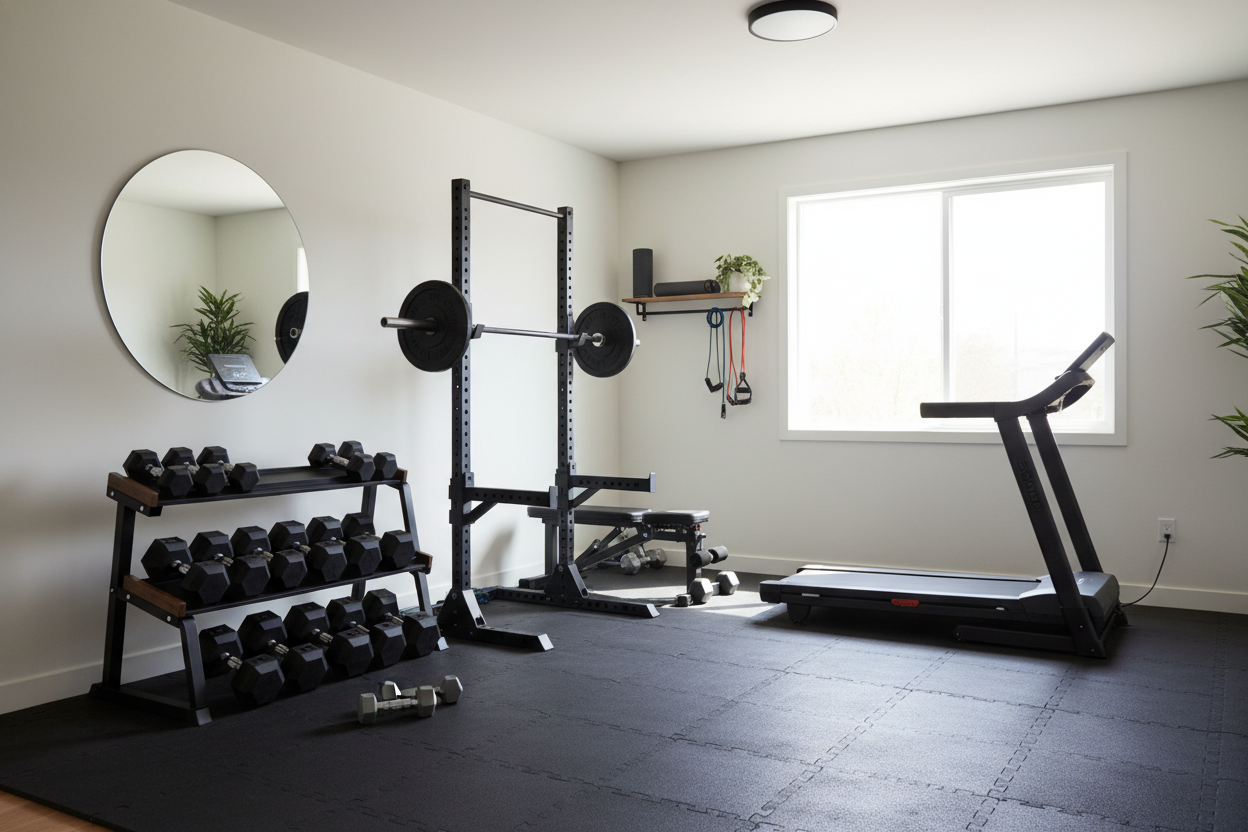
I have spent the last decade living in apartments where the 'gym' was also the place I ate dinner and watched Netflix. I have also spent that decade trying to maintain a 400-pound deadlift. These two lifestyles usually crash into each other like a dropped bumper plate on a ceramic tile floor. Most living room exercise equipment looks like it was designed by someone who hates interior design, or worse, someone who doesn't actually lift heavy things.
Quick Takeaways
- Vertical storage turns a footprint of four square feet into zero.
- Adjustable gear is the only way to keep your sanity and your floor space.
- Floor protection is about acoustic dampening as much as it is about scratches.
- If it takes more than 60 seconds to set up, you will eventually stop using it.
Why Your Shared Space Doesn't Need to Look Like a CrossFit Box
Your living room is for relaxing, not for tripping over a stray 45-pound plate while you're trying to find the remote. I have seen too many people turn their beautiful mid-century modern apartments into cluttered dungeons because they thought they needed a full power rack. You don't. You need stealthy living room workout equipment that works hard during your lunch break and disappears by happy hour.
The goal is to find gear that carries its weight without demanding center stage. We are looking for high-quality steel, matte finishes that don't scream 'commercial gym,' and footprints that respect your square footage. It is about training like an athlete without living in a locker room.
The 'Hideability' Test Every Piece of Gear Must Pass
If a piece of equipment claims to be 'storable,' I look for the catch. Usually, that catch is a bag of bolts you have to remove every time you want to tuck it away. Real hideability means a tool-free folding mechanism that feels solid under load. I look for benches that fold down to under 10 inches and bikes that can roll into a hall closet without a fight.
A foldable upright exercise bike is the gold standard here. The difference between a hidden machine and a permanent eyesore is the footprint when it is not in use. If it can't slide under a bed or hide behind a door, it is not apartment-friendly gear; it is just furniture you have to move around.
Protecting Your Floors (And Your Downstairs Neighbors)
Hardwood floors and iron weights are natural enemies. I have lost security deposits to 'controlled' deadlifts that weren't quite controlled enough. Beyond the physical damage, the vibration of a heavy kettlebell landing on a floor can sound like a car crash to the person living below you. You need high-density rubber mats, but you don't need to cover your entire floor in them.
Modular drop pads are a lifesaver for heavy lifting in small spaces. They soak up the impact and kill the noise, and you can stack them in a corner when you are done. Moving toward quiet exercise equipment for apartment living is as much about being a good neighbor as it is about saving your floors. Focus on magnetic resistance for cardio and rubber-coated weights to keep the clanging to a minimum.
Cardio That Doesn't Command the Entire Floor Plan
Most treadmills are massive, 300-pound anchors that dominate a room. Unless you are training for a marathon, you don't need a seven-foot deck. I prefer a low-profile exercise bike because the vertical footprint is significantly smaller. You can tuck one into a corner by a window, get your heart rate into the red zone, and still see your television.
Look for machines with transport wheels. If I can't tilt it and roll it with one hand, I don't want it in my living room. The best cardio gear for small spaces is the stuff that stays out of your peripheral vision when you're trying to decompress after work.
My Go-To Storage Hacks for Heavy Iron
I don't leave my dumbbells on the floor. I use a heavy-duty storage ottoman that can support 200 pounds of iron. It looks like a footrest, but it's actually a hidden arsenal. Another trick is using decorative wicker baskets for resistance bands and yoga blocks. It sounds soft, but it keeps the 'gym' feel from bleeding into your home aesthetic.
For adjustable dumbbells, I keep them on a small rolling cart that fits inside my coat closet. When it's time to train, I roll the whole 'gym' out into the center of the room. When I'm done, it disappears. This keeps the dust off the gear and the gear off my rugs.
Personal Experience: The Barbell Blunder
I once bought a 7-foot Olympic barbell for a studio apartment. I thought I'd just lean it in a corner. Within a week, I had a massive gouge in my drywall and had knocked over a floor lamp twice while warming up. I eventually sold it for a pair of 50-pound adjustable dumbbells. The lesson? Respect your dimensions. If you can't do a full range of motion without hitting a wall, the gear is too big for the room.
FAQ
Will heavy weights damage my apartment floor?
Yes, if you drop them. Even with mats, the sheer PSI of a heavy weight can dent soft wood like pine. Use high-density rubber tiles or drop pads, and never 'ego lift' to the point where you have to bail on a rep.
Are folding exercise bikes actually stable?
The good ones are. Look for a wide base and a weight capacity of at least 250-300 pounds. If the bike weighs less than 40 pounds itself, it's probably going to wobble when you sprint.
How do I stop my gear from smelling?
Wipe it down immediately. In a small living room, the smell of sweat lingers. Use a non-bleach disinfectant after every session and keep your yoga mats unrolled until they are completely dry before stashing them.
Share:
Why Your Shoulders Demand a True Heavy Duty Weight Bench
The Best All In One Exercise Machine Isn't an Infomercial Toy