
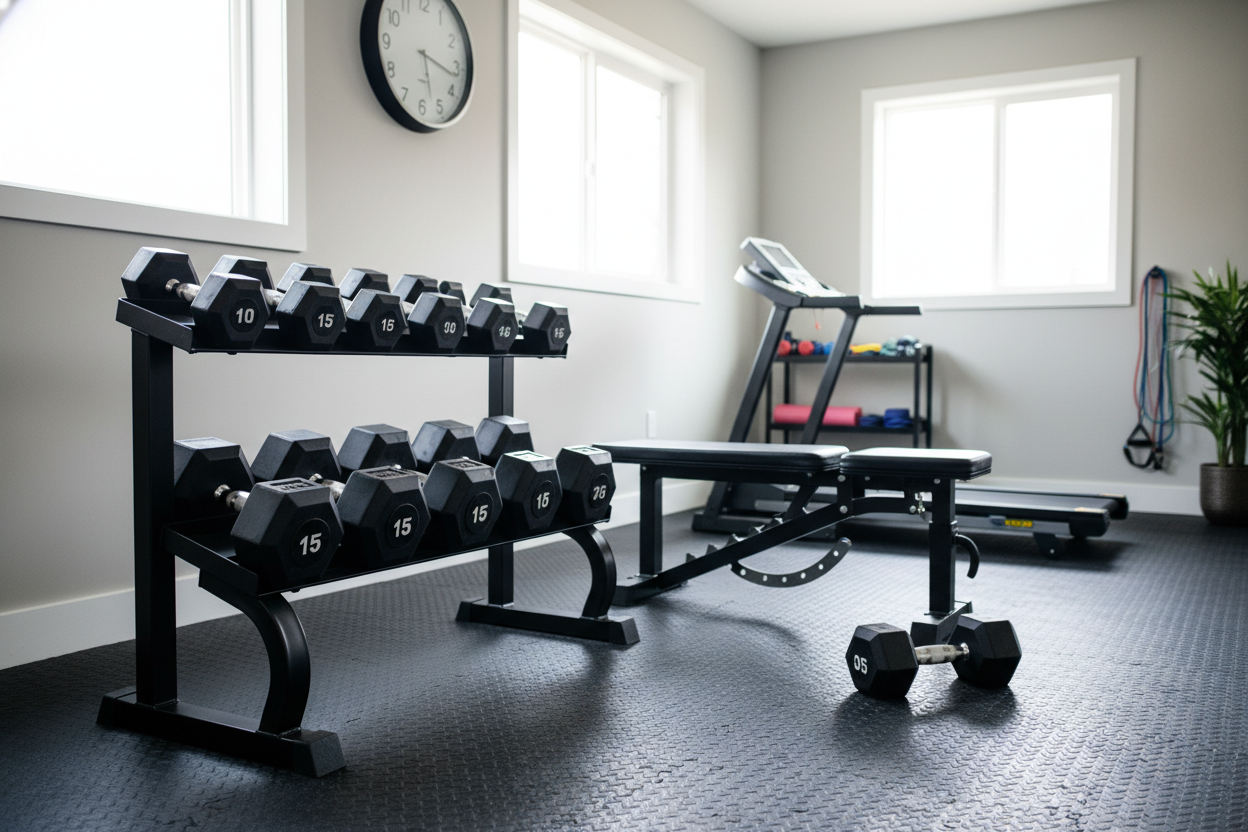
I remember the night I almost blew my entire savings on a commercial-grade rack of iron. My local gym had just hiked their monthly dues, and I was convinced that if I didn't have a full 5-100lb set, I wasn't really training. I spent hours comparing specs until I realized I was trying to build a pro facility in a one-car garage with a cracked slab.
Buying a simple 10/15/20 dumbbell set was the reality check I needed. It is the ultimate starter kit that actually gets used, rather than sitting in the corner collecting dust while you wait for your 'perfect' motivation to arrive. It is compact, affordable, and harder to use than your ego wants to admit.
Quick Takeaways
- Saves hundreds of dollars compared to full racks or high-end adjustables.
- Forces you to master technical movements before adding heavy load.
- Perfect for high-rep hypertrophy and accessory work.
- Takes up less than 2 square feet of floor space.
Why Everyone Gets Their First Dumbbell Purchase Wrong
The most common mistake I see is the 'all or nothing' mentality. People think they need a 5-50lb set or those heavy adjustable blocks that cost as much as a used car on day one. They end up with a lot of heavy iron they aren't ready to move correctly. When you jump straight to the heavy stuff, your form goes out the window, and your lower back starts doing the work your shoulders should be handling.
I fell into this trap myself before I finally built a weight and dumbbell set that actually made sense for my space. By starting with a curated 10 15 20 lb dumbbell set, you remove the temptation to ego-lift. You are forced to focus on time under tension and perfect mechanics. Trust me, 20s feel plenty heavy when you are doing slow, controlled tempo reps instead of swinging weight around like a pendulum.
The Sweet Spot: Breaking Down the 10, 15, and 20 Pounders
This specific trio covers about 90% of what a beginner needs to actually see results. The 10s are your precision tools. They are ideal for lateral raises, rear delt flies, and those rehab movements you've been skipping. If you can't do 15 clean lateral raises with 10s, you have no business touching anything heavier.
The 15s are the workhorses for high-rep hypertrophy. Think bicep curls, overhead extensions, and high-volume lunges. When you are shopping for dumbbells, you will find that 15s are often the most versatile weight in the room. Then you have the 20s. These are your 'heavy' hitters for learning the basics of a goblet squat, a strict overhead press, or a single-arm row. A weight set 10 15 20 allows for a natural progression that keeps you moving without hitting a wall.
Should You Go Lighter? The Case for a 5/10/15 Setup
Not everyone needs to start at 10 pounds. If you are recovering from a shoulder tweak, or if you are a smaller lifter focused on endurance, a 5 10 15 lb weight set might be the smarter play. A 5 10 15 lb dumbbell set is also a secret weapon for shadow boxing or high-intensity interval training where speed matters more than raw mass.
I often recommend a weight set 5 10 15 for seniors or anyone working on intricate rotator cuff stability. There is no shame in the 5lb game—especially when you are doing 30 reps of 'I-Y-Ts' to keep your shoulders healthy for the long haul.
Rubber Hex vs. Neoprene: Don't Destroy Your Floors
When you are looking at a 5/10 15/20 dumbbell set, you will see two main styles: neoprene-coated and rubber hex. Avoid those cheap, slippery vinyl ones at all costs. Neoprene is okay for light weights, but it tends to peel and get gross once you start sweating on it. It also smells like a tire fire for the first three weeks.
I always point people toward a rubber hex dumbbell set. The hexagonal heads mean they won't roll across your garage floor when you set them down between sets of 'man-makers.' Plus, the rubber coating acts as a buffer for your concrete. It won't save your floor if you drop a 100lb bell, but for this weight range, it is the best protection you can get.
How to Know When It's Time to Upgrade
You won't stay with a dumbbells 10 15 20 setup forever, and that is the point. You will know it is time to buy heavier pairs when you can knock out 20+ reps of goblet squats with the 20s without breaking a sweat. Usually, this takes 3 to 6 months of consistent training.
The beauty is that these lighter weights never become obsolete. Even when you move up to 50lb rows, you will still reach for those 10s and 15s for your warm-ups and accessory work. It is a foundational investment, not a temporary fix.
Personal Experience: My First Set
I started with a cheap 10 12 15 lb dumbbell set I found at a garage sale. The 12s were an odd increment, but they taught me the value of small jumps. My biggest mistake was buying a set with round heads first; one rolled right into my drywall during a set of floor presses. Since switching to rubber hex, my walls (and my toes) have been much safer.
Frequently Asked Questions
Can I actually build muscle with only 20 lbs?
Yes. Muscle growth is about mechanical tension and metabolic stress. If 20 lbs is light for you, increase the reps, slow down the eccentric (lowering) phase, or reduce your rest periods. Your muscles don't have a scale; they only know how hard they are working.
Are hex dumbbells better than round ones?
For a home gym, absolutely. Hex dumbbells stay put. If you're doing renegade rows or just living on a slightly uneven garage floor, you don't want your weights migrating away from you.
Should I buy adjustable dumbbells instead?
Adjustables are great for saving space, but they are often clunky and have a 'clanking' sound that can be annoying. A fixed 10 15 20 lb dumbbell set is faster to grab and much more durable for high-intensity circuits.
Share:
Can a Cardio Brand Build a Good Proform Weight Bench With Weights?
I Finally Found Hand Held Weight Sets That Don't Feel Like Toys