
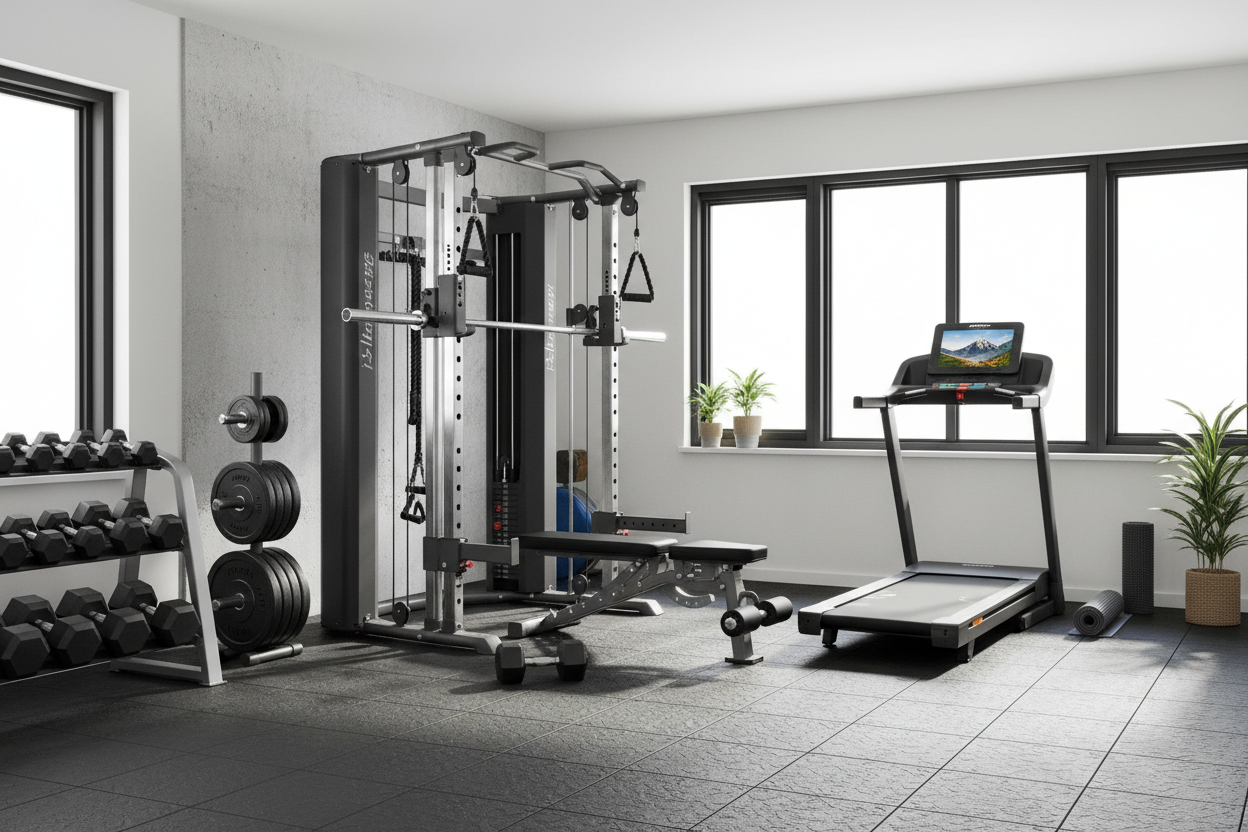
I remember staring at my garage floor, measuring tape in hand, trying to figure out how to fit a squat rack, a cable tower, and a bench without losing my parking spot. My local commercial gym just hiked dues again, and the cheap functional trainer I saw on Amazon looked like it was made of soda cans. Everyone wants to know what the best home workout machine is, but the answer usually depends on how much you value your floor space and your joints.
Quick Takeaways
- Look for 11-gauge steel or better to avoid the dreaded rack sway during heavy lifts.
- A 2:1 pulley ratio is essential for smooth, functional movements like chest flies.
- Smith machine hybrids offer safety for solo lifters but require a specific foot placement.
- Most all-in-one rigs neglect heavy posterior chain work, requiring add-ons.
The All-In-One Promise vs. The Clunky Reality
The hype is real. You see these glossy ads for rigs that claim to replace 12 different machines. Beginners often ask me what is the best workout machine for home, thinking a single $500 unit from a big-box store will get them stage-ready. It won't. If the steel feels thin and the cables catch, you will stop using it within a month.
Fitting a home gym into a tight space requires compromise, but structural integrity shouldn't be one of them. Most budget models use plastic pulleys that degrade. I have seen cables snap and guide rods bend under weights that any serious lifter would consider a warm-up. If it feels like a toy, it will perform like one.
Why Pulley Ratios and Steel Gauge Matter More Than Features
Let’s talk shop. If you buy a unit with 14-gauge steel, it is going to wobble the second you put 135 pounds on the bar. I look for 11-gauge, 3x3 or 2x3 tubing. It stays planted. Then there is the pulley ratio. A 1:1 ratio means 50 lbs feels like 50 lbs, but the travel is short. A 2:1 ratio is the gold standard for home use—it gives you more cable length for lunges or crossovers.
I learned this the hard way with a cheap tower that felt like pulling a sled through gravel. It was easily the best workout machine at home I ever regretted buying. High-quality pulleys with sealed bearings are non-negotiable. If the movement is not smooth, you cannot maintain constant tension on the muscle, which defeats the purpose of cable work.
The Case for the Cable and Smith Hybrid
The hybrid rig is where things get interesting. You get the freedom of dual cables for chest flies and the stability of a fixed track for heavy pressing. For a solo lifter, this is a lifesaver. You do not need a spotter when you can just hook the bar with a flick of the wrist. It is about maximizing gains without risking a crushed ribcage.
Some purists hate on them, but a full body home workout machine built around a Smith system allows for insane hypertrophy because you are not wasting energy stabilizing the load. You can find a solid Smith machine home gym station that fits in a small footprint if you shop smart. These units usually include pull-up bars and landmine attachments, making them a true command center for your training.
Don't Forget the Lower Body (The Big Weakness)
Here is the truth: these machines often suck for legs. Sure, you can do cable pull-throughs or Smith squats, but you will never get the same stimulus as a heavy hinge. If you are serious about your glutes and hamstrings, you will eventually need a dedicated hip thrust machine or at least a real barbell and plates.
Most cable towers top out at 200 lbs per side. That might sound like a lot for a tricep extension, but for a leg press attachment or a heavy squat, you will max that out in six months. Do not let the all-in-one label fool you into thinking your posterior chain is fully covered without extra iron.
The Verdict: Should You Drop $2,000 on One Piece of Iron?
If you have limited space and a decent budget, a heavy-duty hybrid is the move. It solves the problem of needing ten different stations. However, if you have a massive garage and want to move 600 lbs on a squat, stick to a traditional power rack. For 90% of people training for aesthetics and general health, the high-end all-in-one is the smarter investment.
Personal Experience: My Burned Plastic Incident
I once bought a budget functional trainer that arrived with plastic pulleys. Every time I did a lat pulldown, the smell of burning plastic filled the room because the friction was so high. I ended up selling it for half price on Marketplace and buying a real steel unit. Buy once, cry once. The frustration of bad gear is a bigger workout killer than a missed session.
FAQ
Is a 2:1 ratio better than 1:1?
Yes, for most home users. It allows for a longer cable travel, which is necessary for movements like walking lunges or shadow boxing with resistance.
Can I do heavy squats on a Smith machine?
You can, but keep your feet slightly forward to take the stress off your knees. It is a different movement pattern than a free-weight squat.
Will this fit in a standard ceiling?
Most quality rigs are 84 to 92 inches tall. Always measure your ceiling and factor in another 6 inches if you plan on doing pull-ups.
Share:
Are Smith Machines Effective, or Just a Crutch for Lazy Lifters?
Do You Actually Have the Floor Space for a Dumbbell Set 5-100?