
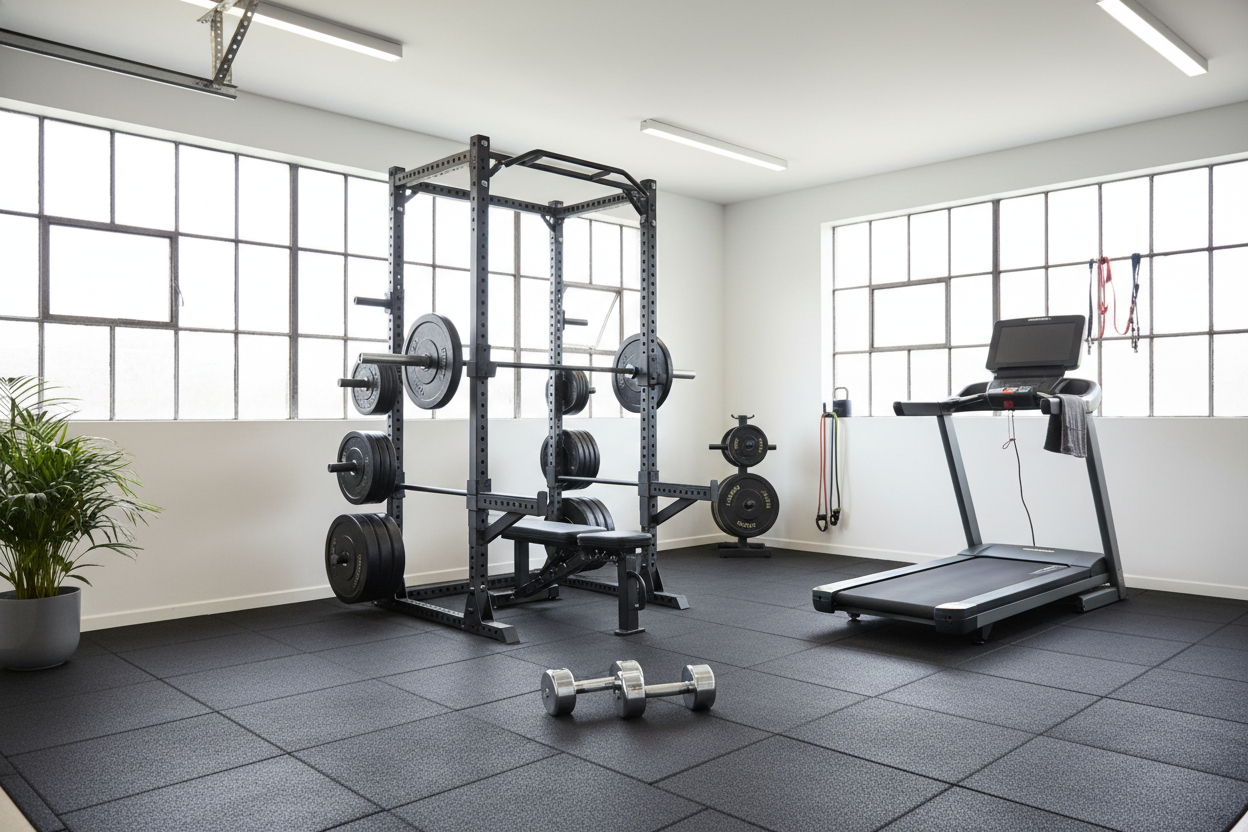
I remember the night I found a Cybex plate-loaded leg press on Facebook Marketplace for $350. It looked glorious in the grainy photos—industrial steel, heavy-duty upholstery, and that unmistakable 'big gym' vibe. I spent three hours trying to convince my wife that we didn't really need a second car in the garage. This is the siren song of commercial exercise equipment. We all want the gear we grew up using in the local powerhouse, but once that 600-pound beast is sitting on your driveway, the reality of commercial-grade ownership hits hard.
Quick Takeaways
- Commercial machines are usually fully welded and won't fit through standard 32-inch interior doors.
- Replacement parts for club-grade gear are expensive and often backordered for weeks.
- Industrial footprints can easily swallow 30-50% of a standard two-car garage.
- Modern high-end residential gear now offers 90% of the feel with 100% more practicality.
The Allure of the 500-Pound Club Machine
There is a specific psychological high that comes with building out a home gym. You start with a cheap barbell and some plastic plates, but eventually, you crave the stability of the stuff you used at the club. You want a frame that doesn't wobble when you're pushing for a PR. This leads most of us down the rabbit hole of searching for liquidated commercial fitness machines. It feels like a treasure hunt where the prize is a piece of equipment that will outlast your house.
We tell ourselves that buying 'the real stuff' is an investment. We see a $4,000 lat pulldown being sold for $500 because a gym went bankrupt, and we stop thinking about physics. We forget that those machines were designed for 20,000-square-foot warehouses with 15-foot ceilings and loading docks. In a residential setting, that 'investment' often becomes a massive, immovable paperweight that limits what else you can do in your training space.
What Nobody Tells You About Commercial Exercise Machines
The Craigslist ad never mentions the logistics. You see a commercial fitness machines listing and think about the gains, not the pallet jack you'll need to rent. These units are built for maximum uptime in a high-traffic environment, which means they are over-engineered to a fault for a home user. They are heavy, awkward, and notoriously difficult to move once they are off the truck.
Industrial Exercise Equipment Is Built for Warehouses, Not Garages
Let’s talk specs. Most industrial exercise equipment features a footprint that would make a sub-compact car jealous. A single commercial leg press can easily measure 8 feet long and 5 feet wide. When you factor in the 'working area' needed to actually load plates on the sides, you’ve lost half of a two-car garage to one single exercise. Unlike residential gear, commercial weight equipment is often fully welded. If it doesn't fit through your side door in one piece, you're either taking the door frame off or leaving the machine on the lawn.
Ceiling height is the other silent killer. I've seen guys buy a commercial functional trainer only to realize the top pulleys sit at 92 inches, while their garage ceiling is exactly 90 inches. You end up digging a hole in the drywall just to make the cables clear. It’s a mess that ruins the aesthetics and the resale value of your home.
The Frayed Cables and Bearings on Commercial Gym Machines
When you buy equipment for commercial gym use from a liquidator, you aren't getting a 'lightly used' piece. You are getting a machine that has endured tens of thousands of reps from people who didn't care about the equipment. Commercial gym machines often arrive with grit in the linear bearings and cables that are one heavy set away from snapping.
Finding replacement parts isn't as simple as a trip to the hardware store. You have to deal with commercial gym suppliers who are used to selling to huge franchises. They might not even talk to a guy in a garage, or they’ll charge you $200 for a proprietary pulley and another $100 for freight shipping. I once spent three months hunting for a specific cam for an old Nautilus machine. By the time I found it, I had lost all interest in using the piece.
When Does Buying Business Gym Equipment Actually Make Sense?
I’m not saying you should never buy business gym equipment. If you have a 2,000-square-foot pole barn with a concrete slab thick enough to support a tank, go for it. If you are a competitive bodybuilder who absolutely needs a specific commercial workout equipment piece—like a Pendulum squat or a specific belt squat—to stay competitive, then the footprint is a secondary concern. But for the guy just trying to stay fit and hit some heavy triples, the trade-off usually isn't worth the headache.
The Smarter Play: High-End Gear Built for the Home
The equipment market has changed. Ten years ago, you had to buy commercial workout machines if you wanted 11-gauge steel. Today, companies are building commercial strength equipment specs into residential footprints. You can get a rack with 3x3 inch uprights and 1-inch holes that fits perfectly under an 8-foot ceiling.
You might ask, can a Marcy Smith machine actually replace a commercial gym? If you pick the right model, the answer is a resounding yes. Modern residential engineering allows a Smith machine home gym station to provide the same guided-path safety and heavy weight capacity as gym equipment commercial units, but with added features like integrated pull-up bars and storage pegs.
Choosing fitness commercial equipment for a home space often feels like buying a semi-truck to commute to the office. It’s cool, but it’s overkill and a pain to park. By sticking with high-end gear designed as fitness equipment for commercial gyms but scaled for the home, you get the durability without the industrial-sized regret.
My Personal Gear Mistake
I once bought a used Life Fitness G7 functional trainer from a hotel liquidation. It looked great, but the weight stacks were capped at 160 lbs per side. For a commercial unit, it was 'light,' but it still weighed 700 lbs. I had to take it apart into a thousand pieces just to get it into my basement. Two years later, when I moved houses, I ended up leaving it there because the thought of moving it again made my back hurt more than a heavy set of deadlifts. I replaced it with a compact residential unit that has a higher weight-to-pulley ratio and takes up half the space. I've never looked back.
FAQ
Is commercial gear more durable?
Yes, it's built for 24/7 use. However, for a home user training 5-10 hours a week, high-end residential gear will still last 20+ years without the maintenance headaches.
Will commercial machines fit through a standard door?
Rarely. Most commercial pieces are 34-40 inches wide and fully welded. Always measure your entry points before buying, or you'll be stuck with a driveway gym.
Are the weight stacks heavier on commercial machines?
Often, yes. But remember that many commercial machines use 2:1 or 4:1 pulley ratios, meaning a 200-lb stack might only feel like 100 lbs or 50 lbs of actual resistance.
Share:
I Trained Exclusively on the Best All-In-One Home Gym for 30 Days
I Wasted $1,000 on Home Gym Equipment for Beginners. Learn from Me.