
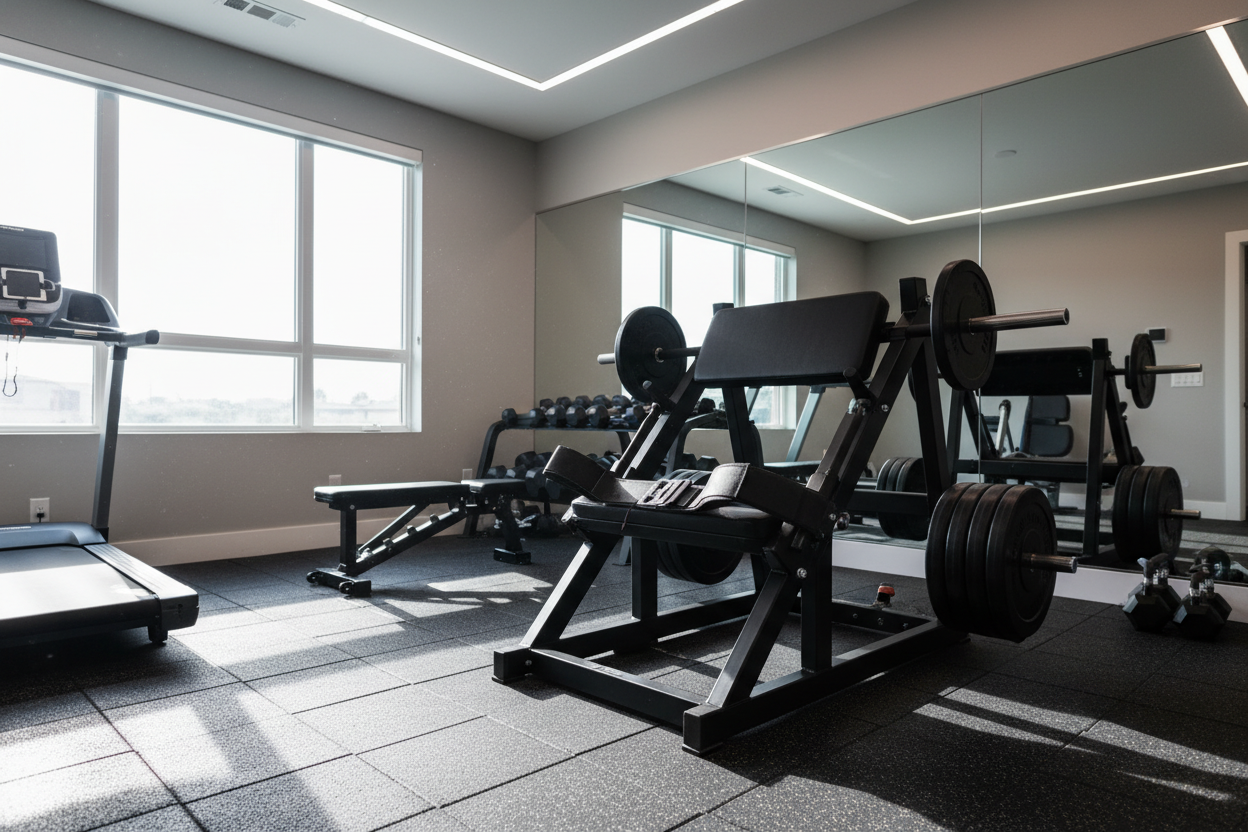
There is a specific kind of heartbreak that happens when you cancel your commercial gym membership to build a garage gym. You love the freedom, but you start to realize that some of those massive, over-engineered pieces of steel were actually doing a lot of the heavy lifting for your physique. For me, it was the anytime fitness hip thrust machine.
I spent months trying to replicate that specific, brutal glute pump using a barbell and a wobbly bench. It wasn't the same. The commercial units have a mechanical advantage that a free-rolling bar just can't touch. But after testing several setups in my own 400-square-foot space, I found that you don't need a commercial lease to get those results.
- Commercial machines use a fixed pivot point to keep tension on the glutes, not the spine.
- The oversized pelvic pads on gym units prevent the 'bone-crushing' feeling of heavy barbells.
- Buying a name-brand commercial unit for a home gym is usually a $3,000 mistake.
- Smith machines and compact dedicated units are the most efficient ways to bridge the gap.
Why That Commercial Glute Drive Feels So Different
The anytime fitness hip thrust machine—usually a Nautilus Glute Drive or a Matrix unit—is a masterpiece of biomechanics. Unlike a barbell, which requires you to stabilize the weight in three dimensions, these machines use a fixed arc. This means the resistance curve is perfectly matched to your hip extension.
The oversized pad is the secret sauce. In a commercial setting, that pad is often 4 inches thick and contoured. It distributes 300+ pounds across your pelvic bone so you can actually focus on the contraction instead of wondering if you're going to need a hip replacement by age 40. The pivot point is also aligned with your hips, ensuring the weight doesn't 'fall off' at the top of the movement.
Can You Just Buy the Hip Thrust Machine Anytime Fitness Uses?
You can, but you probably shouldn't. If you look for the exact hip thrust machine anytime fitness puts on their floor, you're looking at a $3,000 to $4,500 bill before shipping. These things are tanks. They are built to survive 18 hours of daily abuse from people who don't respect equipment.
Beyond the price, the footprint is a killer. A Nautilus Glute Drive is roughly 5 feet wide and 6 feet long. In a standard two-car garage, that is prime real estate. Unless you are a competitive bodybuilder whose entire personality is built on glute medius development, dedicating that much floor space to a single-station machine is a poor ROI for your training.
The Awkward Reality of the Barbell Alternative
We've all tried the 'budget' way. You drag a bench against a power rack so it doesn't slide, spend ten minutes wrestling a loaded barbell over your legs, and then realize you forgot your squat pad. It’s a mess. The bar rolls, the plates clatter, and the setup time is longer than the actual set.
I once tried to go heavy on a standard flat bench and the whole thing tipped backward because I didn't have it anchored. It was embarrassing and dangerous. That friction—both physical and mental—is why most home lifters eventually stop doing hip thrusts altogether. We need a solution that feels like the commercial version but fits a residential reality.
Two Realistic Ways to Hack the Commercial Pump at Home
You don't need to spend four figures to get a smooth lockout. Here are the two best ways I’ve found to get that Anytime Fitness feel without the commercial price tag.
Method 1: The Smith Machine Setup
If you already have a Smith machine in your rack, you're 80% of the way there. The Smith machine mimics the fixed vertical path of a commercial unit. The trick is your foot placement. If your hip thrust on Smith machine feels awkward, you likely have your feet too close to the bench, which shifts the load to your quads.
Use a thick bar pad—something like a 1.5-inch high-density foam—and set your bench so your shoulder blades pivot on the edge. Because the bar is on a track, you can focus entirely on the squeeze at the top, just like you would on the Matrix machine at the club.
Method 2: Compact Dedicated Units
If you want the exact feel of a belt-driven commercial unit, look at a dedicated home hip thrust machine. These are built with a much smaller footprint, usually around 4x4 feet, and use a heavy-duty belt or a padded arm instead of a barbell.
I prefer the belt-style home units because they allow for slight natural variances in your hip path while still providing that 'locked-in' feeling. They also tend to have plate horns that can handle 300-500 lbs, which is more than enough for 99% of the population. They give you the oversized padding you miss from the gym without requiring a forklift to move.
Making the Final Call on Your Floor Space
Before you pull the trigger, look at your floor plan. Are you okay with a machine that only does one thing? When comparing leg press and hip thrust machines, the leg press is usually more versatile, but the hip thrust machine is better at its specific job.
If you're training in a tight 10x10 bedroom, stick to the Smith machine or a high-quality bench link. But if you have the room, a dedicated glute station is the single best way to ensure you actually do the work. Stop bruising your hips with a bare barbell and build a setup that actually makes you want to train.
FAQ
Is a hip thrust machine better than a barbell?
For pure isolation, yes. The fixed path and better padding allow you to push closer to failure without worrying about balancing the weight or crushing your hips.
How much weight should I use on a home hip thrust machine?
Start with about 50% of your barbell max. Because the machine isolates the glutes more effectively, you won't be able to 'cheat' with your lower back as easily.
Can I use a resistance band instead?
Bands are great for warm-ups, but they don't provide the heavy mechanical tension needed for significant growth. You need plates for that.
Share:
Why Most Weightlifting Machines for Sale Online Are Complete Junk
Dedicated Gear vs. A Combo Exercise Machine: The Garage Gym Showdown