
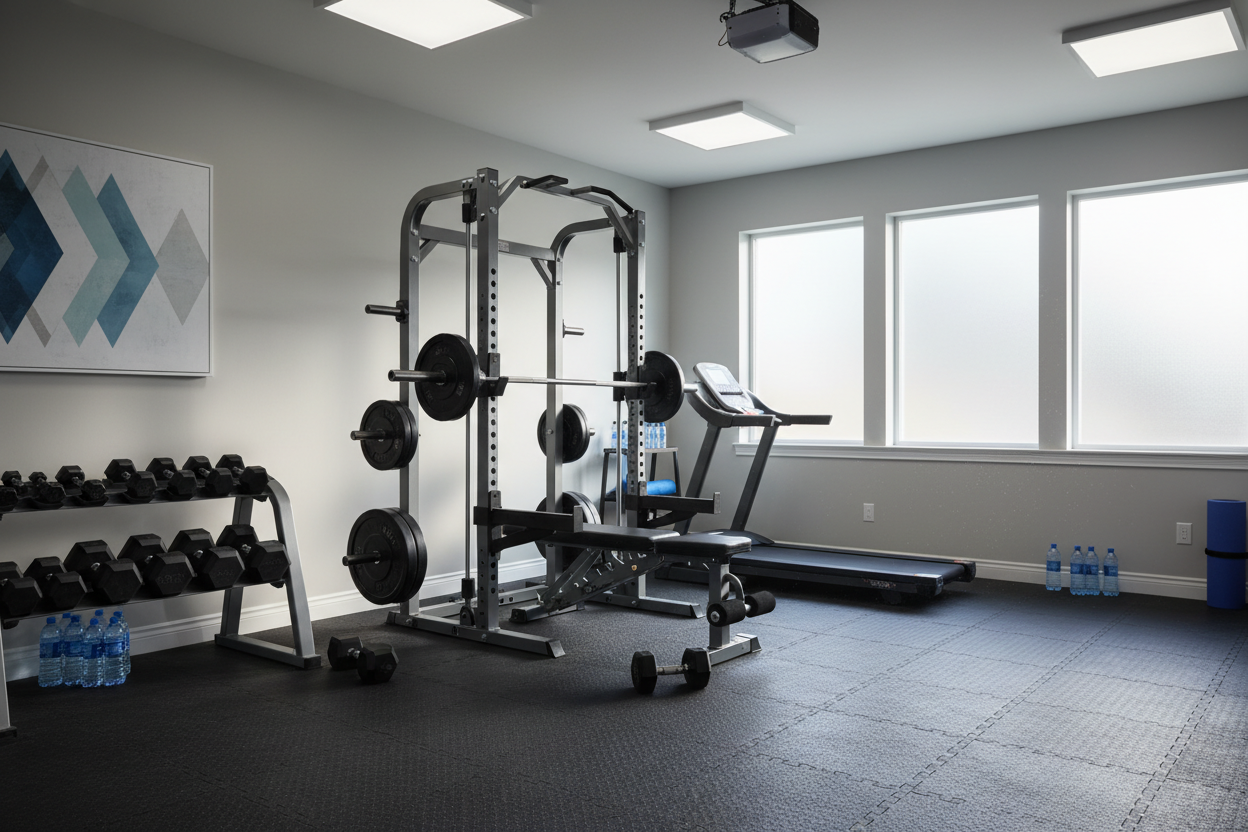
I remember the day my Marcy rig arrived. I spent four hours in a cold garage, surrounded by cardboard and half-tightened bolts, wondering if I’d just bought a very expensive clothes hanger. For the first few months, I treated it like a basic bench station. I was bored, my progress stalled, and I almost sold it on Marketplace for half what I paid.
Then I stopped trying to lift like I was using a power rack and started using the machine for what it actually is: a tool for high-intensity isolation and safe failure. If you are only using marcy smith machine exercises to mimic a flat bench press, you are leaving 70% of your gains on the table. You don't need a 2,000-square-foot commercial space to get big; you just need to stop being lazy with your programming.
Quick Takeaways
- Stop treating the Smith machine like a barbell; use the fixed path to target specific muscle groups without stabilizer fatigue.
- Adjust your foot placement forward on squats to save your knees and torch your quads.
- The safety stops are your best friend—use them to train to absolute failure without a spotter.
- Keep your guide rods lubed with silicone spray; friction is the enemy of a smooth rep.
You Are Probably Underutilizing Your Marcy Rig
Most home gym owners treat their Marcy rig like a glorified bench press station. They hop in, do a few sets of chest press, and then complain that they miss the 'freedom' of a barbell. But the fixed bar path isn't a limitation; it's a feature. It allows you to put your body in positions that would be physically impossible—or incredibly dangerous—with a free-standing bar.
When you're trying to decide if one piece of gear can replace a commercial gym, you have to look at the biomechanics. Because the bar is on tracks, you don't have to worry about the weight drifting forward or backward. This means you can focus 100% of your mental energy on the muscle contraction rather than balancing the load. It’s the difference between surviving a set and actually training a muscle.
Lower Body: Marcy Smith Machine Exercises That Don't Wreck Your Knees
If you have 'crunchy' knees, traditional back squats can be a nightmare. On a Marcy rig, you can walk your feet out 6 to 12 inches in front of the bar. This shifts the load from your lower back and knees directly onto your quads. I call these 'constant-tension hack squats,' and they will leave your legs shaking in a way a standard squat never could.
The versatility of a smith machine really shines when you move into single-leg work. Reverse lunges on a Smith machine are elite. Because you aren't wobbling side-to-side trying to balance, you can go significantly heavier. I’ve found that my glute activation nearly doubles when I don't have to worry about falling over mid-rep. Set the safety catches just below your bottom range of motion so you can bail safely if your legs give out.
Upper Body Builders: Beyond the Flat Bench
Let's talk about the seated overhead press. Doing this on a Smith machine allows you to set the bench at a 75-to-80-degree angle—just slightly off-vertical. This takes the stress off the acromion process in your shoulder while still hammering the anterior delts. It’s a movement that feels much more natural on a fixed track than with a shaky barbell over your head.
Don't forget the back. You can lock the bar at waist height and perform inverted rows. Since the bar is fixed, it’s much more stable than using a TRX or a loose barbell in a rack. For the best results, use a slow eccentric (the way down) and a hard squeeze at the top. If your Marcy model has a built-in cable system, you can superset these with face pulls for a complete posterior chain pump.
Putting It Together: Marcy Smith Machine Workouts
To see real growth, you need to structure your marcy smith machine workouts into a repeatable split. I’m a fan of a 4-day 'Upper/Lower' split. Monday is heavy upper body (presses and rows), Tuesday is quad-dominant lower body (hack squats and lunges), Thursday is volume upper body (inclines and high-rep rows), and Friday is posterior-chain lower body (RDLs and calves).
If you are working on a full body multi training station, you have the added benefit of pulleys. Use the Smith bar for your primary compound lift, then immediately jump to the cables for isolation work. This 'pre-exhaust' method is how you make a home workout feel like a pro bodybuilding session. Keep your rest periods under 90 seconds to maintain the intensity.
Is Your Current Rig Smooth Enough for Heavy Volume?
Nothing kills a workout faster than a jerky bar path. If you feel the bar 'catching' or stuttering during your descent, your linear bearings are crying for help. I’ve found that a quick wipe-down of the guide rods followed by a thin coat of PTFE or silicone spray makes a world of difference. Don't use WD-40; it’ll just gum up the works over time.
I remember when I first built the Marcy Smith machine SM-4008, I was frustrated by the slight friction in the carriage. It took about two weeks of heavy use and some proper lubrication for it to break in. If you've been using your rig for a year and it still feels 'sticky,' it might be time to check the alignment of your uprights. Even a quarter-inch of misalignment can cause the bar to bind under heavy loads.
My Honest Mistake
Early on, I tried to do 'behind the neck' presses because I saw some old-school bodybuilder doing them on YouTube. Bad move. The fixed path of the Smith machine is unforgiving. If your mobility isn't perfect, the machine will force your joints into positions they aren't ready for. Stick to movements that feel natural to your frame. If it hurts your joints, stop. The machine won't move for you; you have to move with the machine.
FAQ
Can you build muscle with just a Smith machine?
Absolutely. Muscle doesn't know if a bar is on a track or free-floating; it only knows tension. By using higher volume and shorter rest periods, you can trigger massive hypertrophy on a Marcy rig.
Is the Marcy Smith machine bar 45 pounds?
Usually not. Most Marcy Smith bars are counterbalanced or made of lighter steel, often weighing between 15 and 25 pounds. Check your specific manual, but always start lighter than you think until you find the 'zero' point.
How do I stop the machine from sliding on my floor?
Bolt it down if you can. If you're on a concrete garage floor and can't drill, use high-density rubber stall mats. The weight of the machine plus your plates should keep it anchored, but aggressive re-racking can cause 'creep' over time.
Share:
Stop Trying to Cram Commercial Gyms Equipment Into a Spare Room
Your Neighbors Hate You: Quiet Exercise Equipment for Apartment Living