
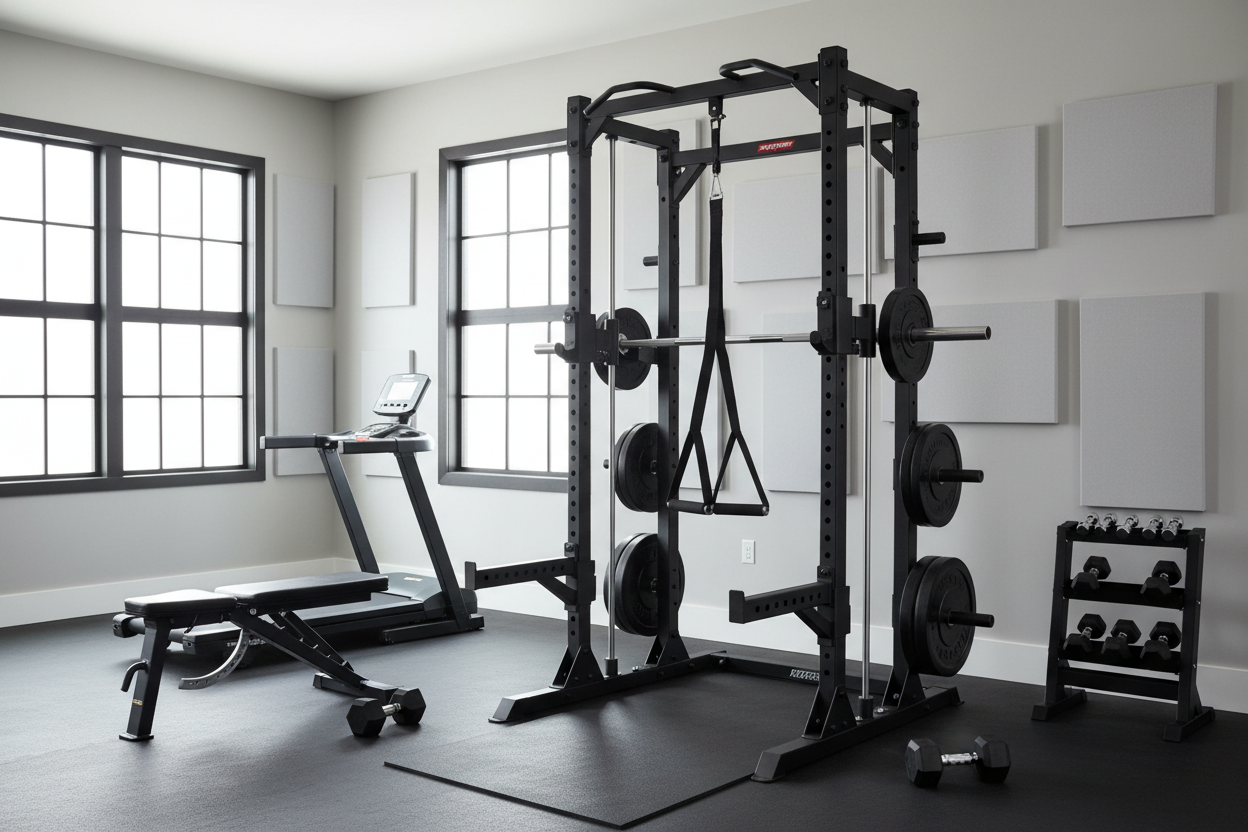
I spent years performing hundreds of bodyweight crunches on a thin yoga mat, wondering why my midsection looked flat despite the agonizing 'burn.' It was a classic home gym mistake. I was treating my abs like an endurance muscle rather than a strength muscle. If you want those deep, blocky abdominal ridges that actually show through a shirt, you have to stop chasing the pump and start chasing the load. A proper smith machine ab workout is the fastest way to bridge that gap.
- Progressive Overload: Easily add 2.5 or 5-lb plates to track real strength gains.
- Stability: The fixed path eliminates the 'wobble,' letting you focus purely on the contraction.
- Safety: Built-in safety catches mean you can push to absolute failure without a spotter.
- Versatility: One machine handles everything from heavy crunches to hanging raises.
Why Your Bodyweight Core Routine Is Failing You
Most home ab routines are basically cardio sessions in disguise. If you're knocking out sets of 50 or 100 unweighted sit-ups, you aren't building muscle; you're building endurance. Think about it: you wouldn't expect to grow massive quads by doing 100 bodyweight squats daily. You'd get under a bar and add weight. Your rectus abdominis is a skeletal muscle like any other, and it requires mechanical tension to hypertrophy.
The problem with high-rep floor work is that your hip flexors often take over once the abs fatigue. By the time you hit rep 30, your midsection is just along for the ride while your psoas does the heavy lifting. This leads to tight hips and a sore lower back, but very little abdominal growth. To see smith machine abs, you need to shorten the rep range to 8-15 and increase the resistance. You need to force the muscle fibers to thicken to handle the stress.
Furthermore, floor work lacks a consistent resistance curve. A standard crunch is hardest at the very top and almost effortless at the bottom. By using a Smith machine, you can manipulate the angle and the load to keep tension on the muscle through a larger range of motion. It’s about quality of contraction, not the quantity of reps you can brag about on a fitness app.
The Secret to Smith Machine Abs: Complete Stabilization
The primary reason I prefer the Smith machine for core work over a free-weight barbell is stabilization. When you’re holding a loose barbell over your chest for a weighted crunch, half your brain power is spent making sure you don't drop the bar on your face or tip over sideways. That 'noise' prevents you from achieving a true mind-muscle connection with your core. The fixed track of the Smith machine removes the need for balance, allowing you to drive 100% of your effort into spinal flexion.
This stabilization is also a back-saver. Because the bar moves on a vertical (or slightly angled) plane, you can position your body so the force is directed straight through your core. You don't have to worry about the bar drifting forward and putting shear force on your lumbar spine. This is why I often include these moves in a full Smith machine workout guide; it’s the most efficient way to isolate a muscle group without secondary stabilizers giving out first.
Another benefit is the ability to use 'micro-loading.' Most Smith machine bars are counterbalanced to weigh around 15 to 25 pounds, but some high-end commercial units feel like zero. This allows you to start light and precisely add weight as you get stronger. In my experience, being able to jump from 10 lbs to 12.5 lbs of added resistance is what actually creates long-term progress, rather than just doing 'more reps' of the same easy bodyweight move.
The 4-Move Smith Machine Ab Workout
Here is the deal: this isn't a circuit you breeze through in five minutes. This is a dedicated strength block. You need to treat these moves with the same respect you give your bench press or squat. Proper setup is the difference between a shredded midsection and a strained neck. Most guys rush the positioning and end up using their arms to push the bar. Don't be that guy.
Before you start, check your machine's safety catches. You'll be lying directly under the bar for several of these, and I've seen enough 'gym fail' videos to know that skipping the safeties is a recipe for disaster. Set them so the bar can't crush your chest if your grip slips or your core gives out. Focus on slow, 3-second eccentrics (the lowering phase) to maximize the time under tension for smith machine core exercises.
1. The Heavy Fixed-Bar Crunch
Slide a flat bench under the bar. Lie down so the bar is directly over your upper chest/shoulders. Reach up and grab the bar with a shoulder-width grip. Now, here is the trick: do not 'press' the bar with your triceps. Keep your arms locked or slightly bent and use your abs to curl your ribcage toward your pelvis, pushing the bar upward along the track.
Common mistake: turning this into a narrow-grip bench press. If your elbows are flaring and your chest is pumping, you're doing it wrong. Your arms should act as nothing more than hooks connecting the weight to your torso. Set the safety stops just below your starting position. I like to aim for 3 sets of 10-12 reps. If you can hit 15 reps with perfect form, it is time to slide a 10-lb plate onto each side.
2. The Smith Machine Reverse Crunch
Set the bar to the lowest possible setting—usually a few inches off the floor. Lie on your back with your head near the bar and reach back to grab it. This provides a rock-solid anchor point. Unlike holding onto a wobbly bench or a pair of light dumbbells, this bar isn't moving. This allows you to pull against the bar, which engages the lats and creates a stable 'upper' base to move your 'lower' half.
Lift your legs and curl your hips off the floor, bringing your knees toward your chest. The key here is the eccentric. Don't just let your hips flop back down. Fight the gravity for a slow 3-count on the way down until your tailbone just grazes the floor. Using the Smith machine as an anchor allows for a much steeper hip incline if you decide to do these on a decline bench later on.
3. The Locked-Out Hanging Leg Raise
Rack the bar at its highest point. Most Smith machines have a max height that works perfectly as a pull-up bar. The bar diameter on a Smith machine is typically thicker than a standard pull-up bar (often 30mm to 32mm), which actually helps with grip comfort during core work. Just like when you're doing a back workout on Smith machine, you'll feel your lats and serratus fire as you hang.
From a dead hang, pull your toes toward the bar without swinging. Because the bar is fixed and won't rotate like some cheap pull-up handles, you can really dig your palms in. If your grip gives out before your abs, use some lifting straps. We aren't here to train forearms; we are here to build a bulletproof core. Aim for 3 sets to failure, focusing on keeping your legs as straight as possible.
4. The Fixed-Track Rollout
This one is brutal. Set the bar to about knee height. Wrap a barbell pad around the center. Stand facing the bar, grab it with an overhand grip, and 'roll' the bar forward as you lean your body toward the floor. If you have a 3D Smith machine (one that moves horizontally and vertically), this is a smooth, natural motion. On a standard Smith, you'll be using the bar as a pivot point for a 'fallout' style move.
Keep your glutes squeezed and your lower back flat. Do not let your spine arch, or you'll feel it in your vertebrae the next morning. If you find the standard version too easy, lower the bar closer to the floor. The lower the bar, the more bodyweight you have to support. This move is the ultimate test of 'anti-extension' strength, which is what gives your abs that 'tight' look even when you aren't flexing.
Programming These Smith Machine Core Exercises
Don't tack these onto the end of a 2-hour leg day when you're already exhausted. If you want results, prioritize them. I recommend picking two of these movements and performing them at the start of your 'push' or 'pull' days twice a week. This ensures you have the neurological energy to actually move heavy weight.
For the Fixed-Bar Crunch and the Rollout, stay in the 8-12 rep range. These are your 'strength' moves. For the Reverse Crunch and Hanging Leg Raise, you can push into the 15-20 rep range to focus on metabolic stress. The goal is progressive overload. If you did 10 reps with 20 lbs last week, try 11 reps or 25 lbs this week. That is the only way to grow the muscle.
My personal favorite split is doing the Heavy Fixed-Bar Crunch on Monday and the Hanging Leg Raises on Thursday. This hits the core from both the 'top-down' and 'bottom-up' perspectives. Remember, your abs are hidden under a layer of fat, so while these exercises build the muscle, you still need to keep your diet in check to see the fruits of your labor.
Is Your Current Rig Sturdy Enough for Heavy Core Work?
If you're training at home, the quality of your machine matters immensely for these moves. A 'sticky' track with cheap bushings will ruin the fluid motion of a crunch or rollout. You want a home gym Smith machine that utilizes linear bearings—this ensures the bar glides smoothly even when you're applying uneven pressure. If the bar catches or stutters, you'll lose the mind-muscle connection immediately.
Safety is the other big factor. When you're doing heavy weighted crunches, you are lying in a vulnerable position. Ensure your rack has heavy-duty safety stoppers that can be adjusted in small increments. Some cheaper units only have a few lockout holes, which might be too high or too low for your specific arm length. A high-quality Smith machine with cable crossover is often the best 'all-in-one' solution because it also allows you to add kneeling cable crunches to your routine for even more variety.
I’ve tested dozens of these setups, and the ones that use 11-gauge steel frames are the only ones I trust when I'm loading up multiple 45-lb plates. If your current rack shakes when you're just racking the bar, it’s probably not the best place to be doing explosive core work. Invest in a rig that stays planted, so you can focus on the contraction instead of whether the whole machine is going to tip over.
Personal Experience: The Day I Ditched the Mat
I used to be a 'purist' who thought Smith machines were for people who couldn't handle real weights. Then I tried to do a 100-lb weighted crunch with a free barbell. I almost rolled off the bench, the bar was tilting, and my hip flexors were doing 90% of the work just to keep me balanced. I swallowed my pride, moved over to the Smith machine, and for the first time in my life, I felt my upper abs actually cramp from the intensity. I haven't gone back to floor crunches since. My only mistake was not setting the safety catches high enough on my first heavy set—I ended up pinned for a second before I could slide out. Set your safeties, people.
FAQ
Can I do a Smith machine ab workout every day?
No. Your abs are a muscle group like your chest or biceps. They need time to recover and grow. Train them 2-3 times a week with high intensity rather than every day with low intensity.
What if the bar is too heavy to start?
Most Smith machine bars are counterbalanced to feel light (15-25 lbs). If that's still too heavy for a crunch, start with the Reverse Crunch where the bar is just an anchor point, or use a machine with a higher counterbalance ratio.
Will this workout give me a six-pack?
It will build the muscle 'blocks' of a six-pack. However, you'll only see them if your body fat percentage is low enough. You can't spot-reduce fat, but you can definitely make the muscles underneath more prominent.
Share:
Is a Multi Smith Machine a Master of None? (My Honest Take)
Is a Budget Cap Dumbbell Weight Set Actually Enough for a Home Gym?