
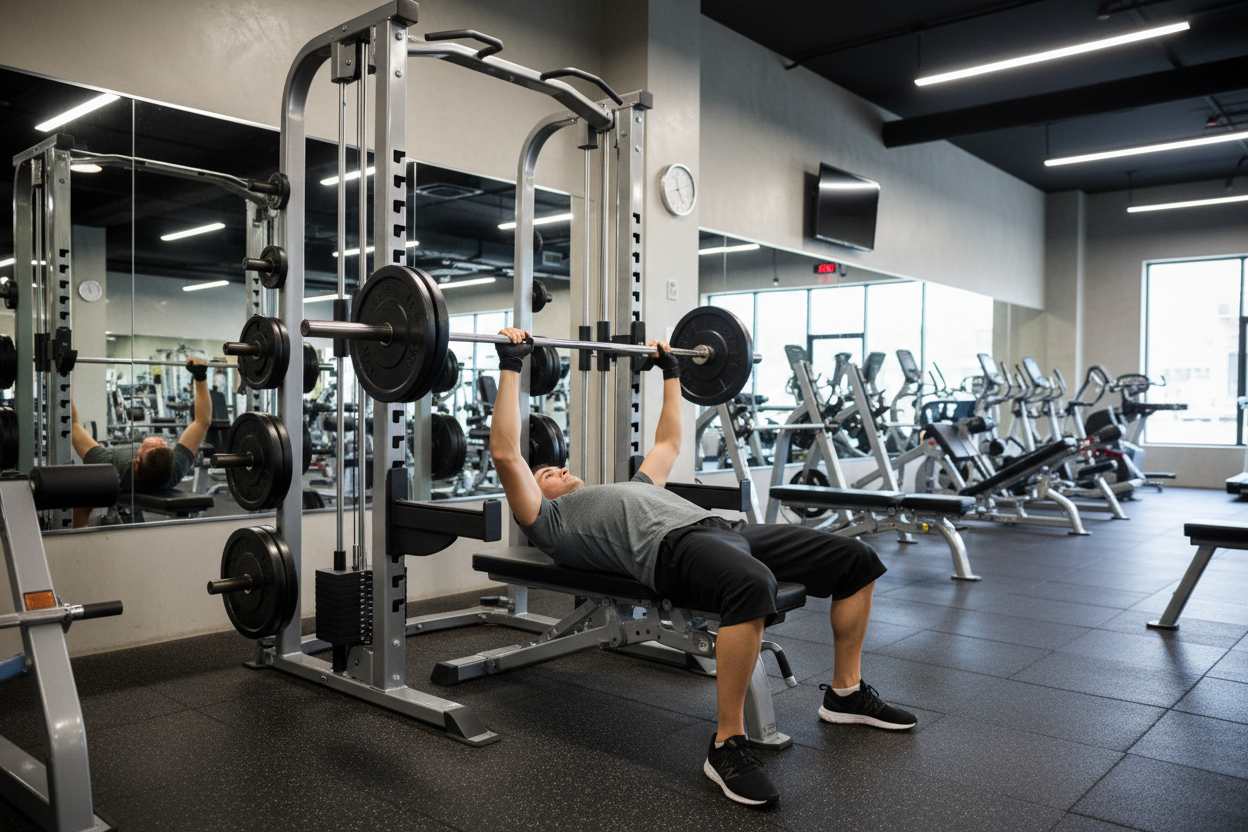
Walk into any commercial gym and you'll witness it eventually. Someone sets up on the Smith machine for bench press and gets an unsolicited opinion from a nearby lifter about how they should "use the real thing." Maybe that's happened to you. Maybe you've been the one doing the judging.
I've been on both sides of that conversation.
After years of coaching clients ranging from complete beginners to competitive powerlifters, I've stopped treating this as a debate with a clear winner. The Smith machine bench press and the barbell bench press are different tools that do different things — and understanding those differences is what allows you to make an intelligent choice for your own training.
Let's break it down completely.
The Core Mechanical Difference
Before comparing results, you need to understand what's actually different between the two movements.
A barbell bench press requires you to control the bar in three dimensions. It can drift forward, back, left, or right. Your rotator cuff, serratus anterior, and a network of smaller stabilizing muscles work constantly to keep the bar on a safe path. This is demanding — and that demand is part of the training stimulus.
A Smith machine bench press locks the bar onto fixed vertical or slightly angled rails. The path is predetermined. You push straight up (or at whatever angle the rails are set to), and the machine handles lateral and horizontal stability for you. Your muscles still work hard — but they work differently.
This single mechanical difference explains nearly every practical comparison between the Smith machine bench press vs. barbell bench press.
Smith Machine Bench Press vs. Barbell: Muscle Activation
This is the question most lifters care about most, and the research here is genuinely interesting.
Studies examining muscle activation during the Smith machine bench press vs. regular bench press consistently find that the free barbell activates more total muscle mass — particularly in the deltoids, serratus anterior, and stabilizing muscles of the rotator cuff. The chest and triceps activation is largely comparable between the two.
What this means practically:
- If your goal is overall upper body strength and athleticism, the barbell bench press provides a more complete training stimulus.
- If your goal is chest and triceps hypertrophy with precise isolation, the Smith machine can match or even exceed the barbell in targeted muscle development.
- For the pecs specifically, the difference is smaller than most people assume.
In my own training, I've noticed that the Smith machine actually allows me to feel my chest working more directly on certain days — precisely because I'm not mentally managing bar path stability. That mind-muscle connection matters for bodybuilding-style goals.
Smith Machine vs. Bench Press: Weight Difference
This is one of the most practically important — and most misunderstood — aspects of the comparison.
When people first switch from the barbell to the Smith machine, or vice versa, they're often confused by how the numbers don't transfer directly. Here's why.
The bar itself: A standard Olympic barbell weighs 45 lbs (20 kg). Smith machine bars vary wildly by manufacturer — many weigh between 15 and 25 lbs, and some counterbalanced Smith machines have bars that feel almost weightless. If you don't know the weight of your gym's Smith machine bar, check the manufacturer specs or ask staff.
The mechanical advantage: Because the Smith machine eliminates the need to stabilize the bar, you're doing less total work per rep even if the plate load is identical. Some research suggests the effective load difference can be in the range of 15–20%, though this varies based on the individual and the specific exercise.
The practical takeaway on Smith machine vs. barbell bench press weight difference: Don't be discouraged if you can lift more on the Smith machine — and don't be surprised if your Smith machine numbers don't directly translate to your barbell numbers. They're measuring different things.
When I program both for clients, I track them as separate lifts with their own progression tracks. Trying to make one predict the other leads to frustration.
Smith Machine Bench vs. Regular Bench: Safety
This is where the Smith machine has a genuine, undeniable advantage.
Training alone without a spotter is a real-world scenario for a huge percentage of gym-goers. The Smith machine safety hooks mean you can take a set to absolute failure — getting stapled by the bar — and simply rotate your wrists to rack it safely. No spotter needed. No failing to roll the bar down to your stomach as a last resort.
On the barbell bench press without a spotter, your options when you miss a rep are: set the bar on your chest and hope you can roll it, dump it off one side (damaging the plates and flooring), or get someone's attention. None of these are great.
This safety advantage has real implications for training effectiveness. If you can train closer to failure safely on the Smith machine, you may actually accumulate more productive volume per session than you would on a barbell where you're leaving reps in reserve as a safety buffer.
I personally noticed this when I started using the Smith machine for my second bench press movement in a session — already pre-fatigued from barbell work, I could push the Smith machine sets harder because I knew the hooks were there.
Smith Machine Incline Press vs. Barbell: Is There a Difference?
The incline variation follows the same general logic as the flat bench comparison, with one additional nuance.
On a barbell incline press, the natural bar path is slightly back toward the face as you press from the lower chest to lockout. Good lifters learn to accommodate this arc naturally. On a Smith machine incline press, the bar travels in a fixed straight line — which actually aligns reasonably well with the pressing mechanics on an incline.
This means the Smith machine incline press vs. barbell comparison is actually more favorable to the Smith machine than the flat bench comparison. The fixed path interferes less with natural pressing mechanics on an incline, making it one of the scenarios where the Smith machine performs closest to the free barbell.
For upper chest development specifically, the Smith machine incline is an excellent tool — the controlled path allows you to really emphasize the stretch and contraction of the upper pec without fighting bar drift.
Smith Machine Bench vs. Free Weight: When Each One Wins
Rather than declaring a winner, here's an honest breakdown of when each option serves you better.
Choose the Barbell Bench Press When:
You're training for powerlifting or strength sports. Competition uses a free barbell. Your training needs to reflect that. The stabilization demands, bar path management, and full-body tension of the barbell bench are non-negotiable for serious strength athletes.
You want maximum upper body muscle recruitment. The barbell bench press trains more total musculature per rep. Over time, this compounds into more comprehensive upper body development.
You're building a foundation. Learning to control a free barbell builds proprioception, joint stability, and movement patterns that carry over to everything else you do in the gym and in life.
You have a spotter. The barbell bench press with a competent spotter is a superior training experience — more natural mechanics, full stabilizer engagement, and the safety net covered.
Choose the Smith Machine Bench Press When:
You train alone and want to push sets hard. The safety hook system makes going to failure genuinely safe. This is the single biggest practical advantage of the Smith machine bench press vs. regular bench press for solo lifters.
You're in a hypertrophy phase focused on the chest and triceps. The isolation effect works in your favor. You can pile volume onto the target muscles with less systemic fatigue from stabilizer demands.
You're working around an injury. Shoulder impingement, rotator cuff irritation, and AC joint issues are often better tolerated on the Smith machine where the bar path is controlled and you can adjust your position precisely. Always consult a physical therapist or sports medicine physician before training around an injury.
You want a reliable second movement. The Smith machine bench press shines as a secondary exercise after heavier barbell work — when your stabilizers are already fatigued, the Smith machine lets your chest and triceps keep working hard without the injury risk of a compromised free-weight press.
You're a beginner learning the pressing pattern. The guided bar removes one layer of complexity while the foundational pattern is being established.
A Practical Programming Approach: Using Both
Here's how I personally structure pressing in my own training and how I often program it for intermediate to advanced clients:
Day 1 (Strength focus): Barbell Bench Press — 4 sets x 4–6 reps (heavy, spotter or safety bars)
Day 2 (Hypertrophy focus): Smith Machine Bench Press — 4 sets x 10–12 reps (controlled tempo, taken close to failure) Smith Machine Incline Press — 3 sets x 12 reps
This approach captures the stabilization and strength benefits of the barbell while using the Smith machine's safety and isolation advantages for volume work. The two movements complement each other rather than compete.
Addressing the Most Common Arguments
"The Smith machine causes injury because of the fixed bar path."
This concern has some merit, but it's overstated. Injury on the Smith machine typically comes from poor positioning — specifically, placing your body in a position relative to the bar that would never occur with a free weight. If you position yourself as you would for a natural pressing motion, the fixed path poses minimal added risk for most people.
"You can't build real strength on the Smith machine."
Muscle tissue doesn't know whether the bar guiding it is free or fixed. Progressive overload on the Smith machine builds real muscle and real strength — just with a different stabilizer profile than the barbell. Dismissing Smith machine strength gains is more gym mythology than exercise science.
"Smith machine bench press numbers don't mean anything."
They mean something — just not the same thing as barbell bench numbers. Smith machine bench press vs. barbell bench press numbers represent different qualities. Both are worth tracking and progressing.
The Bottom Line on Smith Machine Bench Press vs. Barbell Bench Press
After years of coaching and personal experience with both movements, here's my honest synthesis:
The barbell bench press is the superior movement for overall upper body strength, athletic development, and anyone competing in strength sports. It trains more muscle, builds more functional stability, and develops the pressing pattern in its most complete form.
The Smith machine bench press is a legitimately excellent tool for hypertrophy-focused training, solo lifters who want to train safely to failure, injury management, and as a complement to barbell work in a well-designed program.
The difference between Smith machine and bench press isn't good versus bad. It's specific versus general, isolated versus comprehensive, safe-to-fail versus fully loaded.
Use the right tool for the right goal. And stop judging what other people are pressing.
This article is based on personal training experience and coaching practice. Always consult a qualified professional before beginning a new training program or training around injury.
Share:
Why I Stopped Pretending the Gravitron Machine Is Cheating
Bulgarian Split Squat: The Complete Guide to the Most Effective Leg Exercise You're Probably Avoiding