
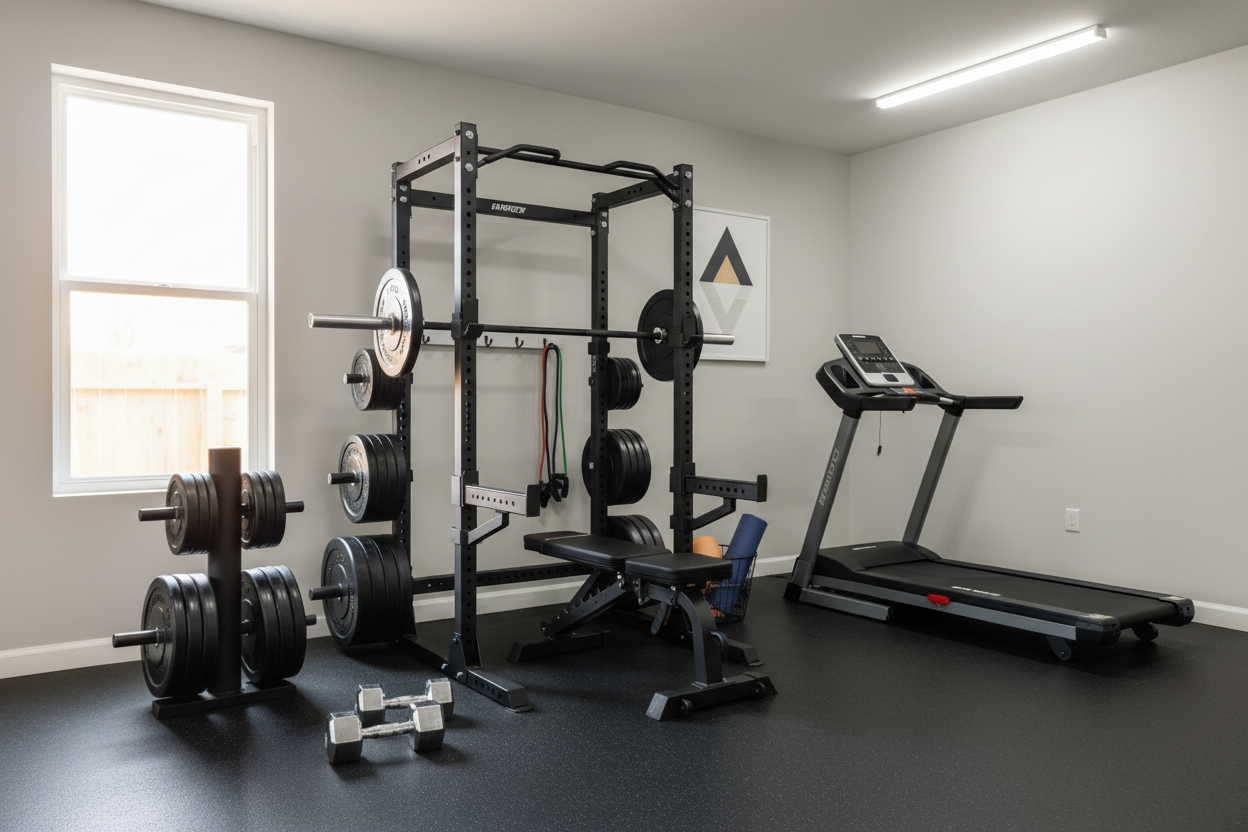
I have spent the better part of a decade dragging barbells across concrete and testing every 'revolutionary' piece of gear that hits the market. Most of it is overpriced garbage. I have seen people spend $5,000 on a multi-stack machine that ends up holding laundry because it is too clunky to actually use. If you want to setup a home gym that actually builds muscle and stays functional, you need to ignore the flashy Instagram ads and focus on the iron.
- Prioritize Steel: A 3x3 power rack is the backbone of everything you do.
- Skip the Gimmicks: If a machine claims to do 50 exercises, it probably does all of them poorly.
- Flooring Matters: Horse stall mats are cheaper and better than 'fitness' tiles.
- Buy Once, Cry Once: A cheap barbell will bend; a good one will last your lifetime.
The 'Influencer Trap' Destroying Your Budget
Every time you open your phone, some guy in a pristine 2,000-square-foot facility is trying to sell you a specialized leg extension machine or a cable system with more pulleys than a sailing ship. It looks cool, but it is a trap. Beginners often get paralyzed trying to replicate a commercial facility. They think they cannot start training until they have every attachment under the sun. This leads to 'analysis paralysis' where you spend six months researching gear instead of lifting it. You do not need a commercial-grade leg press to build big quads; you need a place to squat.
Building a highly effective, simple gym at home is about maximizing the utility of every square foot. When you buy a massive multi-station rig, you are often paying for 'versatility' that you will never use. Most of those stations feel wobbly because the manufacturers spread the budget thin across twenty different parts. I have seen guys buy these rigs only to realize they cannot even perform a proper pull-up because the frame shakes. A basic home gym focuses on the big movements: squats, presses, rows, and deadlifts. These are the exercises that actually move the needle on your strength and physique. If your gear does not support those four movements with absolute stability, it is wasting your space and your money.
The Holy Trinity of a Basic Home Gym Set Up
If you have a 400-pound squat, you are a strong human. To get there, you only need three things: a rack, a bench, and a barbell with plates. This is the foundation of any legitimate basic home gym set up. I always recommend a power rack over a half-rack if you have the space. A full cage with 11-gauge steel gives you the safety of spotter arms, which is non-negotiable when you are training alone in a garage. Look for a rack with 5/8-inch or 1-inch holes so you can add core home gym essentials like dip bars or landmines later on without needing a whole new unit.
The bench is where most people cheap out, and it is a mistake. A $100 bench from a big-box store will feel like a wet noodle when you try to press anything over 135 pounds. You want a bench rated for at least 1,000 pounds. Even if you do not lift that much, that rating ensures the frame is rigid and the padding won't bottom out. Whether you go flat or adjustable depends on your goals, but a solid flat bench is often more stable for heavy hitting. As for the bar, do not buy the 'starter' sets that come with the plates. Those bars have bushings that do not spin and knurling that feels like smooth plastic. Spend the extra $200 on a multi-purpose bar with a decent zinc or chrome finish. This home workout set up will cover 90% of your training needs for the next decade. The other 10% is just icing on the cake.
Free Weights vs. Machines (Keep Your Home Gym Simple)
Machines have their place, but in a garage, they are space hogs. A single functional trainer can take up a 5x5 foot footprint and cost three times as much as a full barbell set. When you keep your home gym simple, you rely on the barbell for everything. Gravity does not care if you are using a $10,000 Iso-lateral row machine or a $300 bar; your lats only care about the tension. I once replaced my free weights with a Marcy machine for a month just to see if I could make it work. It was frustrating. The range of motion was fixed and unnatural, and the weight stacks felt 'light' because of the pulley ratios. It did not feel like real work.
Free weights force you to stabilize the load. This builds the small accessory muscles that machines ignore. A basic home gym built around a barbell allows for infinite scaling. You can go from a 45-pound empty bar to a 600-pound deadlift on the same piece of equipment. Most home-grade machines max out at 200 pounds and start to creak long before you hit that limit. If you are worried about variety, remember that a barbell can be a row, a press, a squat, a lunge, a curl, and an extension. You do not need a dedicated station for each of those. You just need to learn how to move the bar.
Dumbbells: The Ultimate Hack for a Simple Home Gym Set Up
Dumbbells are the bridge between 'I have no space' and 'I have a full gym.' If you are working with a tight area, a simple home gym set up is not complete without them. They allow for unilateral work, which is crucial for fixing muscle imbalances that barbells can sometimes hide. Instead of buying a dedicated pec deck or a lateral raise machine, a pair of dumbbells handles it all. I prefer rubber hex dumbbells because they do not roll away when you set them down between sets of heavy rows, and they are much quieter on concrete than iron plates.
Investing in a reliable rubber hex dumbbell set is often better than buying cheap adjustable ones that rattle. While adjustables save space, they often have a long, clunky footprint that makes certain movements like curls or overhead presses feel awkward. A fixed set from 5 to 50 pounds is the sweet spot for most lifters. It gives you enough weight for heavy isolation and light enough weight for high-rep burnout sets. Plus, you can drop them. You should never drop adjustable dumbbells, but a solid hex dumbbell can take a beating and keep coming back for more. They are the ultimate 'buy once' item.
Flooring and Flow: The Unsexy Side of Your At Home Workout Setup
You can have the best rack in the world, but if it is sitting on a cracked, uneven concrete floor, your training will suck. Flooring is the most overlooked part of an at home workout setup. Skip the 'puzzle piece' foam mats you see at department stores. They are too soft; your feet will sink during squats, and they will tear the first time you drop a plate. Go to a farm supply store and buy 3/4-inch horse stall mats. They are dense, heavy, and virtually indestructible. They protect your foundation and dampen the noise so you do not wake up the neighbors during 6 AM deadlift sessions.
Flow is also about the footprint. You need at least 18 to 24 inches of clearance on all sides of your barbell to load plates comfortably. If you cram your rack into a corner against a wall, you will spend half your workout shimmying plates onto the sleeves. Lighting also matters more than you think. Most garages have one dim bulb in the center. Adding a few $40 LED shop lights will change the entire vibe of the space. It stops feeling like a dark cave and starts feeling like a place where work gets done. A clean, well-lit space is a space you will actually use.
When You're Actually Ready to Buy the Fancy Stuff
Eventually, you might hit a wall. Maybe your joints are feeling the wear of heavy free weights, or you want to push your hypertrophy to a level that requires more stability. That is when you look at specialized gear. You will know you are ready when you can no longer get a localized pump in a specific muscle without your whole body fatiguing. At that point, you might upgrade to a Smith machine. Modern Smith machines with linear bearings are incredibly smooth and allow you to push to absolute failure on squats or presses without worrying about the bar pinning you.
If your goal is pure aesthetics, you can eventually transition toward a pro-level bodybuilding setup by adding cable crossovers or a leg curl/extension combo. But notice the order of operations here: you build the strength base with the basics first. I spent three years with nothing but a rack and a bar before I ever bought a cable attachment. By the time I added the fancy stuff, I already had the discipline and the strength to actually benefit from it. Do not put the cart before the horse. Master the iron, then buy the machines.
My Biggest Mistake
When I first started, I bought a folding wall-mount rack because I wanted to keep my garage 'versatile' for parking. I used the folding feature exactly twice in three years. It was a pain to set up, and it never felt as solid as a four-post bolt-down rack. I ended up selling it at a loss to buy a real power cage. If you have the space, just buy the full-sized gear. You will not regret the stability.
FAQ
Do I need a platform for deadlifts?
Only if you are worried about your floor or using iron plates. If you have 3/4-inch stall mats and bumper plates, you can deadlift directly on the mats without any issues.
Is a 1-inch or 2-inch hole rack better?
Go with 2-inch (Olympic) sized equipment. 1-inch 'standard' bars and plates are harder to find, have lower weight capacities, and the accessories are almost non-existent.
How much space do I really need?
A standard 8x8 foot area is the bare minimum for a rack and barbell. If you have a 10x10 space, you have plenty of room for a full setup including a dumbbell rack and some storage.
Share:
Everyone Asks What Are the Best Home Gyms. Here is My Answer.
How to Build a Brutal Machines Workout Without Touching Free Weights