
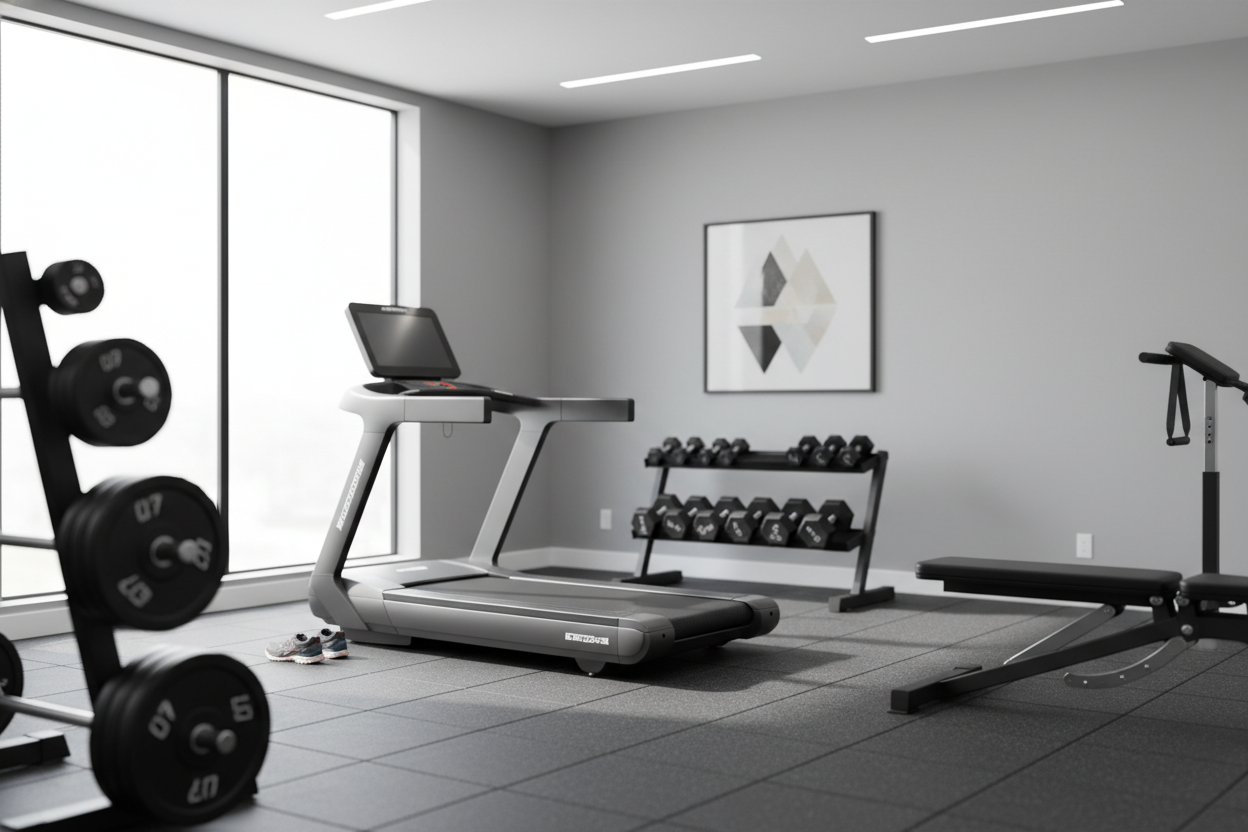
I remember the day I tried to wedge a retired Life Fitness commercial treadmill into my single-car garage. It was like trying to park a school bus in a walk-in closet. Most people think they need the heavy-duty run machine gym owners buy, but that is usually a recipe for a blown circuit breaker and a very expensive coat rack. Commercial units are built for 18 hours of daily abuse, not for the constraints of a residential spare room.
Quick Takeaways
- Commercial units often require dedicated 20-amp circuits that most homes lack.
- Manual curved treadmills are better for mechanics and take up less space.
- Look for a motor with at least 3.0 CHP (Continuous Horsepower), not just 'peak' power.
- A 60-inch belt length is the minimum for anyone over six feet tall to avoid 'short-striding'.
Why Big Box Cardio Gear Fails in the Garage
The biggest mistake I see is people chasing 'gym quality' without looking at their electrical panel. Most gym running equipment is designed for industrial power grids. You plug one of those into a standard 15-amp outlet shared with your fridge, and you will be resetting your breaker every time you hit an incline. These things are also massive. A standard commercial running exercise machine can weigh over 400 pounds and take up a 7-foot by 3-foot footprint.
Maintenance is the other killer. When a commercial-grade running workout machine breaks, you cannot just call a local handyman. You are looking at specialized technicians who charge $150 just to show up. For a home setup, you want running exercise equipment that is modular or, better yet, has fewer electronic points of failure. The sheer bulk makes it nearly impossible to move once it is dropped by the delivery truck.
Motorized vs. Manual: The Real Runner Gym Equipment Debate
If you actually care about your running form, stop looking at motorized running workout machines and start looking at curved manual belts. A manual runner gym machine like the AssaultRunner or Woodway is powered entirely by your legs. There is no motor to burn out, and they force you to run with a mid-foot strike. If you get lazy and try to heel-strike, the belt literally won't move correctly.
When you are building a home gym, space is your most valuable currency. Motorized units need to stay near a wall for the plug, but a manual runner gym equipment can live anywhere. It is louder, sure, but it burns about 30% more calories because you are the engine. I have found that for most of my clients, a manual belt is the superior gym equipment for running because it requires zero electrical maintenance and lasts a lifetime.
What Actually Matters When Picking a Running Workout Machine
If you must go motorized, ignore the flashy touchscreens. Those tablets will be obsolete in three years while the frame is still good. Focus on the Continuous Horsepower (CHP). A cheap running gym equipment motor will stutter when your foot hits the deck, which feels like a mini-seizure for your knees. You want a 3.0 CHP motor or higher if you plan on doing anything faster than a light jog.
Belt size is the next non-negotiable. I have tested plenty of exercise equipment for running that felt like walking a tightrope because the belt was only 18 inches wide. You want at least 20 inches of width and 60 inches of length. This gives you the 'drift room' you need when you get tired. Also, check the deck's shock absorption. A good workout equipment running setup should have some 'give' to it—if it feels like running on concrete, your shins will let you know by week two.
What If You Just Need to Protect Your Knees?
Not everyone needs to sprint at 10 mph. If you are a lifter with beat-up joints, sometimes the best running fitness equipment isn't a treadmill at all. I have tested real gym equipment for walking that provides a much better stimulus for recovery days without the pounding. Heavy rucking or high-incline walking can get your heart rate into Zone 2 without the orthopedic cost of traditional running.
For those dealing with chronic issues or looking for the best exercise equipment for elderly family members, step-up height is the spec that matters most. A running equipment in gym settings often has a high deck that is a trip hazard. Look for 'low-profile' decks that sit 5-8 inches off the floor. It makes getting on and off much safer when your legs are toasted after a session.
Personal Experience: The Motor Meltdown
I once bought a mid-tier motorized treadmill because the specs looked okay on paper. Three months in, I was doing interval sprints, and the motor started smelling like an electrical fire. The 'Peak' horsepower was high, but the 'Continuous' power was garbage. I ended up having to haul a dead 300-pound machine out of my basement piece by piece. Now, I stick to manual slats or high-end refurbished commercial units if I can verify the service history. Don't buy the 'budget' version of a heavy-duty machine—it is better to buy a high-end version of a simpler one.
Frequently Asked Questions
Does a manual treadmill require electricity?
No. Manual curved treadmills are powered by the friction of your feet and the weight of the slats. The console usually runs on AA batteries. This makes them the ultimate choice for garage gyms where outlets are scarce.
How much ceiling height do I need for a treadmill?
Take your height, add the deck height (usually 8-12 inches), and add another 6 inches for 'head bounce.' If you are 6 feet tall and the treadmill deck is 10 inches high, you need at least an 8-foot ceiling to keep from scalping yourself.
Is a curved belt harder to run on?
Yes, significantly. Because you are the motor, you use more of your hamstrings and glutes to pull the belt back. Expect your pace to be about 20% slower than what you see on a motorized screen for the same effort level.
Share:
I Fact-Checked the Will Smith Bench Press Numbers (Is 385lbs Real?)
Why the Best Home Exercise Equipment UK Has to Offer Isn't on Amazon