
I remember the day I realized my 'hardcore' barbell-only routine was leaving my chest looking like a flat tire. I was obsessed with the purity of the lift, thinking if it didn't rattle a cage or require a spotter, it didn't count. I spent years avoiding anything with a pulley because some guy on a forum told me machines were for people who didn't want to work hard.
The truth is, my joints were screaming and my muscle growth had stalled. When I finally swallowed my pride and started incorporating weight machine exercises, my physique actually started to change. Machines aren't a shortcut; they are a precision tool for people who are tired of their joints being the limiting factor in their muscle growth.
Quick Takeaways
- Machines provide constant tension that free weights can't match.
- They allow you to train to absolute failure without a spotter.
- Resistance machines are superior for isolating specific weak points.
- Modern home gym equipment is compact enough to fit in a standard garage.
The Free Weight Purity Trap is Killing Your Gains
The fitness industry spent the last decade brainwashing us. We were told that 'functional' training only happens with a barbell or a kettlebell. If it moves on a fixed path, it's 'cheating.' This mindset is one of the biggest roadblocks to hypertrophy. When you're balancing a heavy barbell, a massive portion of your neural drive goes into stabilization. That's great for athleticism, but it's sub-optimal for making a specific muscle grow.
By ignoring workout machine exercises, you're leaving meat on the bone. A machine removes the balance requirement, allowing you to shove the target muscle right into the gutter of failure. I've found that my best growth happened when I stopped worrying about 'stabilizing' and started focusing on 'contracting.' Cables and levers aren't for the weak; they're for the people who want to actually feel the muscle they're supposed to be training.
Chest Day Upgrade: Ditch the Dumbbell Fly
I love a good dumbbell fly for the stretch, but let's be real: the tension curve is garbage. At the bottom, the stress on your shoulder capsule is terrifying. At the top, when the dumbbells are over your chest, there is zero tension on the pecs. Gravity is just pushing the weight down into your joints. You're effectively resting at the peak of the movement.
This is where a machine destroys free weights. Using a Weight Bench Chest Press Machine Independent Arms Z1 Pro gives you a consistent load from the start of the press to the very end. Because the arms move independently, you get the same 'feel' as dumbbells but with a resistance profile that actually gets harder as you reach peak contraction. It’s the difference between a floppy workout and a pump that feels like your skin is going to tear. Plus, if you hit a wall, you just let go. No more awkward 'dropping the dumbbells' dance that ruins your floor mats.
The Leg Press Isn't Just an Ego Lift
We've all seen the guy at the commercial gym loading 12 plates per side on a leg press and moving it three inches. Don't be that guy. When done right, lower body resistance machine exercises are quad-builders that a back squat can't touch. The problem with heavy squats isn't the legs; it's the lower back. Most lifters find their erectors or their core stability gives out long before their quads are truly exhausted.
The leg press allows you to pin your back against a pad, neutralizing the shearing force on your spine. This lets you focus entirely on knee extension. I like to keep my feet low on the platform to maximize quad recruitment. It’s a brutal way to finish a leg day. You can reach a level of intensity—where your legs are literally shaking—that would be dangerous with a bar on your back. It’s not about ego; it’s about mechanical advantage and safety.
Why the Smith Machine Squat Belongs in Your Routine
The Smith machine is the most misunderstood piece of equipment in the garage gym world. People call it the 'shame machine,' but those people usually have small legs. The fixed bar path is actually its greatest strength. It allows you to manipulate your center of gravity in ways that would result in a face-plant with a barbell. For example, by placing your feet six inches forward, you can keep your torso completely vertical, turning the movement into a pure quad-crusher.
If you're looking to add a Smith Machine to your resistance machine workout, you need to be smart about your numbers. Don't just assume the bar is a standard 45 lbs. Many use counterbalances or lighter internal rods. Reading up on Why Your Smith Machine Starting Resistance Is Lying To You will save you from a very confusing ego-check when you realize your '405-lb squat' was actually 360. Regardless of the math, the ability to sit back into the lift without falling over makes it a staple for anyone chasing serious leg mass.
Stop Using Momentum on Back Day
Back day is the easiest day to cheat. On a barbell row, it's so tempting to use a little hip hinge to get the weight moving. Before you know it, you're doing a rhythmic dance instead of a back exercise. Strength training exercises with equipment like a seated cable row or a lat pulldown fix this by locking your lower body in place. When your thighs are wedged under a pad, you can't use your legs to cheat the weight up.
This isolation allows for a strict eccentric focus—the lowering phase of the lift where most of the muscle damage happens. I've found that slowing down the return on a cable row does more for my lat width than any amount of 'heavy' kipping pull-ups ever did. You can feel the fibers stretching under load, which is a sensation you often lose when you're fighting to keep your balance with a heavy barbell.
How to Actually Fit These Into a Garage Gym Layout
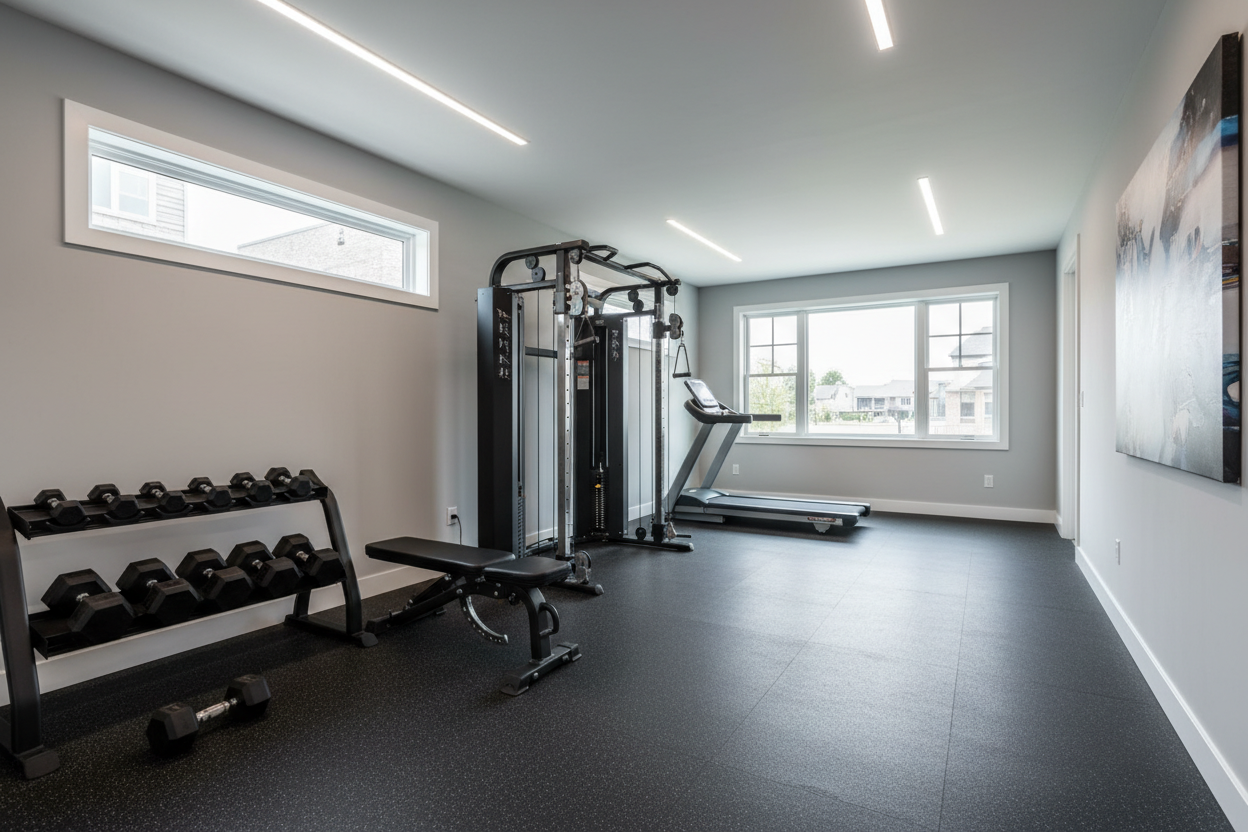
The biggest hurdle for home gym owners is space. You can't fit a 12-station cable crossover in a single-car garage. However, you don't need to. The market has shifted toward 'all-in-one' units that combine a power rack with a functional trainer or a Smith machine. A single 4x6 foot footprint can now house a system that handles 90% of the exercises I've mentioned here.
My advice? Prioritize a machine that offers adjustable pulleys. If you have a rack, look for plate-loaded attachments. You can get a massive pump without needing a 5,000-square-foot commercial facility. It's about being surgical with your equipment choices. Buy things that provide a tension profile your free weights can't, and you'll see your physique fill out in places you didn't know were lagging.
My Experience with the 'Machine Shift'
A few years back, I tore a minor ligament in my wrist. I couldn't grip a heavy barbell for a bench press or a row without sharp pain. I thought my training was over. Instead, I moved almost exclusively to machines—using D-handles on cables and chest-supported levers. Six months later, not only was my wrist healed, but my chest and back were noticeably thicker. My mistake for years was thinking intensity only came from a barbell. The real intensity comes from how much tension you can force a muscle to handle, and machines are the kings of tension.
FAQ
Are weight machine exercises safer than free weights?
Generally, yes, because the path is fixed and you can't drop the weight on your neck. However, you can still get hurt if you use poor form or try to lift weights your tendons aren't ready for. Don't let the 'safety' of a machine make you reckless.
Can you build as much muscle with machines?
Absolutely. For pure hypertrophy, machines are often superior because they allow for better isolation and more time under tension. Most pro bodybuilders use a heavy mix of both free weights and machines for this exact reason.
How do I know how much the machine bar weighs?
Check the manufacturer's specs. Some Smith machine bars are counterbalanced to weigh as little as 6 lbs, while others are a full 45 lbs. When in doubt, use a luggage scale to find the starting resistance so your tracking stays accurate.
Share:
Stop Buying Pink Plastic: Get a Real Adjustable Dumbbell for Women
The Best Place to Buy Exercise Equipment Isn't Just One Store