
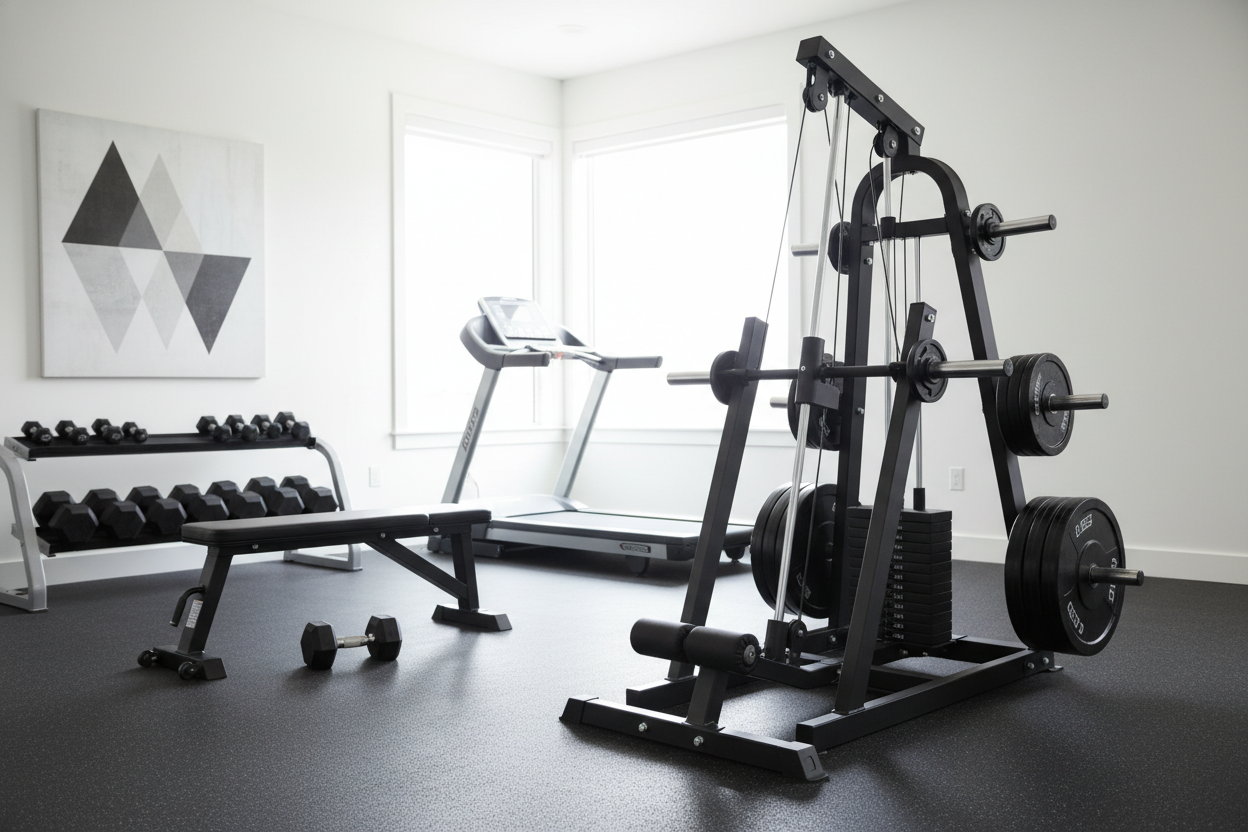
You finally cleared the boxes out of the garage, laid down some heavy-duty rubber mats, and bolted your new resistance training machine to the floor. You load up the plates, sit down for your first set of chest presses, and it feels... off. It is heavy as lead right off your chest, but by the time you are halfway through the rep, the tension vanishes. You are basically throwing the weight at the ceiling.
I have tested dozens of these rigs, from $5,000 commercial units to the $300 'Amazon Specials' that arrive in a beat-up box. Most budget home machines feel totally dead at the top of a rep because they are designed for a shipping container, not a human body. If your gear does not match your muscle's natural strength curve, you are leaving gains on the table and probably annoying your joints in the process.
- Most home machines use fixed circular pulleys that create a flat, unnatural resistance profile.
- Friction from cheap plastic bushings can 'steal' up to 20% of the weight you think you are lifting.
- Independent moving arms are superior for fixing muscle imbalances compared to fixed bars.
- Aluminum pulleys and linear bearings are the gold standard for a 'commercial' feel at home.
The 'Dead Zone' Problem in Home Workouts
There is nothing more frustrating than a resistance workout machine that gives up on you halfway through a set. You know the feeling: the first four inches of a leg extension feel like moving a mountain, but the lockout is so light you could do it in your sleep. This is the 'Dead Zone.'
In a perfect world, the machine should get harder as you get stronger throughout the movement. Most cheap home units do the opposite. They use basic pulley setups that do not account for the fact that your chest, quads, and shoulders are actually strongest at the end of the contraction. When the machine loses tension at the top, your muscles stop working. You are not finishing the rep; you are just coasting on momentum. It makes the hardest part of the lift—the lockout—feel completely pointless.
What Actually Makes a Machine Feel 'Smooth'?
Smoothness isn't magic; it is physics. A high-end resistance trainer machine uses cams—those kidney-bean-shaped pulleys—instead of perfect circles. As you pull or push, the cable moves across the cam, changing the leverage. This ensures the resistance stays heavy exactly where you are strongest.
Contrast that with a budget tension workout machine. These usually rely on a 1:1 or 2:1 pulley ratio with zero cam adjustment. If the pulley is just a plastic wheel, the resistance is linear, but your body is not. You end up fighting the machine's physics rather than your own limits. A well-engineered rig feels like an extension of your limbs, not a clunky pile of steel cables fighting against you.
The Truth About Bar Weights vs. Effective Resistance
If you put 100 pounds on a plate-loaded machine, you aren't actually lifting 100 pounds. Between the angle of the rails, the friction in the bushings, and the pulley math, the 'effective resistance' is a moving target. This is a massive headache for anyone trying to track progressive overload accurately.
Manufacturers love to inflate numbers. I have seen rigs where the carriage weight is 'counterbalanced' but the math doesn't add up. This is exactly why your Smith machine starting resistance is lying to you. You might think you are benching 45 pounds, but with the friction of the glide rods, it might feel like 60. You have to learn how to calculate the real Smith machine resistance weight if you want to stop guessing and start growing. If the machine uses cheap plastic bushings instead of linear ball bearings, that friction will change based on how humid your garage is. That is not a workout; it is a science experiment gone wrong.
Cables, Cams, and Independent Levers Explained
The best resistance weight machine I ever used did not have a single fixed bar. It used independent levers. When you use a machine where both arms are welded to one bar, your dominant side (usually the right) does about 60% of the work. You won't even notice it until your left pec looks noticeably smaller in the mirror.
That is why I always recommend a chest press machine independent arms setup. It forces unilateral strength. Beyond the arms, look at the cable quality. Most home rigs ship with 1/8-inch aircraft cable coated in nylon. It is fine for a while, but it stretches. A real resistance machine uses 3/16-inch or 1/4-inch cables that do not have that 'bouncy' feel when you are trying to grind out a final rep. The cams and independent levers ensure that the tension stays constant and balanced, mimicking free weights without the risk of dropping a 45-lb plate on your face.
How to Spot a Junk Rig Before You Buy It
Do not get fooled by the glossy stock photos. When you are looking for a high-quality Smith machine or functional trainer, zoom in on the pulleys. If they are black plastic with a visible seam down the middle, they are nylon bushings. They will get 'flat spots' and start to jerk. You want aluminum pulleys with sealed bearings. They spin forever and feel buttery smooth.
Check the rail pitch too. If the vertical rails are perfectly 90 degrees, it is a budget design. Most natural pressing movements happen at a slight 7-to-10-degree angle. Finally, look at the cable thickness and the 'stack' guides. If the weights slide on thin, chrome-plated tubes, they will rust and catch. You want solid steel guide rods. If the specs do not list the bearing type, assume it is the cheapest plastic available.
Personal Experience: The $400 Paperweight
A few years back, I bought a 'commercial grade' lat pulldown from a local liquidator. It looked beefy—3x3 steel frame, big weight stack. But the moment I sat down, I realized I had messed up. The pulley ratio was so weird that the first 6 inches of the pull felt like 200 lbs, and the rest felt like 50. The friction was so high that the weight stack would actually get stuck halfway up if I did not 'help' it. I ended up selling it for parts. It taught me that frame thickness means nothing if the pulleys and cams are garbage.
FAQ
Why does my machine feel easier at the top?
Your muscles are naturally stronger at the end of a movement (the lockout). If the machine uses a standard round pulley, the resistance stays the same while you get stronger, making the top feel 'easy' or dead.
Are aluminum pulleys really worth the extra money?
Yes. Nylon pulleys warp under heavy heat and friction, leading to a 'hitch' in your rep. Aluminum stays perfectly round and uses better bearings for a smoother pull.
Can I fix a jerky machine?
Sometimes. Cleaning the guide rods and using a dry silicone spray helps, but if the pulleys are cheap plastic, the only real fix is replacing them with high-quality bearings.
Share:
Can the LeBron James Exercise Machine Replace a Real Garage Gym?
Is a Multifunctional Smith Machine Actually Good at Everything?