
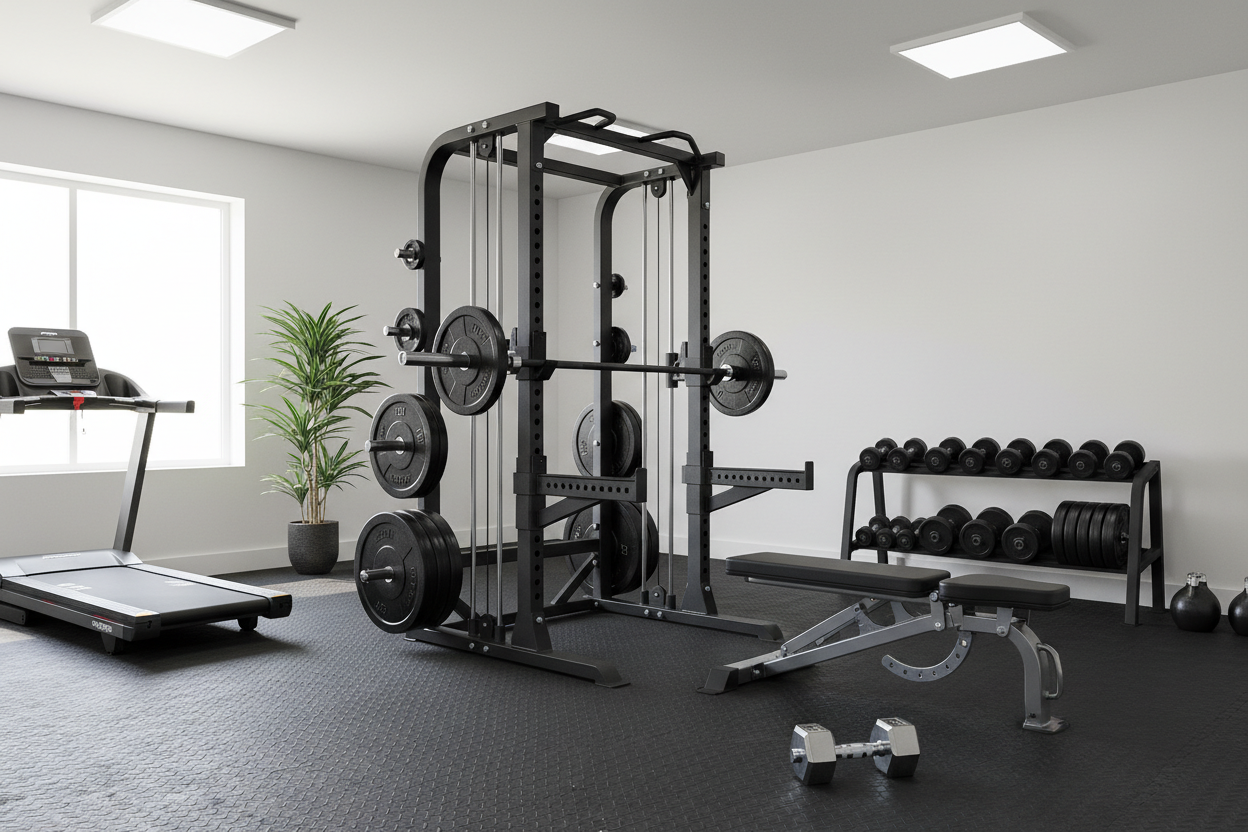
I remember the first time I walked past the Smith machine in a commercial gym and rolled my eyes. I was a barbell purist, convinced that if the bar wasn't free-floating, the lift didn't count. I thought it was the 'easy way out.' Then I actually tried to push a set of twenty reps to failure with my feet out in front, and my quads felt like they were being hit with a blowtorch.
The debate over whether are smith machine squats harder than their free-weight cousins usually ends in a shouting match between powerlifters and bodybuilders. But after loading up my own rig and testing the mechanics, I've realized the answer isn't a simple yes or no. It depends entirely on whether you're talking about the weight on the bar or the fire in your muscle fibers.
Quick Takeaways
- The bar weight is usually lighter (15-25 lbs) due to counterbalances, making the initial lift feel easier.
- Friction from the guide rods adds a small amount of constant resistance you won't find on a barbell.
- Because you don't have to balance, you can push your quads to absolute failure without your lower back giving out.
- It is a superior tool for hypertrophy, but inferior for developing 'raw' functional strength.
The Great Ego Check: Free Weights vs. Fixed Rails
Barbell purists love to claim that any machine-based lift is 'cheating.' I used to be one of them. But if you look at the legs on elite bodybuilders, you'll see a lot of them swear by the fixed path. The reality is that free weight snobs are missing out on a specific type of intensity that a standard rack can't provide.
In my garage, I've found that the Smith machine removes the 'fear factor.' When I have 315 lbs on my back in a power rack, a huge portion of my mental energy goes into not falling over or collapsing my spine. On the rails, that mental energy is redirected. I'm not worried about the bar path; I'm only worried about the leg drive. This makes the set feel 'harder' on the muscles even if the stabilization is 'easier.'
The Physics: How Much Easier is Smith Machine Squat?
Let's talk numbers because this is where the confusion starts. If you're asking how much easier is smith machine squat from a pure poundage perspective, the answer is usually 'about 15 to 20 percent.' Most modern Smith machine setups use a counterbalance system with cables and weights hidden in the frame. This means a bar that looks like a 45-lb Olympic bar might actually only weigh 15 lbs in your hands.
However, there's a hidden tax: friction. No matter how much silicone spray you slather on those guide rods, there is mechanical resistance. Unlike a free barbell that moves through the air, the Smith bar is fighting against the bushings. In my testing, this friction makes the eccentric (lowering) phase feel more controlled, but it requires a more consistent 'push' on the way up. You can't just 'pop' the weight off your shoulders like you can with a barbell.
The Paradox: Why Removing Balance Makes It Hurt More
So, are smith machine squats harder? Mechanically, no. You are moving less total mass because your stabilizers are on vacation. But muscularly, the answer is often a resounding yes. When you squat in a rack, your lower back or your core often reaches fatigue before your quads do. You rack the bar because your form is breaking down, not because your legs are empty.
On the Smith, you can keep going until your quads literally stop firing. There is no technical breakdown that will cause the bar to dump forward. This allows for high-intensity techniques like drop sets or rest-pause sets that would be suicidal with a free barbell. It’s the difference between a total-body grind and a localized muscle execution.
Taking Stabilizers Out of the Equation
When you remove the need to balance, you can manipulate your foot position in ways that would be impossible with a barbell. I like to kick my feet out about 6 inches in front of the bar. This shifts the center of gravity and turns the movement into something closer to a hack squat. By doing this, stance changes the smith machine squat muscles worked, allowing you to target the teardrop or the outer sweep with surgical precision.
Your adductors and core don't have to work nearly as hard to keep you upright. This is a negative if you're training for a Spartan race or a powerlifting meet, but it's a massive win if your goal is just to grow the biggest legs possible. You're effectively trading 'functional' stability for 'mechanical' tension.
When You Outgrow the Fixed Bar
While I love the Smith for high-rep burnout sets, it has its limits. The vertical (or slightly angled) path is unnatural. Your body wants to move in a slight S-curve during a squat, and forcing it into a straight line for years can beat up your knees if you aren't careful. If you find yourself hitting a plateau or feeling a 'click' in your joints, it might be time to look at other fixed-path options.
For those who want that same 'push to failure' safety but with a more natural arc, a compact hack squat combo machine is the logical next step. It provides the same stabilization benefits but usually offers a more ergonomic angle for the hips and lower back. I still use my Smith machine weekly, but I treat it as a specialized tool, not the only way to squat.
My Personal Experience
I once tried to replicate my 1RM barbell squat on a Smith machine at a local commercial gym. I loaded up four plates on each side, thinking it would be a breeze. I nearly folded in half. Because the bar path was strictly vertical and I hadn't adjusted my foot placement, I couldn't use my hips the way I normally do. I ended up stuck at the bottom, saved only by the safety pins. It taught me that 'easier' is relative to how you use the machine. Don't respect the rails, and they'll pin you just as fast as a barbell.
FAQ
Do Smith machine squats count as real squats?
Yes. Your muscles don't have eyeballs; they only know tension and load. If your quads are moving weight through a full range of motion, they are squatting. It just isn't a 'competition' powerlifting squat.
Why do my knees hurt on the Smith machine?
Usually, it's because your feet are too far back (directly under the bar). This creates excessive shear force on the patella. Try moving your feet 3-6 inches forward to take the pressure off the joints and put it on the quads.
Is the bar on a Smith machine always 45 lbs?
Almost never. Most commercial and home units have a starting weight between 15 and 25 lbs. Always check the sticker on the frame; most manufacturers list the starting resistance right there.
Share:
The Hidden Math Behind an All In One Home Gym System
The Most Underrated Leg Exercise on Smith Machine for Quads