
I remember my first year of training in a cramped garage. I was a total free-weight elitist. I thought if it wasn't a barbell or a rusty pair of dumbbells, it was a 'cheat' or a waste of time. I spent six months stalled on my overhead press, my shoulders screaming and my lower back doing more work than my delts. It wasn't until I sat down at a plate-loaded press that I realized I was fighting for balance more than I was fighting for muscle growth. That’s the moment I stopped asking what are machine weights and started asking why I hadn't used them sooner.
Quick Takeaways
- Machines provide a fixed path that eliminates the need for stabilizer muscles, allowing for deeper mechanical tension on specific targets.
- A weight machine is any system—cable, pulley, or lever—that guides the resistance through a predetermined range of motion.
- Selectorized machines (pin-loaded) are built for speed and drop sets, while plate-loaded machines feel more like raw iron.
- For most home gyms, a solid bench and a cable system offer the best bang for your square footage.
Let's Settle This: What Is a Weight Machine, Exactly?
In the simplest terms, a weight machine is a piece of equipment where the path of the weight is determined by the gear, not by you. When you grab a barbell to bench press, you have to keep that bar from drifting toward your chin or falling toward your stomach. You are the stabilizer. With a machine, the manufacturer has already decided where the weight goes. You just provide the force.
This is called fixed-path resistance. Whether it is a cable crossover, a leg extension, or a massive 45-degree leg press, the machine handles the 'balance' part of the equation. This is precisely why what is a weight machine matters to your programming: it changes the 'cost' of the exercise. You can push to absolute failure on a machine without worrying about a bar crushing your windpipe. It’s about isolating the engine from the chassis.
Most machines use a series of pulleys and cams. These aren't just for show; they can actually change the resistance profile. Some cams are shaped to make the weight heavier at the top of a movement and lighter at the bottom, matching your muscle's natural strength curve. You can't get that from a standard dumbbell without some serious physics gymnastics.
Why Your Muscles Do Not Care Where the Resistance Comes From
Your biceps don't have eyes. They don't know if you're holding a $500 custom-milled barbell or pulling on a cable attached to a stack of plastic-coated plates. They only recognize tension. In fact, sometimes a machine is better at providing that tension. On a dumbbell fly, there is almost zero tension at the top of the movement because gravity is pulling the weight straight down through your joints. On a cable machine, that tension stays constant through the entire arc.
However, not all machines are built the same. I’ve spent way too much money on gear that looked good in photos but felt like dragging a sled through gravel once it was in my gym. I remember dissecting a budget weight machine set after the cable snapped on a routine set of rows. The pulleys were cheap nylon and the bearings were non-existent. That friction ruins the 'smooth' benefit of a machine. If the resistance is jerky, your muscles aren't getting consistent tension, and your joints are taking the hit.
The real advantage here is isolation. If your goal is to grow a massive chest, sometimes the limiting factor on a bench press is your triceps or your shaky shoulders. By switching to a machine, you can hammer the pecs into the floor without those smaller muscles giving out first. It isn't 'cheating'; it's being surgical with your training.
The 3 Types of Machines You'll Actually Encounter (And Use)
If you're looking to add machine work to your routine, you need to know what you're actually looking at. They generally fall into three buckets: selectorized, plate-loaded, and the Smith machine. Selectorized machines are the ones with the pin and the weight stack. They are the kings of convenience. If you’re doing a giant set or a drop set, you can change the weight in two seconds. No plates to lug around, no collars to mess with.
Then you have plate-loaded leverage systems. These are my personal favorite for a home gym. They use your existing Olympic plates, which saves you from buying a 200-lb iron stack. A high-quality chest press machine with independent arms is a prime example. Because the arms move separately, you can't let your strong side take over, which is a common issue with fixed bars. It feels more 'raw' than a cable machine but keeps you in that safe, guided track.
Finally, there's the Smith machine. It’s essentially a barbell on tracks. People love to hate it, but for high-volume squats or shrugs, it’s a tool like any other. One thing to watch out for is the starting weight. I spent an afternoon figuring out the starting bar weight on various commercial models, and it varies wildly. Some are counterbalanced to feel like zero pounds, while others have a beefy 45-lb or even 55-lb starting weight. Always check the feel before you start piling on the 45s.
Do You Actually Need Fixed-Path Gear in a Home Gym?
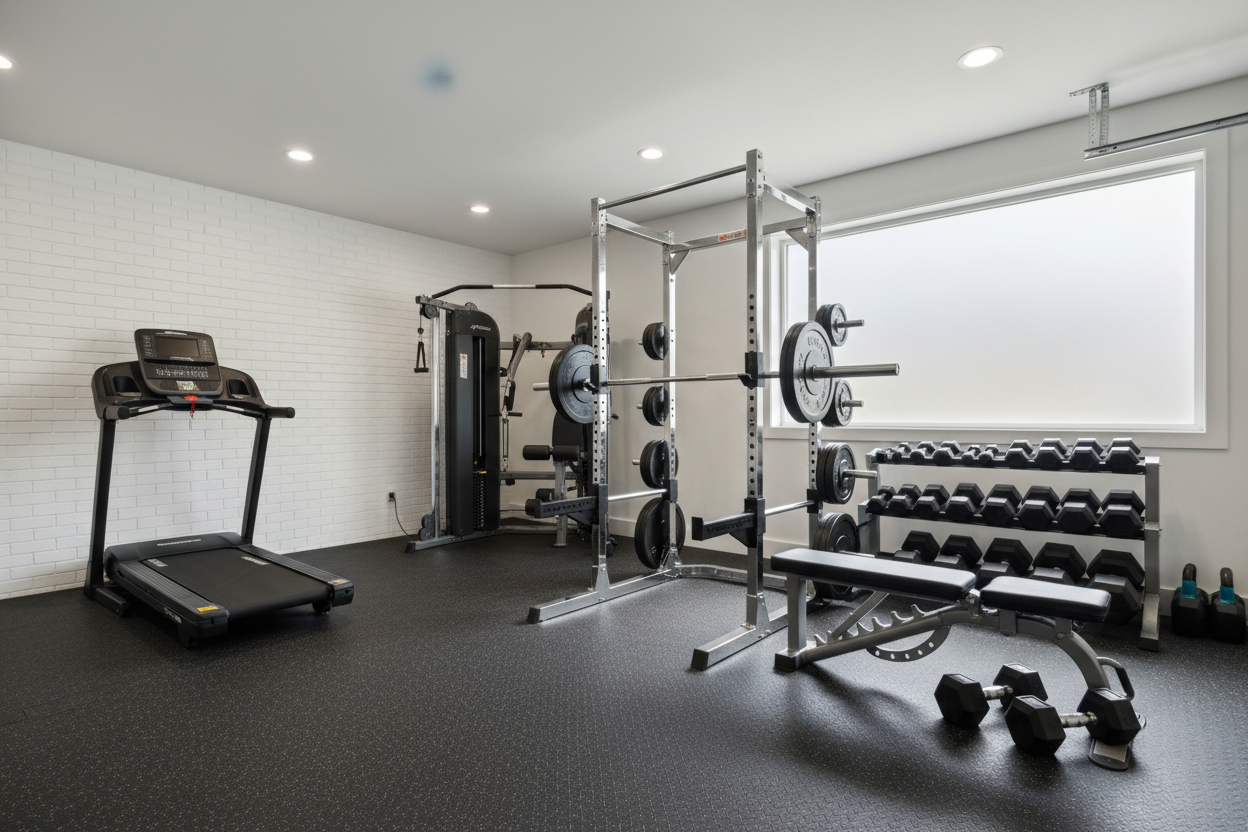
This is where the rubber meets the road—or the iron meets the rubber flooring. If you have a 10x10 spare bedroom, you probably shouldn't buy a dedicated leg press that takes up 40 square feet. You have to be smart. For most of us, the priority should be a power rack and a solid adjustable weight bench. That combo handles 90% of your needs. You can do your presses, rows, and squats right there.
But if you have the space, adding a cable tower or a functional trainer is the biggest upgrade you can make. It bridges the gap between 'raw iron' and 'machine weights.' You get the benefit of constant tension and guided paths without the footprint of ten different single-use machines. I eventually added a lat pulldown attachment to my rack, and it changed my back development more than any amount of barbell rows ever did.
The mistake I see most people make is buying a 'total home gym' machine that tries to do 50 things but does none of them well. These usually have flimsy cables and a weight range that you'll outgrow in three months. If you’re going to buy a machine, buy one that does one or two things exceptionally well. Your gains—and your floor space—will thank you.
Personal Experience: The Leg Press Lesson
I once bought an old, commercial-grade hack squat machine for my garage. It was a beast, weighing nearly 600 lbs. I thought it was the ultimate addition. Two weeks later, I realized I couldn't even fit my barbell in the rack because the machine was in the way. I was so blinded by the 'cool factor' of a machine that I forgot about the flow of my workout. I ended up selling it and getting a high-end cable system instead. Lesson learned: specialized machines are great, but versatility is king in a home gym environment.
FAQ
Are machine weights safer than free weights?
Generally, yes. You can't drop a machine weight on your toes, and you don't need a spotter to push to failure. However, you can still get injured if the machine isn't adjusted to your height or if you use poor form on a heavy leg press.
Why do machine weights feel lighter than dumbbells?
It usually comes down to the pulley ratio. Many machines use a 2:1 ratio, meaning 100 lbs on the stack only feels like 50 lbs of actual resistance. Plus, since you aren't balancing the weight, you can direct 100% of your energy into the push.
Can I build as much muscle with machines?
Absolutely. Some of the greatest bodybuilders in history relied heavily on machines to isolate muscles and reach higher levels of fatigue than they could safely achieve with a barbell. It's all about the total volume and tension you apply.
Share:
Your Dials Will Break. An Adjustable Dumbbell Bar Set Won't.
Why Your Leg Exercises Machine Workout Isn't Building Any Mass