
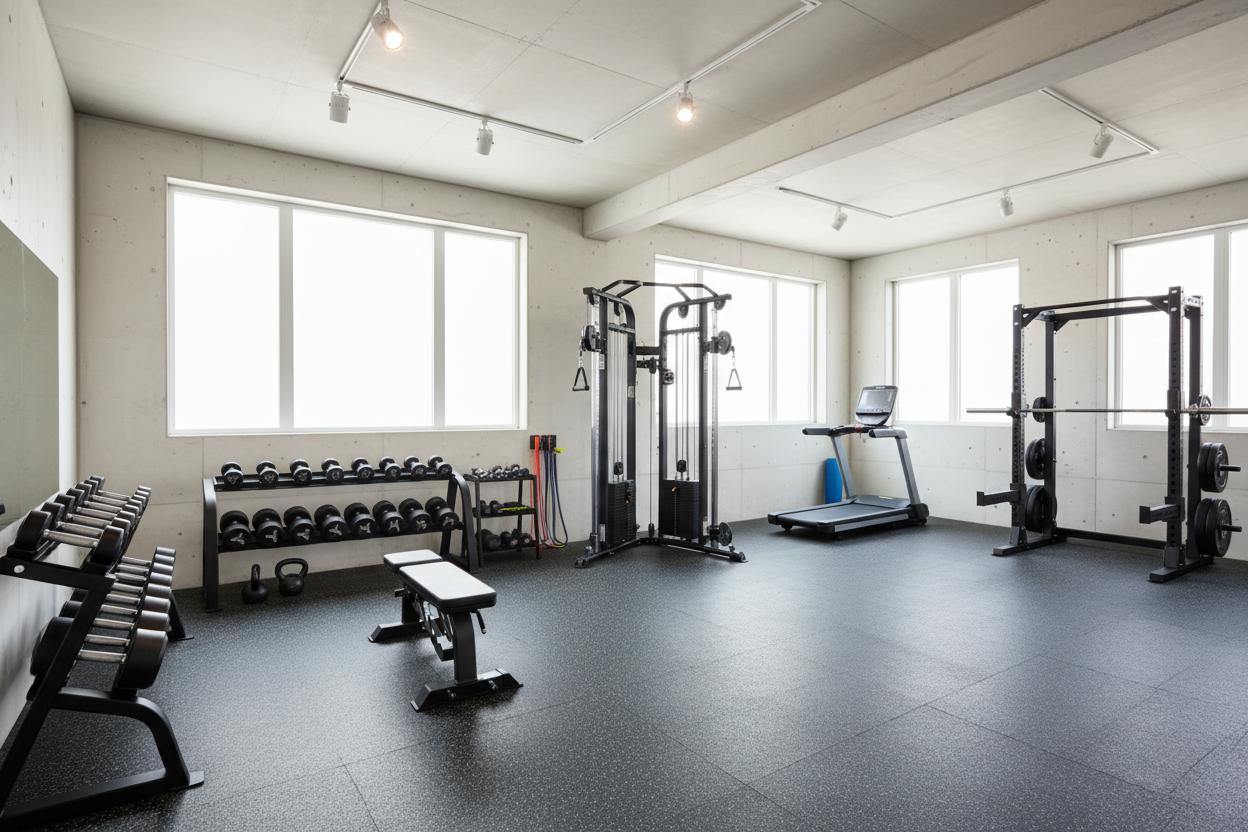
I have spent a decade building and rebuilding my training space. I have bought 'heavy-duty' racks that swayed like a palm tree during pull-ups and pulleys that felt like they were filled with sand. Finding a reputable gym machine store is only the first step; the real work happens when you step onto the showroom floor and start poking at the floor models.
Quick Takeaways
- Never trust the printed dimensions; measure the 'working footprint' yourself.
- Perform a lateral shake test on every rack and functional trainer.
- Check for 11-gauge steel and aluminum pulleys over plastic ones.
- Account for the 'plate swing' space on plate-loaded machines.
The Showroom Floor Illusion
When you walk into a high-end fitness machine shop, everything looks indestructible. The lighting is dim and dramatic, and the floor is perfectly leveled with high-density rubber. This is a trap. In your garage or basement, that same equipment for gym use will be sitting on a sloped concrete slab that hasn't been level since 1974.
The showroom floor hides manufacturing flaws. A machine that feels stable on professional flooring might rattle your teeth once it is on a hard surface. I always look at the welding joints under the bright light of my phone. If the welds look like a stack of sloppy dimes, that machine is going to creak the moment you load it with real weight. Most available gym equipment looks great in a catalog, but the physical reality is often thinner steel and cheaper powder coating than the photos suggest.
Don't let the 'gym equipment usa' labels fool you into thinking everything is commercial grade. Retailers often mix residential and light-commercial gear. If the frame feels light enough for you to slide it across the floor with one foot, it is too light for serious training. You want mass. Mass equals stability when you are grinding out that last rep of a heavy set.
The 'Shake Test' for Gym Exercise Machines
Before you talk to a rep, give the gym exercise machines a literal shake. Grab the uprights of a power rack or the top of a functional trainer and try to move it side-to-side. If it has more than a half-inch of play, the bolt-together design is weak. This is the primary difference between a budget setup and a legitimate Home Gym that can handle 500-pound squats without screaming.
Next, test the pulleys. Pull the handle slowly and feel for 'catches.' Cheap gym exercise equipment uses nylon pulleys with low-grade bearings that develop flat spots. You want to see aluminum pulleys with sealed bearings. They are louder, but they are infinitely smoother under load. While you are at it, check the upholstery. If you can pinch the vinyl and feel the wood underneath, that padding will bottom out within six months of heavy benching. High-density foam should resist your thumb pressure.
Check the cable thickness too. I’ve seen workout equipment in gym showrooms that uses 1/8-inch cables that look like clotheslines. You want 3/16-inch or thicker, ideally nylon-coated. If the gym fitness machine feels 'springy' when you pull the weight, the cable is stretching, which is a safety hazard waiting to happen. This is why testing exercise equipment at gym retailers in person is non-negotiable.
Why You Must Ignore the Printed Spec Sheets
Manufacturer placards are notorious for lying by omission. They give you the footprint of the base, but they don't tell you how much room you need to actually use the thing. For example, a Smith Machine Home Gym Station might be listed as 48 inches wide, but that doesn't account for the seven-foot bar or the space you need to slide 45-pound plates onto the sleeves without hitting your wall.
I bring a 25-foot tape measure and physically mark out the floor space. I measure the height at the highest point of the cable travel, not just the frame. I’ve seen guys buy gym exercise fitness equipment only to realize they can't do a full-range chin-up because their head hits the ceiling. You need to measure the 'dynamic footprint'—the space the machine occupies when you are actually moving.
When looking at gym equipment and exercises you plan to perform, consider the 'swing zone.' If you are buying a leg extension, how far out does the lever arm travel? If it’s a functional trainer, how wide do the arms go when fully extended? These are the numbers that matter for your floor plan, and they are almost never on the gym equipment sites you browse at midnight.
Translating Sales Speak from a Fitness Equipment Professional
A fitness equipment professional at a retail store is there to move inventory. They will use words like 'commercial-grade' and 'ergonomic' to justify a 40% markup. You need to cut through the noise. Ask specifically about the steel gauge. If it’s 14-gauge, walk away. You want 11-gauge steel for anything structural. Ask about the warranty on wear items like cables and pads, not just the 'lifetime' frame warranty that everyone offers.
Don't get sucked into the 'military-grade' hype either. As noted in the guide on Why Real Military Exercise Equipment Rarely Belongs in a Home Gym, some gear is designed for high-volume abuse in a way that makes it bulky and miserable for a personal space. You don't need a 1,000-pound rig that requires floor bolting if you're just looking for a solid place to press. You need equipment in fitness gym quality that fits a residential workflow.
Ask the rep to show you the maintenance log for the floor models. If they are already replacing cables on a machine that only gets tested by guys in polos, imagine how it will hold up to your daily training sessions. Be wary of gym machines online that don't have a physical showroom you can visit. If you can't touch it, you can't trust the 'the gym equipments' quality claims.
The Hidden Costs of Taking It Home
The price on the tag is never the final price. Large equipment at gym retailers often comes with a 'white glove' delivery fee that can run $300 or more. If you choose to haul it yourself, ask if the warranty is voided by self-assembly. Some brands are picky about who turns the bolts. Also, check the box count. A single functional trainer can come in six different boxes, some weighing over 150 pounds.
Return policies are the final hurdle. Most stores have a 'no returns once assembled' policy. This is why that in-store test is so critical. If you get it home and realize the range of motion is garbage for your height, you are stuck with a very expensive coat rack. Always ask about the floor model discount. If a machine has been sat on by 500 people but is structurally sound, you can often knock 20-30% off the sticker price of the exercise equipment in gym showrooms.
Personal Experience: The Ceiling Height Disaster
I once bought a power rack from a local shop because the website said it was 82 inches tall. My basement ceiling was 84 inches. Perfect, right? Wrong. I forgot to account for the pull-up bar bolts and the fact that I actually need space for my head to go *above* the bar. I spent the first week of ownership doing chin-ups with my neck craned like a turtle. Now, I never go to a store without my tape measure and a clear understanding of my room's 'airspace.'
FAQ
Is 11-gauge steel really necessary for a home gym?
If you are lifting heavy or want the machine to last a lifetime, yes. 14-gauge is fine for light attachments, but for racks and main frames, 11-gauge provides the rigidity you need to feel safe.
Should I buy a floor model?
Absolutely, if you can get a discount. Most 'wear' on floor models is cosmetic. Just check the cables for fraying and the upholstery for tears. You can save hundreds of dollars this way.
How much space do I really need around a machine?
A good rule of thumb is 24 inches of 'service space' on all sides. This allows you to load plates, clean the floor, and perform maintenance without moving the entire unit.
Share:
Why Your Press Feels Weird on a Hammer Strength Smith Machine
How Many Machines Should I Use at the Gym Before It's Junk Volume?