
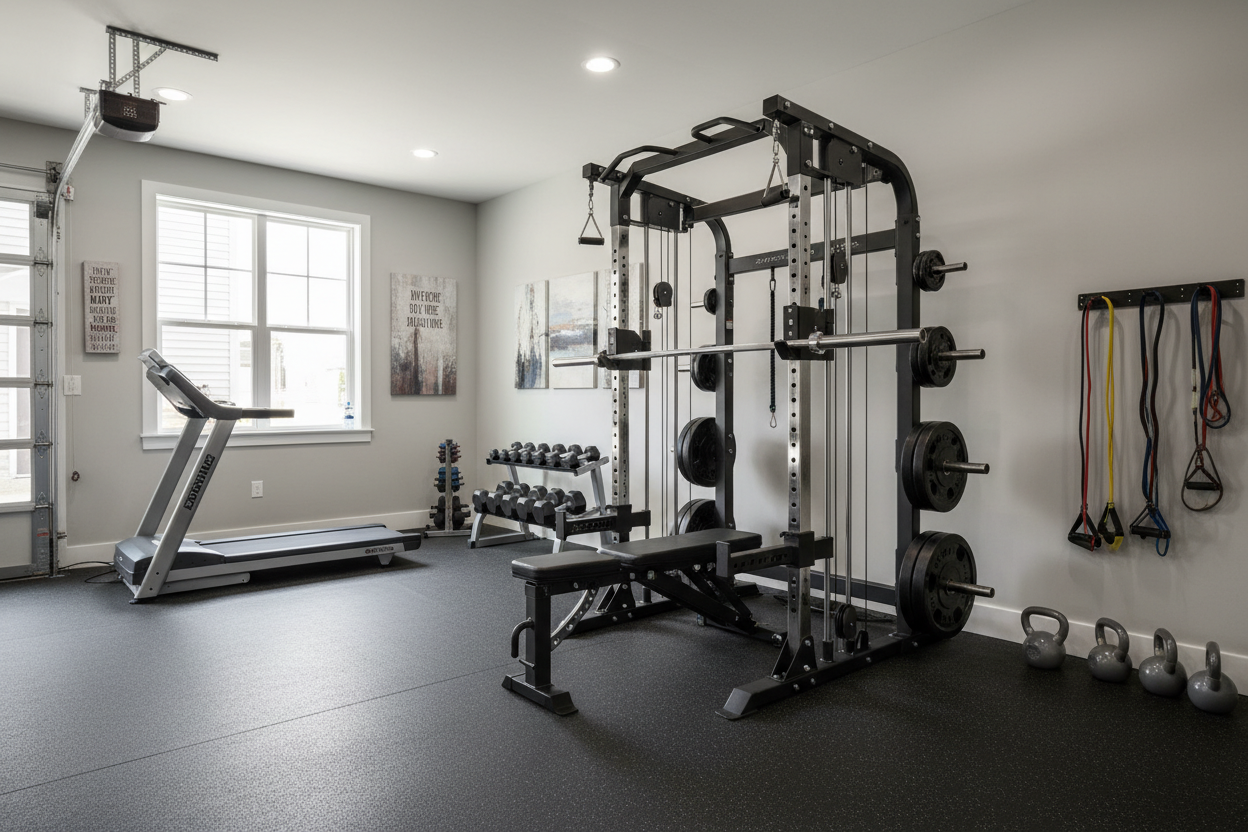
I used to be the guy who sneered at anything with a pulley. My garage was a temple of iron: a squat rack, a rusty barbell, and enough bumper plates to sink a small boat. I thought multi function home gym equipment was for people who preferred spandex to sweat and didn't care about real strength.
Then I hit 35. My shoulders started sounding like a bag of gravel every time I benched, and my hypertrophy stalled because I couldn't isolate a muscle to save my life. I finally caved and bought an all-in-one rig, and honestly, my training has never been better.
Quick Takeaways
- Constant tension from cables fixes the 'dead zones' found in free weight movements.
- A 2:1 cable ratio is essential for smooth, functional movements like face pulls and flys.
- Look for 11-gauge steel frames; anything less will wobble when you're moving heavy stacks.
- The best setups integrate a Smith machine for safe, solo training to failure without a spotter.
Confessions of a Barbell Purist
When I first started building a complete home gym, I had a very specific vision: a dark, gritty space where I only did the 'Big Three.' No machines, no fluff, just raw strength. For three years, it worked. I got strong, but I also got beat up. The nagging joint pain became a permanent resident in my elbows and knees.
The problem with the 'barbell only' lifestyle is that it's binary. You're either on or you're off. There's no middle ground for high-volume accessory work that doesn't also tax your central nervous system. I needed a way to hit my rear delts and lats without grinding my spine into dust every single session. My ego was holding back my gains.
The Problem With Just Using Free Weights in a Garage
Free weights are the gold standard for building raw horsepower, but they have a massive flaw: the resistance curve. In a dumbbell fly, there is zero tension at the top of the movement. Your muscles are basically resting while you balance the weight. That’s wasted time.
In a cramped garage, trying to fix this with more specialized bars or weird setups usually just leads to a cluttered floor. I realized I was leaving serious muscle growth on the table because I couldn't get the constant tension that only a cable system provides. A multi functional gym machine for home use solves this by packing ten different isolation tools into the footprint of a single rack, allowing for better hypertrophy without the joint shearing.
What Makes a Good Multi Functional Gym Machine for Home?
If you're going to drop four figures on a rig, it better not shake like a leaf when you're doing pull-ups. I've tested machines that felt like they were made of soda cans. You want a frame made of at least 2x3-inch, 11-gauge steel. If the manufacturer doesn't list the steel gauge, run away.
Sourcing quality gear can be tricky depending on where you live. For instance, finding the best home multi gym uk often means sifting through a lot of lightweight 'consumer' grade stuff that won't survive a year of heavy use. Look for commercial-grade pulleys and aircraft-grade cables rated for at least 2,000 lbs. If the pulleys are plastic, they will eventually crack; aluminum is the way to go.
Look for Smooth Cable Ratios (Not Sticky Pulleys)
Cable ratios are where most people get confused. A 2:1 ratio means 100 lbs on the stack feels like 50 lbs in your hand, but you get twice the cable travel. This is what you want for 'functional' stuff. It’s smoother, faster, and doesn't jerk when you're doing explosive movements.
Cheap machines use 1:1 ratios with plastic pulleys that have way too much friction. If the weight 'stutters' on the way down, the machine is trash. High-quality bearings in the pulleys ensure that the resistance stays consistent throughout the entire range of motion, which is the whole point of using cables in the first place.
Why You Need a Multi Gym With Bench That Actually Docks Right
I once bought a multi gym with bench where the bench just kind of floated in front of the machine. Every time I tried to do a chest press, the bench would slide six inches to the left. It was dangerous and incredibly annoying. If you can't get perfectly centered, your strength will always be asymmetrical.
A high-end setup will have a bench that physically docks or locks into the frame. I eventually moved to a weight bench with barbell rack that included a dedicated leg station. Having that stability allows you to focus on the contraction rather than worrying about whether you're going to tip over mid-set. Plus, having a leg extension/curl attachment on the bench saves you from needing a separate machine.
The 'Home Gym 3 Station' Setup I Actually Recommend
If you have the space, a home gym 3 station configuration is the ultimate endgame. This usually looks like a half-rack in the front for your heavy squats, a dual-pulley functional trainer in the middle, and a Smith machine in the back. It’s the Swiss Army knife of lifting.
Integrating a smith machine home gym station was the biggest surprise for me. As a purist, I used to hate them. But when you're training alone in a garage at 6 AM, having those safety catches on a guided track means you can actually take your sets to absolute failure. I've used it for heavy shrugs and calf raises where a free barbell would be too clunky to stabilize.
Is It Time to Ditch the Basic Power Rack?
If you're a competitive powerlifter, keep your rack. But for the 95% of us who just want to look good and feel strong, the all-in-one trainer is a better use of floor space. My old rack took up a 4x4 footprint and only let me do three things. My new rig takes up 5x6 and lets me do fifty. The efficiency is undeniable.
Don't let the 'hardcore' mindset keep you from making progress. I wasted two years stuck at a 225-lb bench plateau because I refused to do cable crossovers and tricep pushdowns. Once I added the variety, the numbers started moving again. Build the gym that actually makes you want to train, not the one that looks coolest on a minimalist's mood board.
FAQ
Does a multi-gym take up more space than a rack?
Usually, yes. While a standard rack is about 4 feet wide, a full multi-station rig needs about 6 to 7 feet of width to allow the cable arms to extend fully. Always measure your ceiling height too; some of these towers hit 84 inches or more, which can be a problem in low-ceiling basements.
Can I still do heavy squats on an all-in-one?
If it has a built-in power rack or half-rack with J-cups on the front uprights, absolutely. Just check the weight capacity of the uprights. Most quality units are rated for 600-1,000 lbs, which is more than enough for most mortals.
Is a 2:1 ratio better than a 1:1 ratio?
For most people, yes. A 2:1 ratio allows for a longer cable reach (great for lunges or crossovers) and more incremental weight jumps. A 1:1 ratio is better for heavy lat pulldowns where you want the full weight of the stack immediately, but it can feel 'choppy' on lighter movements.
Share:
Why the Different Weights of Barbells Are Messing Up Your PRs
What Is Best Exercise Equipment If You Can Only Pick One Thing?