
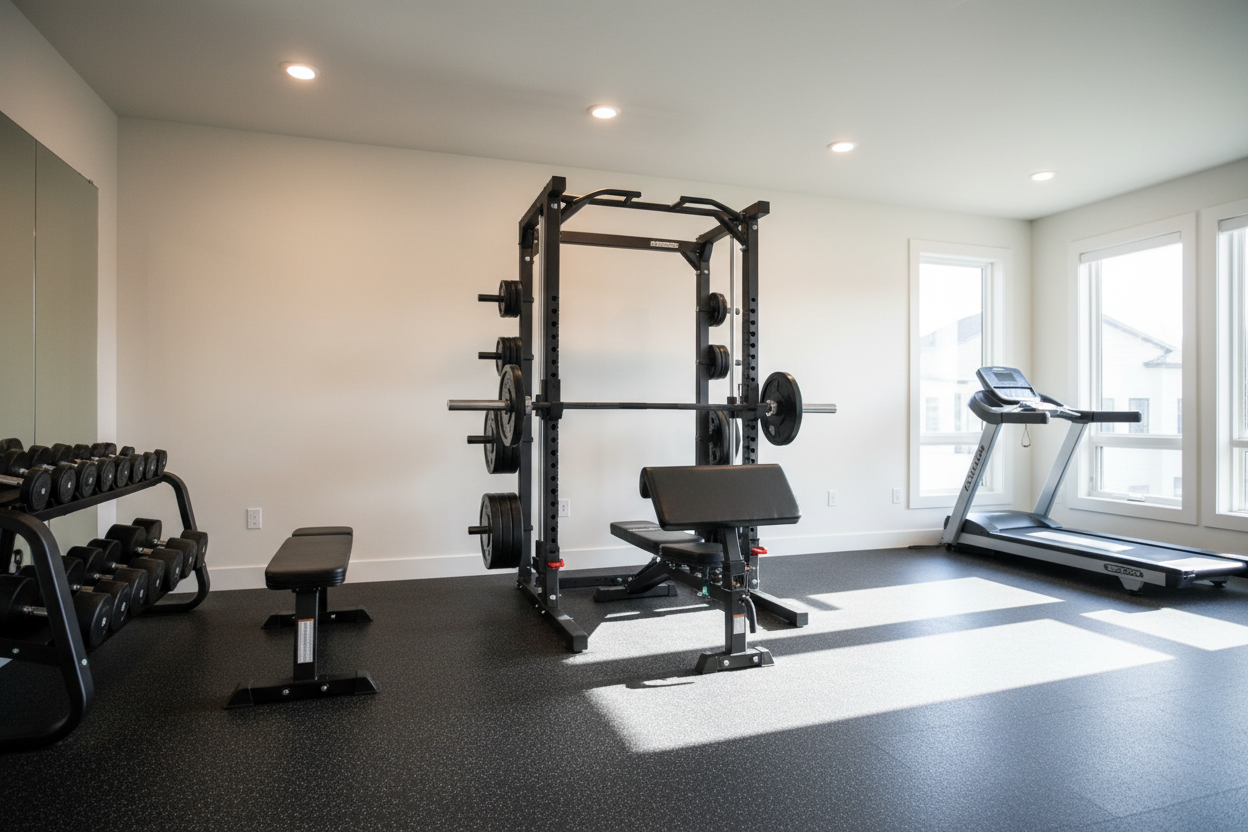
I remember the first time I tried to load four plates on a barbell for hip thrusts in a crowded gym. I spent ten minutes hunting for a usable pad, five minutes rolling the bar over my bruised shins, and the entire set felt more like a balancing act than a glute workout. That was the day I realized the smith machine glute bridge is the superior choice for anyone who actually wants to train their posterior chain without the logistical circus act.
Quick Takeaways
- No more balancing a heavy bar on your pelvis—the track handles the stability.
- Setup time is cut in half compared to free-weight barbell bridges.
- Fixed path allows for 100% focus on the mind-muscle connection.
- Safety catches mean you can push to absolute failure without a spotter.
The Problem With Free-Weight Glute Bridges
Free weights are the gold standard for squats and deadlifts, but for bridges? They are a logistical disaster. Rolling a heavy, loaded barbell over your thighs is a great way to end up with a collection of bruises you didn't ask for. Beyond the discomfort, there is the constant struggle to keep the bar even. If one side dips, you're wasting energy on stabilization that should be going into your glutes.
I have seen guys spend more energy just getting into position than they do on the actual set. When you are fighting to keep 225 lbs from sliding down your legs, you aren't getting a quality contraction. You are just trying to survive the set. It is inefficient, and frankly, it makes you less likely to go heavy enough to see real growth.
Why the Smith Machine Glute Bridge Just Makes Sense
The beauty of the smith glute bridge is the fixed track. By removing the need to balance the weight, you can finally isolate the target muscle. Biomechanically, this is a win because your central nervous system isn't worried about the bar tipping over. You can drive through your heels with everything you have.
Upgrading to a dedicated Smith Machine completely transforms lower body training by eliminating balance bottlenecks. When I made the switch, my glute activation skyrocketed because I could finally focus on the squeeze at the top of the rep rather than the wobble of the bar. It allows for a level of intensity that free weights just can't match for this specific movement.
How to Set Up Without Crushing Your Hips
Setup is where most people fail. Start by placing a flat bench or a sturdy riser about two feet away from the bar. Use a high-quality barbell pad—one of those thick, high-density foam ones. Do not try to be a hero; your hip bones are not designed to support raw steel under heavy tension.
Slide yourself under the bar so it sits right in the crease of your hips. If you are using a versatile rig like the All In One Smith Machine With Cable Crossover S1 V4, you can easily slide a bench under the bar for the perfect bridge angle and set the safety catches just below your lowest point. This ensures that if your glutes give out, the bar stays off your lap. Your shins should be vertical at the top of the movement; if your feet are too far out, you will feel it in your hamstrings.
Common Mistakes Killing Your Glute Activation
The most common error I see with glute bridges on smith machine setups is quad takeover. This usually happens because your feet are tucked too close to your butt. You want to drive through the heels, not the toes. Another massive mistake is hyperextending the lower back. People think more range of motion is always better, but if you arch your spine at the top, you are just compressing your vertebrae.
Instead, focus on a posterior pelvic tilt. Think about tucking your tailbone under and keeping your chin tucked toward your chest. This keeps your spine neutral and forces the glutes to do the heavy lifting. If you want to build a complete lower-body routine after mastering the bridge, check out Stop Wobbly Lunges: 5 Brutal Glute Exercises on Smith Machine for more isolation ideas.
Programming the Glute Bridge With Smith Machine Workouts
I usually slot the glute bridge with smith machine work right after my main heavy lift, like a squat or a RDL. Since you aren't fighting for balance, this is the perfect time for high-volume hypertrophy work. I recommend 3 to 4 sets of 12-15 reps with a hard 2-second pause at the top of every single rep.
Because the bar is on a track, you can also easily implement advanced techniques like drop sets or rest-pause sets. Try doing 10 reps, resting 15 seconds, and then hitting as many as possible. The pump is unreal, and the risk of injury is significantly lower than doing the same thing with a wobbly barbell. It is the smartest way to build a posterior chain that actually looks like you lift.
FAQ
Is a Smith Machine bridge better than a barbell bridge?
For pure glute isolation, yes. It removes the stability requirement, allowing you to move more weight and focus entirely on the muscle contraction rather than balancing the bar.
Does the Smith Machine path matter?
A vertical path is usually best for bridges, but an angled Smith Machine works fine as long as you position your body so the bar moves straight up and down relative to your hips.
How high should I lift my hips?
Lift until your body forms a straight line from your knees to your shoulders. Going higher usually results in lower back arching, which you want to avoid at all costs.
Share:
Is Buying Life Fitness Dumbbells for a Home Gym Massive Overkill?
Your Dials Will Break. An Adjustable Dumbbell Bar Set Won't.