
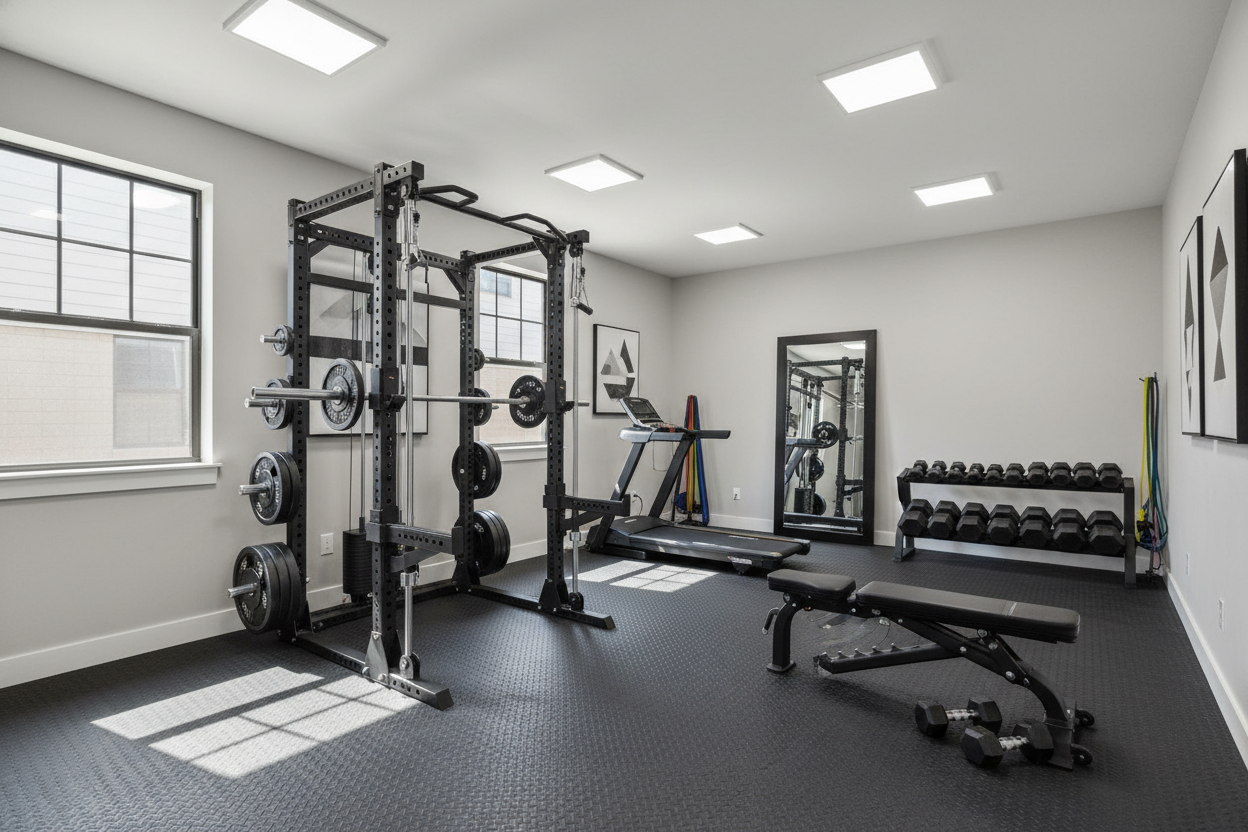
I remember the exact moment I realized my first 'home gym' was a total waste of money. I was trying to do a chest press on a plastic-shrouded multi-gym I bought from a big-box store, and the whole frame groaned when I hit 150 pounds. The cables felt like they were dragging through wet sand, and the seat wobbled so much I spent more energy balancing than lifting. That is the reality for most people searching for the best at home full body workout equipment—they end up with a glorified coat rack that doesn't actually build muscle.
- Durability: Look for 11-gauge or 14-gauge steel; anything thinner is a toy.
- Versatility: A real rig should allow for squats, pull-ups, and cable work.
- Safety: Spotter arms are non-negotiable if you are training alone.
- Footprint: Aim for a machine that uses vertical space rather than spreading across the floor.
The Infomercial Trap: Why Most Multi-Gyms Suck
We’ve all seen the late-night ads. A guy with shredded abs claims he got that way using a machine that folds up under his bed. It’s a lie. Those plastic-pulley systems are designed for marketing, not mechanics. The moment you try to apply progressive overload—the literal foundation of muscle growth—these machines fail. The weight stacks are usually too light, and the fixed range of motion is often awkward for anyone who isn't exactly 5-foot-10.
The biggest issue is the 'slop' in the system. When you pull a handle on a cheap machine, there is about three inches of dead space before the weight actually moves. That lack of constant tension kills your gains. Plus, those thin cables are prone to snapping. I’ve seen it happen. There is nothing quite like the fear of a tension cable popping while it's inches from your face. If you want real results, you need equipment that can handle a beating without shaking like a leaf in a hurricane.
What Actually Makes a Machine Worth Your Garage Space?
If you are dropping a few thousand dollars, you need to be picky. The why a Smith rig beats standard multi-gyms argument usually comes down to the quality of the movement. A real, high-quality best full body home exercise machine should feature linear bearings. These are the same components used in industrial machinery to ensure smooth, friction-free travel. If the bar catches or stutters, you aren't training your muscles; you're fighting the equipment.
You also need to look at the steel. If the manufacturer doesn't list the gauge, assume it is thin garbage. 11-gauge steel is the gold standard for commercial gyms, but a solid 14-gauge is plenty for a home setup. You want a frame that stays planted when you rack a 300-pound barbell. If the machine moves when you do a pull-up, it’s a safety hazard. Real equipment uses oversized bolts and reinforced gussets at the corners to keep everything rigid.
The Case for the All-In-One Rig
The modern solution to the space problem is the all-in-one rig. This is essentially a power rack, a functional trainer, and a Smith machine smashed into one footprint. It is the best full body workout machine at home because it eliminates the need for five different stations. You can go from heavy back squats in the rack to high-to-low cable flies in about thirty seconds. This is how you maximize a 10x10 spare room or a corner of your garage.
When you start looking at a Smith machine home gym station, you're looking for a piece that doesn't compromise on free-weight capability. You want the ability to use a real Olympic barbell for your primary lifts, but have the Smith bar there for burnout sets or solo heavy pressing. A heavy-duty multi training station usually includes plate-loaded or selectorized cable stacks, which are vital for accessory work like face pulls, tricep extensions, and lat pulldowns. This combination allows you to hit every muscle group from every angle without ever leaving the cage.
How to Program a Full Routine on One Machine
You don't need a sea of machines to get big. I run a simple Push/Pull/Legs split on a single rig. On Push day, I use the rack for overhead presses and the cables for lateral raises. On Pull day, I hit weighted pull-ups on the multi-grip bar and seated rows using the low pulley. For Legs, it’s all about the squat rack and maybe some Smith machine lunges to really torch the quads. The key is to treat the machine like a toolbox, not a fixed-path robot.
The beauty of a cable-and-rack combo is the ability to adjust the resistance curve. Free weights are heaviest at the bottom of the movement, while cables provide constant tension throughout. By mixing both on one machine, you're giving your nervous system a variety of stimuli. You can do your heavy 5x5 work with the barbell, then immediately move to the cables for high-rep hypertrophy work. It’s efficient, and it keeps your heart rate up because you aren't walking across a gym to find the next station.
Is the Upfront Investment Actually Worth It?
A high-end rig isn't cheap. You might see a price tag of $2,000 to $4,000 and have a minor heart attack. But do the math. A decent commercial gym membership is easily $600 to $1,000 a year once you factor in 'annual maintenance fees' and gas. In four years, the machine has paid for itself. More importantly, you get your time back. No more waiting for the guy on his phone to finish his tenth set of curls in the only squat rack.
If you are serious about building a dedicated home gym, buy once and cry once. I’ve seen too many guys buy a $300 bench, then a $400 rack, then a $500 cable tower, only to realize they hate all of them. They end up selling it all for a loss on Facebook Marketplace and finally buying the heavy-duty rig they should have bought in the first place. Invest in a piece of equipment that will outlast you. If it’s built from real steel and uses quality pulleys, your grandkids will be using it to get jacked long after you’re gone.
Personal Experience: The Wobble That Broke Me
Years ago, I bought a 'complete' home gym for $500. It had a butterfly press attachment that felt like it was made of coat hangers. Every time I used it, the frame would tilt slightly to the left. I spent more time tightening bolts than I did lifting weights. Eventually, the cable housing cracked, and the whole thing became a dangerous eyesore. I finally bit the bullet and bought a 3x3 steel rack with a functional trainer. The difference was night and day. My lifts went up because I finally felt safe enough to push to failure. Don't make my mistake—don't buy the cheap stuff.
FAQ
How much ceiling height do I need for a full-body rig?
Most standard cages are around 82 to 84 inches tall. You generally want at least 90 inches of ceiling height so you don't smack your head on the ceiling during pull-ups. Always measure twice before ordering.
Is a Smith machine better than free weights?
It’s not 'better,' it’s a different tool. Free weights build stability, while the Smith machine is excellent for isolating muscles and staying safe when training alone. A good home rig gives you both.
Are plate-loaded cables as good as weight stacks?
Weight stacks are faster to adjust, but plate-loaded systems are much cheaper and allow you to use the plates you already own. As long as the pulleys are high-quality, the 'feel' of the resistance is nearly identical.
Share:
The Only Cardio Equipment at Planet Fitness Worth Your Time
Don't Trust Most Exercise Machines Reviews (Look for This Instead)