
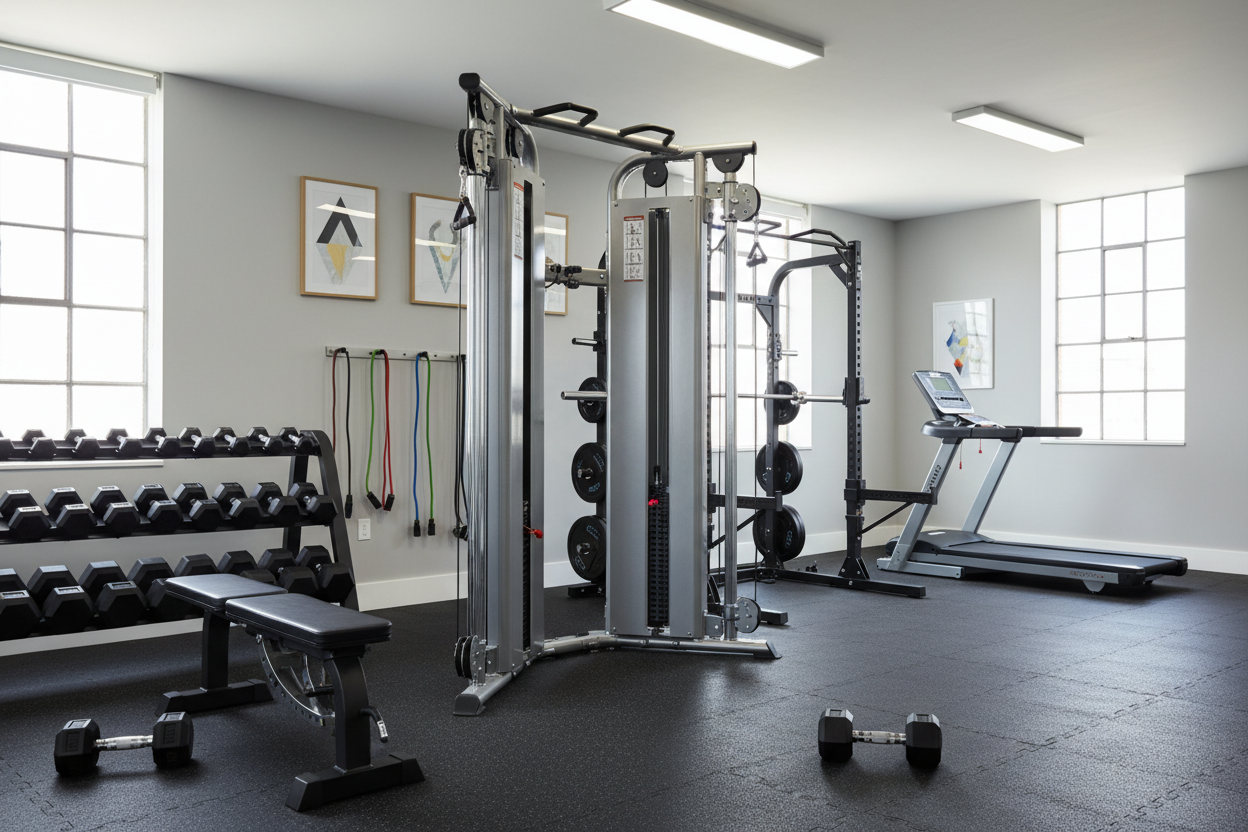
I remember the desperate days of 2020, scrolling through Amazon at midnight, trying to convince myself that a set of colorful latex bands would replace my local gym's cable crossover. Three months later, those bands were frayed, my progress had stalled, and I was terrified of a snap-back taking out an eye during a face pull. If you are hunting for the best at home workout machines, you need to stop looking at rubber and start looking at steel.
Quick Takeaways
- Cables provide constant tension throughout the entire range of motion, unlike bands which are easiest at the bottom.
- Look for 11-gauge steel frames to ensure your machine doesn't wobble during heavy rows.
- Aluminum pulleys last longer and provide a smoother travel than cheap nylon versions.
- Functional trainers are the most space-efficient way to get a full-body workout in a spare room.
The Problem with 'As Seen on TV' Fitness Gimmicks
We've all seen the late-night infomercials for 'revolutionary' tension rods or foldable plastic benches that promise a gym-quality workout for ninety-nine bucks. They are almost always garbage. These machines for home gym use rely on flimsy materials that simply cannot provide the consistent resistance curve required for hypertrophy.
The biggest issue with cheap tension-based gear is the 'dead zone.' You get zero resistance at the start of the movement, and then it ramps up so aggressively at the end that your form breaks down. When you decide to stop buying toys and invest in a legitimate home gym, you realize that gravity and steel are your only real friends in the pursuit of muscle.
Why Cables and Pulleys Beat Elastics Every Time
The physics are simple: cables offer constant tension. Whether you are at the start of a bicep curl or the peak contraction, the weight stack is pulling against you with the exact same force. This is why the best home exercise system will almost always be built around a pulley mechanism.
High-end home units use aircraft-grade steel cables coated in nylon and aluminum pulleys. This setup ensures that the 'drag' or friction is minimal. Rubber degrades over time, loses its elasticity, and eventually snaps. A well-maintained cable system will likely outlive your house. If you want the best home trainer equipment, don't settle for anything that uses a bungee cord.
Key Specs to Look For in a Real Machine
Don't get blinded by shiny paint jobs. You need to look at the bones of the machine. First, check the steel gauge. 11-gauge steel is the gold standard; it’s thick, heavy, and won't flex when you're pulling 200 lbs. If a manufacturer doesn't list the gauge, it's probably thin 14-gauge junk.
Next, look at the pulley ratio. A 2:1 ratio means 100 lbs on the stack feels like 50 lbs in your hand, but you get twice the cable travel—essential for functional movements and shadows boxing. A 1:1 ratio is 'true weight,' which is better for heavy lat pulldowns. Understanding these nuances is vital in learning How to Pick the Best Home Resistance Gym for Serious Lifting without wasting your budget on a machine you'll outgrow in six months.
Selectorized Stacks vs. Plate-Loaded Systems
This is the classic budget vs. convenience debate. Selectorized (pin-loaded) stacks are incredible for supersets. You move a pin and go. They represent the best home strength equipment for people who want to get in, get out, and get on with their day. However, they are expensive to ship because, well, they are heavy.
Plate-loaded systems use the Olympic plates you probably already own. They are much cheaper and often have a higher weight ceiling, but they take up more 'working space' because you need room to slide the plates on and off the pegs. I personally prefer a stack for cables, but plate-loaded is a great way to save a thousand dollars.
All-in-One Systems That Actually Justify Their Footprint
If you only have one corner of a room, a functional trainer/Smith machine hybrid is the way to go. These are often rated as the best home gyms for women and men who want a safe, guided barbell experience without a spotter. They consolidate a squat rack, a pull-up bar, and a dual-cable station into one footprint.
When shopping for these, ensure the Smith bar has a smooth travel and that the cable pulleys swivel 180 degrees. A high-quality Smith Machine Home Gym Station should feel like it belongs in a commercial club, not a basement. If it shakes when you do a pull-up, it’s not the best workout systems for home; it's a liability.
How to Fit a Massive Machine in a Spare Room
Before you drop three grand on the best at home workout system, grab a roll of painter's tape. Tape out the footprint on your floor, but add two feet of 'user space' on every side. I've seen too many people buy a beautiful machine only to realize they can't actually stand in front of it to do a cable fly.
Check your ceiling height, too. Many functional trainers stand 80 to 84 inches tall. If you have a 7-foot basement ceiling and want to do pull-ups, your head is going through the drywall. Always account for the height of the pull-up bar and the 'swing' of the weight plates. A little planning saves you a massive headache and a very expensive return shipping fee.
My Personal Lesson in Cheap Steel
I once bought a 'budget' lat pulldown that used plastic pulleys and a thin square-tube frame. Every time I went over 120 lbs, the whole frame would bow toward me like it was bowing to a king. It was terrifying. I eventually sold it for a loss and bought a commercial-grade functional trainer. The difference in my back development was night and day because I finally felt stable enough to actually push to failure.
FAQ
Are cable machines better than free weights?
They aren't 'better,' they are different. Free weights are king for raw strength, but cables provide constant tension and allow for angles—like lateral raises or chest flys—that dumbbells just can't replicate effectively.
Do I need to grease my cable machine?
Yes. Use a silicone-based spray on the guide rods every few months. Never use WD-40; it attracts dust and will gum up the works, making your 'smooth' machine feel like it's full of sand.
Can I build real muscle with a home cable system?
Absolutely. As long as you have enough weight to trigger progressive overload, your muscles don't know if the resistance is coming from a $50,000 commercial stack or a well-built home unit.
Share:
Is Anytime Fitness Equipment Good Enough for Heavy Lifters?
Are Freestanding Pull Up Machines for Home Worth the Space?