
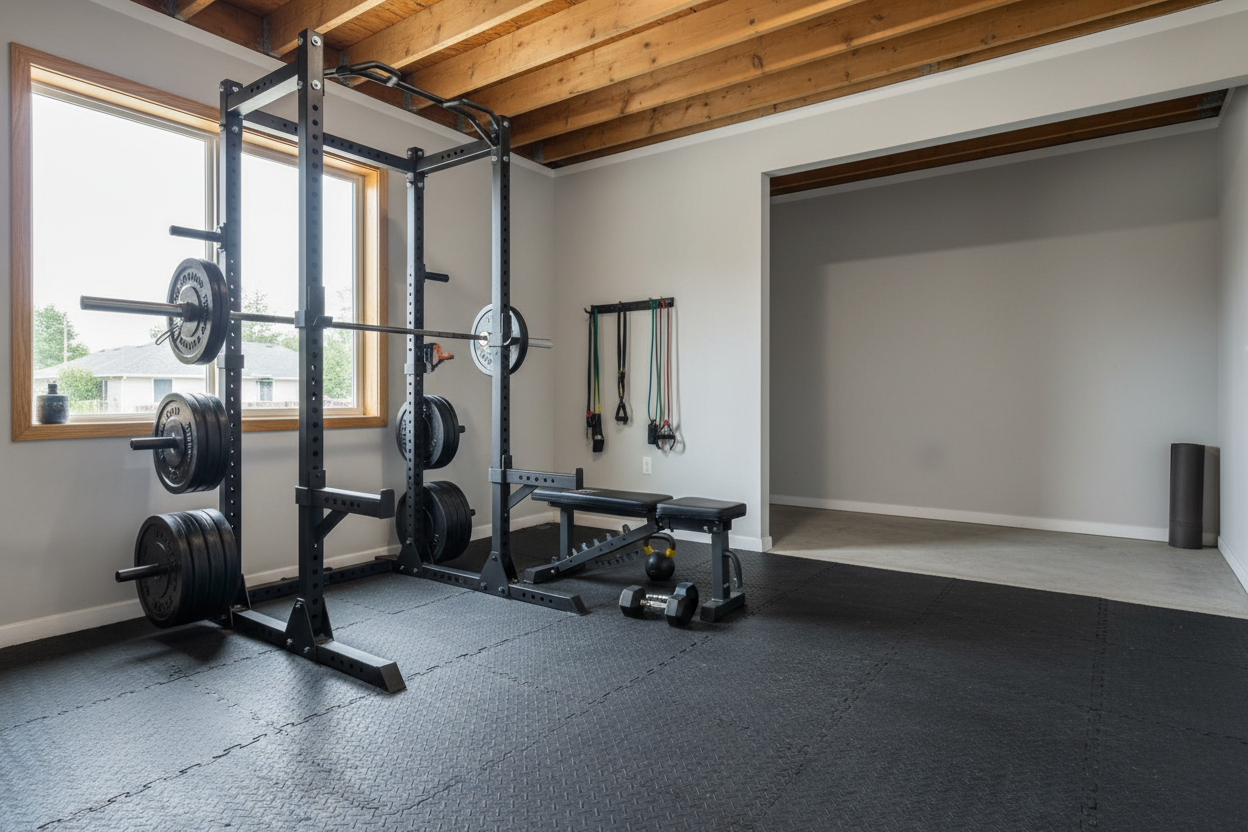
I remember the day I finally quit my $60-a-month commercial gym. I looked at my bank account, then at the crowded squat rack I had to wait twenty minutes for, and realized I could own the equipment for the price of a single year's dues. I spent that night scrolling through Amazon and fitness sites, nearly falling for the trap of buying a 'complete' machine that looked like it was made of soda straws.
If you want to build the best home gym under $1000, you have to stop thinking like a consumer and start thinking like a lifter. You don't need fancy screens or Bluetooth-enabled cup holders. You need steel, iron, and a floor that can take a beating.
Quick Takeaways
- Prioritize the 'Holy Trinity': A power rack, a 20kg barbell, and iron plates.
- Skip the cardio machines; the sidewalk is free and doesn't require a repairman.
- Allocate at least $200 for your barbell—it is the only piece of gear you touch on every rep.
- Avoid 'all-in-one' home gym machines that use cables for everything; they feel mushy and break easily.
The $1,000 Reality Check (What You Can and Cannot Buy)
Let's be real: a thousand bucks is a lot of money, but in the equipment world, it’s a mid-range budget. You aren't going to outfit a 2,000-square-foot facility with custom-branded turf. However, you can absolutely build a setup that will last a decade if you focus on raw materials over electronics. While a home gym under 300 is basically just a pair of dumbbells and a prayer, a $1,000 budget gets you into the world of heavy-duty power racks and Olympic-sized plates.
The goal here is durability. You want a rack that doesn't wobble when you re-rack 300 pounds and a bar that won't permanently bend the first time you drop it. At this price point, you are buying 14-gauge steel and cast iron. It isn't flashy, but it's effective. You are trading the 'amenities' of a commercial gym for the ability to train in your underwear at 11:00 PM without waiting for a bench.
The Holy Trinity: Your Rack, Bar, and Iron
This is the foundation of any home gym. If you get these three things right, you can perform 95% of the most effective strength movements in existence. I recommend spending roughly $750 of your $1,000 right here. You want a power rack with a pull-up bar and safety pins. A solid 2x2 or 2x3 steel cage gives you the confidence to squat and press to failure without needing a spotter.
Next is the barbell. Do not buy the $50 bar from a big-box store. Those bars often have 'sleeves' held on by hex bolts that eventually fly off. Look for a 20kg bar with a 28mm or 28.5mm diameter and a tensile strength of at least 190,000 PSI. This ensures the bar has a good 'whip' but won't turn into a pool noodle under load. Finally, buy iron plates. Used iron is great, but even new cast iron is cheaper than the fancy urethane-coated plates you see in high-end studios.
Where Most Lifters Accidentally Blow Their Budget
The biggest budget killer is the 'shiny object' syndrome. I’ve seen guys spend $600 on a budget treadmill that dies in six months because the motor wasn't built for heavy use. Others get sucked into buying a massive cable crossover machine that takes up the whole garage. While a Smith machine home gym station is a fantastic centerpiece for those with more cash to burn, it will eat your entire $1,000 budget alone, leaving you with no money for plates or a bench.
Avoid the 'as-seen-on-TV' foldable benches and the plastic-shrouded weight stacks. These machines use proprietary parts. If a cable snaps or a plastic pulley cracks, you're stuck with a very expensive coat rack. Stick to 'dumb' equipment. A piece of steel doesn't have a motherboard that can fry during a thunderstorm.
My Exact Math for a Home Gym for Under 1000
When I’m helping a friend plan a home gym for under 1000, I break the math down like this to ensure every dollar adds performance. You can usually find a squat stand or a light-duty power rack for around $350. This should include J-cups and some form of safety spotting arms. Spend $200 on a reputable multi-purpose barbell—something with decent knurling that won't cheese-grate your hands but still offers a secure grip.
For weights, aim for a 160lb to 230lb set of iron plates, which usually runs about $1.20 to $1.50 per pound, totaling around $300. That leaves $150 for a heavy-duty flat bench. I prefer a flat bench over an adjustable one at this price point because a $150 flat bench is a tank, while a $150 adjustable bench often feels like a teeter-totter. This simple breakdown is the secret to building the best home gym under 1000 without any regrets.
How to Expand When You Get Your Next Paycheck
The beauty of a barbell-based gym is that it's modular. You’ve built the core; now you can add the 'accessories.' Once you have another $100, grab a pair of gymnastics rings to hang from your rack for dips and rows. The next month, maybe you find a deal on a pair of 50lb dumbbells or a kettlebell for accessory work.
By starting with the basics, you learn what you actually use. I spent years thinking I needed a leg extension machine, only to realize that once I had a rack, I preferred lunges and Bulgarian split squats anyway. Buy the essentials first, get strong, and let your training style dictate your next purchase.
Personal Experience: The Wobbly Bench Lesson
Early in my lifting days, I tried to save money by buying a $70 'adjustable' bench from a random online seller. It looked fine in the photos. But the first time I tried to bench 225 pounds, the backrest shifted an inch to the left. I spent the whole set focused on not falling off rather than moving the weight. It was terrifying. I sold it for $20 and bought a solid flat bench the next day. Don't cheap out on the things that support your bodyweight and a loaded bar.
FAQ
Do I need special flooring for a $1,000 gym?
Don't buy 'fitness' foam tiles; they tear and compress. Go to a farm supply store and buy 4x6 foot horse stall mats. They are 3/4-inch thick rubber, weigh 100 pounds, and are virtually indestructible for about $50 a pop.
Is a squat stand better than a full power rack?
If you are tight on space, a squat stand is fine. But for a $1,000 budget, a full rack is safer because it has four uprights and better safety bars. It also gives you a place to hang bands and store plates.
Can I get a good workout without dumbbells?
Absolutely. You can do almost everything with a barbell. For movements that usually require dumbbells, like lateral raises, you can use small change plates or even jugs of water until you can afford a real set.
Share:
Why You Lift Way More on Machine Weights (And It Isn't Cheating)
The 3 Specs That Make a Real Gym Weight Bench Feel So Solid