
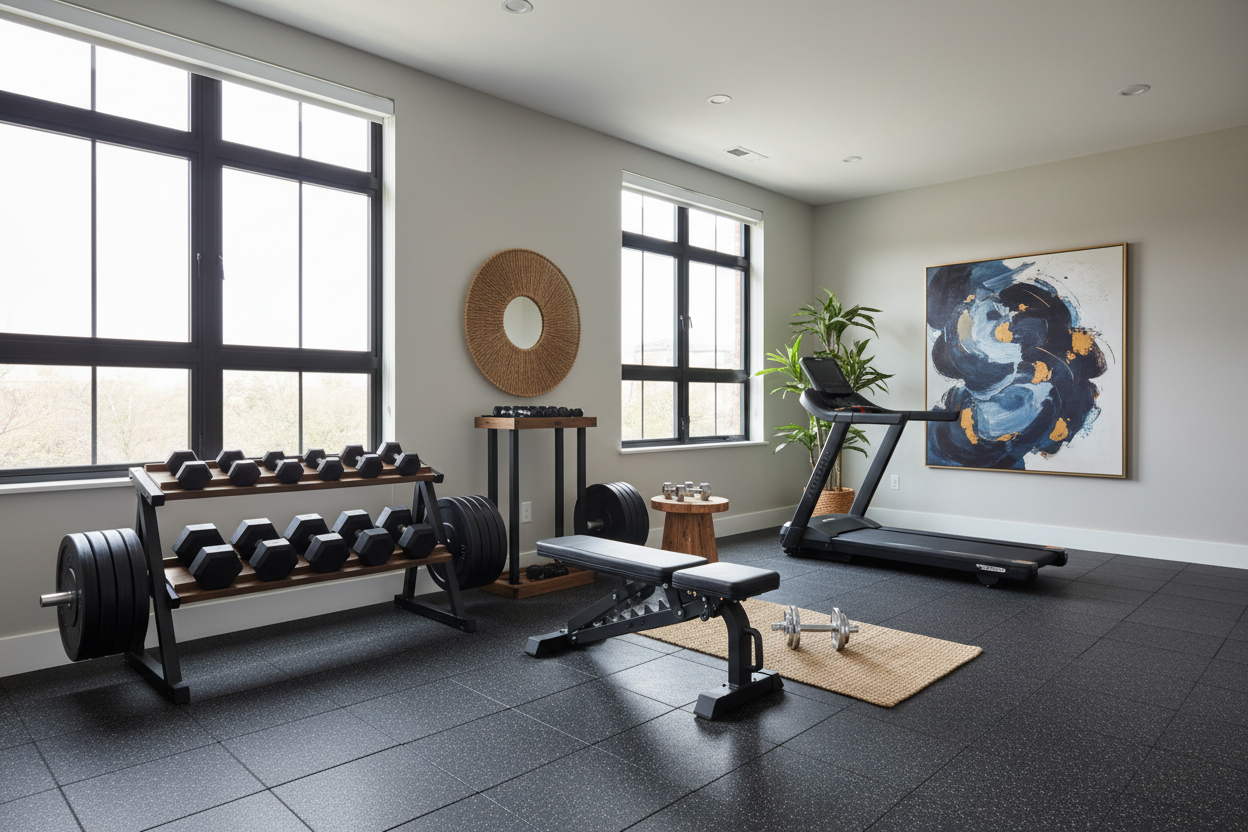
I remember my first garage setup. It was a single 40-watt bulb hanging over a rusty rack that smelled like wet dog and old copper. Every time I walked in there, I felt like I was serving a sentence, not hitting a PR. We have all been there—scrolling through marketplace ads for used iron while our own training space feels like a cold, damp basement corner. But the secret to incredible home gyms isn't just about how much 11-gauge steel you can cram into a 20x20 space.
The difference between a room where you store weights and a place where you actually train comes down to the environment. If your gym feels like a dungeon, you will find every excuse to stay on the couch. I have learned the hard way that a coat of paint and a few light strips do more for your bench press than a $500 specialty bar ever could.
Quick Takeaways
- Lighting is the highest-ROI upgrade you can make for motivation.
- Texture and wall color define the psychological 'zone' of the room.
- High-end aesthetics do not mean you have to sacrifice heavy-duty equipment.
- A single 'anchor' piece of gear should dictate your layout and flow.
Stop Treating Your Garage Like a Prison Cell
Most people treat their home gym like a storage unit that happens to have a barbell. They leave the exposed insulation, the grease stains on the floor, and that depressing grey drywall. When you walk into a space that looks like a mess, your brain registers it as a chore. You are fighting your environment before you even touch the knurling.
An incredible training space needs to be a sanctuary. It should be the one room in your house where you feel completely in control. This starts with a psychological 'trigger.' For me, it is the smell of rubber mats and the sight of a clean, organized rack. When the space is intentional, your brain flips a switch the second you cross the threshold. You aren't 'at home' anymore; you are at work.
Think about the friction points. If you have to move a lawnmower and a stack of boxes just to get to your dumbbells, you are going to skip your accessory work. A unique home gym is built around accessibility and flow. Every piece of equipment should have a home, and that home should look like it belongs there, not like it was dropped off by a moving truck that lost its way.
The Nightclub Effect: Why the Best Looking Home Gyms Use Mood Lighting
Standard garage lighting is garbage. Those flickering fluorescent tubes or cheap LED shop lights kill the vibe. They wash everything out in a cold, clinical blue that makes you look and feel flat. There is a reason high-end boutiques use dim, strategic lighting—it creates focus. It narrows your world down to the bar in front of you.
I always tell people to ditch the overheads and go for 'layered' lighting. Get some RGB LED strips and run them behind your rack uprights or along the ceiling perimeter. Set them to a deep red or a muted blue. It sounds cheesy until you try it. Suddenly, your rack has depth, the plates have shadows, and the whole room feels like a private club. You start to realize that the best at-home gym doesn't exist in a vacuum; it is a product of how you perceive the space while you are under the bar.
Don't forget the mirrors. Not for ego, but for light and space. A large, frameless mirror reflects those LEDs and makes a cramped 10x10 spare bedroom feel like a professional studio. It opens up the room and keeps you from feeling claustrophobic when you are grinding out a heavy set of squats in the dark.
How to Build a Unique Home Gym That Fits Your Exact Vibe
You need to decide what kind of lifter you are before you start buying gear. Are you the gritty powerlifter who wants a bunker that smells like chalk and ammonia? Or are you the functional fitness enthusiast who wants a clean, minimalist studio with plenty of floor space? Your aesthetic should match your training style. When you are building a home gym, the gear is just the skeleton—the vibe is the soul.
For a 'Bunker' vibe, go with dark matte walls—charcoal or navy. Use horse stall mats for that rugged, indestructible feel. If you want the 'Modern Studio' look, go for light oak flooring over your rubber mats and white walls with black accents. This isn't just about best looking home gyms for the sake of photos; it is about creating a space where you feel like the athlete you are trying to become.
Specs matter here too. If you're building a powerlifting den, you want 3x3-inch 11-gauge steel racks with 1-inch holes. If you're going for a sleek studio, maybe you opt for a wall-mounted folding rack that disappears when you're done. Whatever you choose, make sure the quality of the finish matches the room. Nothing ruins a cool home gym designs faster than a cheap, chipping powder coat on a budget rack.
Cool Home Gym Designs That Don't Sacrifice Heavy Iron
People often think 'pretty' gyms are for people who don't lift heavy. That is a mistake. You can have a 500-lb deadlift in a room that looks like it belongs in an architecture magazine. The trick is integration. Instead of a massive, sprawling power rack that eats the whole room, look at a compact smith machine station or a high-end functional trainer with a polished chrome finish.
These pieces of equipment act as the visual centerpiece. A high-quality rack with stainless steel uprights looks like a piece of industrial art. When you pair that with urethane-coated plates instead of chipped iron, the whole aesthetic stays sharp. Urethane plates don't just look better; they are quieter and hold their color forever. If you are training in a spare bedroom, your neighbors (and your spouse) will appreciate the noise reduction of high-end rubber and urethane.
I’ve seen cool home gym designs that incorporate wood-slat acoustic panels behind the rack. It looks incredible, but it also serves a purpose: it dampens the 'clang' of the plates so the sound doesn't echo through the whole house. That is the hallmark of a professional setup—form meeting function in a way that makes you want to train harder.
Where to Start When You Have Bare Walls and Zero Inspiration
If you are staring at a pile of boxes in a messy garage, don't panic. Start with the floor. Rip out the carpet or clean the concrete and lay down high-density rubber. This is the foundation of your gym. Once the floor is down, the room stops being a garage and starts being a training hall. It changes the acoustics and the smell immediately.
Next, pick your anchor. For most, this is the rack. If you are tight on space, look into space-saving all-in-one machines. These units combine a cable system, a smith machine, and a pull-up bar into one footprint. It keeps the middle of the room open, which is the secret to a high-end look. A cluttered floor makes a gym feel small; open floor space makes it feel premium.
Finally, address the walls. Paint is the cheapest way to transform a room. Avoid 'hospital white.' Go for something with some depth. Hang one or two high-quality banners or framed prints—not a dozen cheap posters. One focal point is better than ten distractions. Once the walls are done and the lighting is set, you will find that those 5 a.m. sessions aren't nearly as hard to start.
Personal Experience: The Mistake of the 'Budget' Floor
When I built my second gym, I tried to save money by using thin, interlocking foam tiles from a big-box store. I thought they looked 'clean' enough. Within two months, they were sliding apart under my feet during lunges, and the heavy rack had permanently crushed the foam down to the concrete. It looked cheap, felt dangerous, and ruined the vibe of the whole room. I ended up ripping it all out and buying 3/4-inch stall mats. I wasted $200 and a full Saturday because I prioritized a quick fix over a real foundation. Do it right the first time.
FAQ
Do I need a professional designer for a unique home gym?
Not at all. Most of the best setups are DIY. Focus on three things: consistent colors, hidden cable management, and layered lighting. If you keep the color palette to two or three tones, it will look professional.
What is the best wall color for a home gym?
Darker colors like charcoal grey or forest green are great for focus and hide scuff marks from weights. If the room is very small and has no windows, a light grey can keep it from feeling like a coffin while still looking better than plain white.
How can I make my gym look better on a tight budget?
Paint the walls and buy a $30 set of LED light strips. Organizing your plates on a dedicated tree instead of leaning them against the wall also makes a massive visual difference for almost no cost.
Share:
Will a Heavy Weight Leg Press Machine Crack Your Garage?
I Tested the Everyday Essentials Home Gym So You Don't Have To