
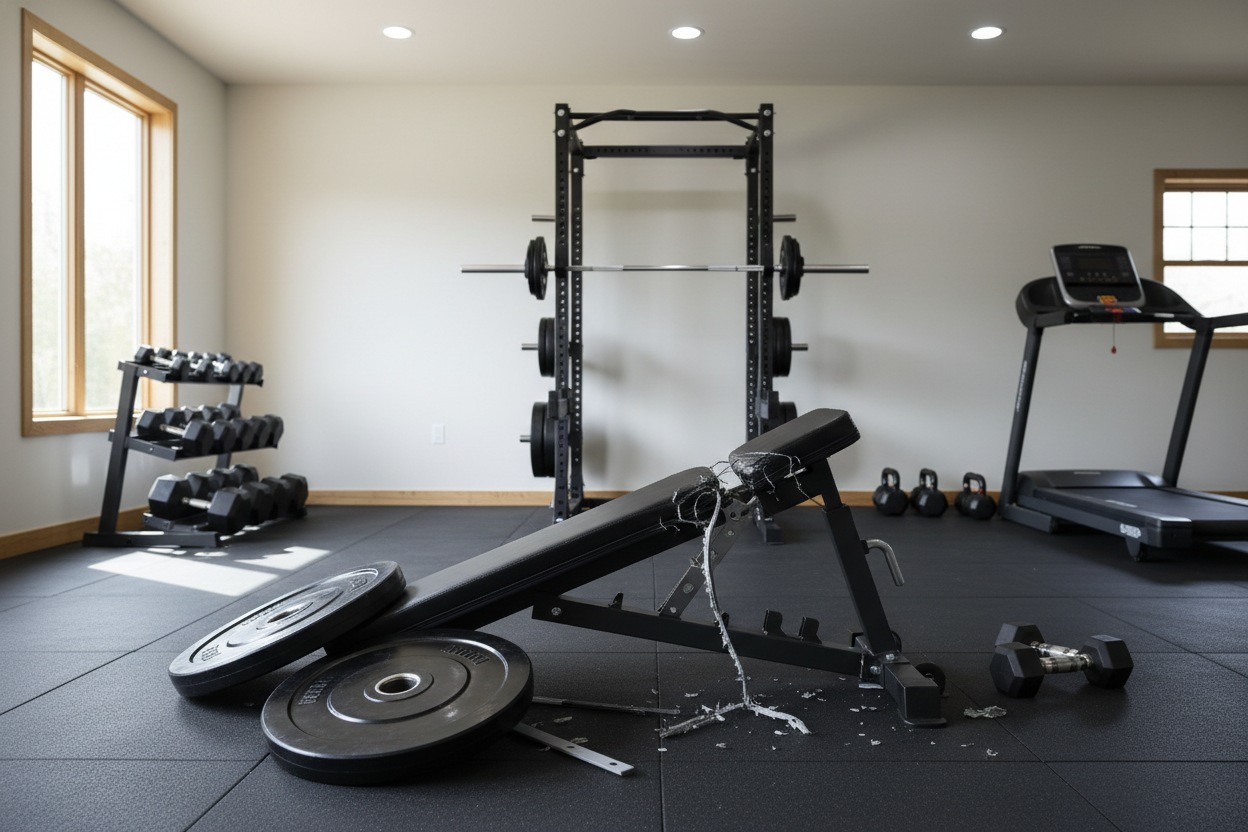
I remember scrolling through Amazon during the 2020 lockdowns, desperate for anything that didn't cost five hundred bucks or take six months to ship. I almost clicked 'buy' on a plastic exercise bench that looked like a glorified LEGO set. It had four stars and a 'budget-friendly' price tag that felt like a win at the time. Thank god I hesitated.
Most people see a flat surface and think 'bench press,' but there is a massive difference between a platform meant for stepping and one meant for supporting a human plus a loaded barbell. If you are serious about lifting, that plastic frame is a ticking clock. Eventually, physics wins, and usually, it wins right when you have a heavy bar over your throat.
Quick Takeaways
- Plastic is excellent for cardio and metabolic conditioning, but dangerous for heavy strength training.
- Polymer fatigue is often invisible; the bench looks fine until the moment it shatters.
- Weight capacities on plastic gear are frequently misleading and don't account for dynamic force.
- Steel is the only material that belongs under your spine during a heavy press.
The Dangerous Confusion Between Aerobic Steps and Lifting Benches
The market is flooded with gear labeled as a plastic workout bench, but 90% of these are actually high-density polymer aerobic steps. They are fantastic tools for box jumps, high-rep lunges, or cardio-focused circuits. They are designed to take the impact of your feet, which is a distributed load. They are not designed to handle the concentrated force of your shoulder blades digging in while you are holding iron.
New home gym owners often see the word 'bench' and assume it's a universal term. It isn't. A true lifting bench needs to be rigid to allow for proper leg drive and stability. A plastic step flexes. That flex might feel like 'cushioning' during a step-up, but during a bench press, that instability causes your stabilizer muscles to fire erratically, ruining your form and increasing the risk of a shoulder tweak.
Why a Plastic Weight Bench Can't Handle Real Iron
Physics doesn't care about your budget or how many positive reviews a product has. Plastic is a polymer; it flexes and 'creeps' under load over time. When you are benching, you aren't just holding weight; you are creating a high-pressure point on a very small surface area. Most lifters forget that Your Gym Math Is Wrong The Real Matrix Bench Press Bar Weight isn't the only number that matters—you have to add your own body weight to that total.
If you weigh 200 lbs and you are benching 150 lbs, that plastic weight bench is supporting 350 lbs of force. Most of these plastic units are rated for exactly that—300 to 350 lbs. You are redlining the equipment on every single rep. Unlike steel, which might slightly bend or creak to warn you of failure, plastic tends to fail catastrophically. It snaps. One second you are mid-set, and the next, the support leg has sheared off because the polymer reached its fatigue limit.
The Weak Points: Hinges, Pins, and Polymer Fatigue
This is where the cheap stuff really falls apart. If you buy an adjustable plastic model, look closely at the hinges. They are usually held together by thin metal pins or, in the worst cases, molded plastic tabs. These are the primary stress points. Every time you sit down, you are grinding those joints. Over months of use, the plastic around the pin holes begins to wallow out, making the bench wobbly.
Polymer fatigue is a silent killer in the gym. Unlike a steel frame that shows rust or visible cracks in a weld, plastic can look brand new while its internal structure is compromised by UV exposure or repeated stress cycles. I've seen 'heavy duty' plastic platforms literally crumble because they were kept in a hot garage for two summers. You don't want to be the guy who finds out his bench has expired while holding a pair of 70-lb dumbbells.
When Does a Plastic Workout Bench Actually Make Sense?
I am not a total hater. I actually keep a plastic step in my garage. It is light, it doesn't rust when the humidity hits 90%, and it is the perfect height for Bulgarian split squats. If your feet are on the floor and you are using 15-lb or 20-lb dumbbells for high-rep metabolic work, a plastic setup is perfectly safe and actually quite functional. It's a tool for conditioning, not max-effort strength.
If you are doing physical therapy, rehab exercises, or light dumbbell circuits where you never exceed a total load (bodyweight plus weights) of 250 lbs, go for it. The portability of plastic is a huge plus if you need to drag your gear into the driveway for a HIIT session. Just know the limits. As soon as you start chasing PRs, that plastic gear needs to stay in the corner.
Budget-Friendly Steel Upgrades That Won't Snap Mid-Press
If you are serious about getting strong, skip the polymer and go straight to a real Weight Bench made of 11-gauge or 14-gauge steel. You do not have to spend six hundred dollars to get something that won't kill you. The peace of mind you get from knowing your equipment isn't the weakest link in your training is worth every penny of the upgrade.
For those looking for versatility without the danger, the Adjustable Weight Bench Owb01 is a prime example of what a budget-friendly steel alternative should look like. It provides the stability of a tank and uses actual steel bolts and a reinforced frame that won't wobble when you are trying to set a new personal record. It is an investment in your safety, not just your gains.
My Personal Experience with Plastic Gear
I once tried to use a plastic aerobic step for heavy seated overhead presses because my main bench was buried under a pile of move-in boxes. I thought, 'It is just one set, it will be fine.' About three reps in, I felt the plastic platform 'sigh.' It didn't break, but it compressed enough that my center of gravity shifted. I had to ditch a 60-lb dumbbell, and it missed my big toe by about an inch. That was the last time I ever trusted my spine to a piece of molded plastic.
FAQ
Is a plastic bench okay for beginners?
Only if you are sticking to bodyweight exercises or very light dumbbells. If you plan on progressing to heavier weights, you will outgrow a plastic bench in three months. Buy steel once and save money in the long run.
What is the actual weight limit of a plastic exercise bench?
Most are rated between 250 and 350 lbs. Remember, this includes your body weight. If you are a 200-lb man, you only have 50-100 lbs of 'weight capacity' left for your dumbbells.
Does plastic equipment degrade over time?
Yes. Heat, cold, and UV light (sunlight) all make plastic more brittle over time. A plastic bench that was safe three years ago might be a hazard today if it's been stored in a garage.
Share:
I Built a Full Garage Routine Around a 25 lb Dumbbells Set of 2
Why a Back Exercise Bench Is the Most Underrated Tool in Your Gym