
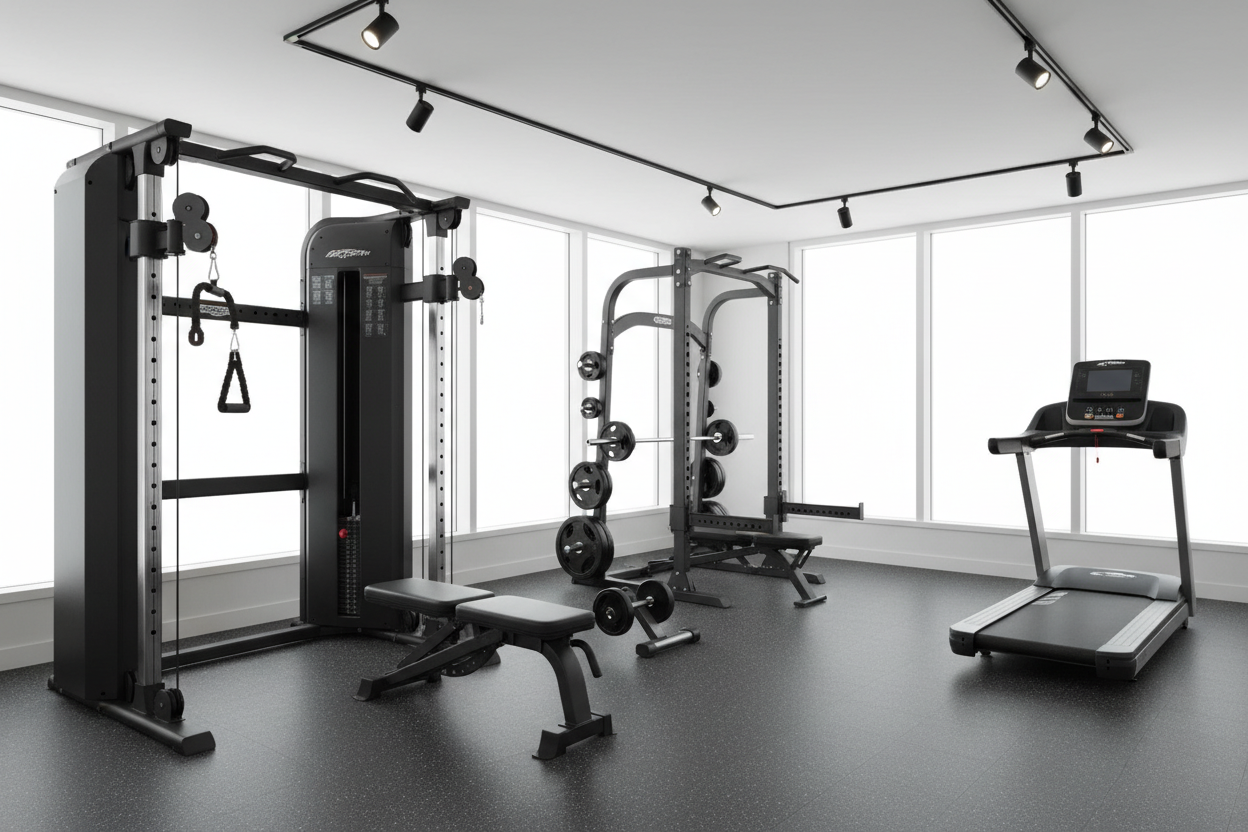
I remember the first time I brought a budget-grade multi-gym into my garage. It looked great in the glossy photos, but the first time I sat down for a chest press, my right shoulder clicked like a socket wrench. Most home fitness machines aren't actually designed for your body; they're designed to fit into a specific shipping container dimensions to maximize profit margins.
Quick Takeaways
- Fixed movement paths ignore your natural joint mechanics, leading to chronic inflammation.
- Cheap nylon pulleys create friction 'dead spots' that ruin your eccentric control.
- Micro-adjustments are a necessity, not a luxury, especially for lifters outside the 5'8' to 5'11' height range.
- Independent, converging arms are the gold standard for shoulder health.
The 'One Size Fits All' Lie of Residential Gear
Most mass-market engineering teams design for a 'statistically average' human. If you're 6'2' or 5'2', you've probably noticed that the leg developer on your weight gyms hits your shins in the wrong spot or the overhead press starts three inches behind your ears. This isn't just uncomfortable; it's a recipe for a labrum tear.
A quality weight machine for home gym use needs more than just a seat that goes up and down. You need adjustable start positions. If a machine forces you to start a heavy lift from a position of extreme stretch because the handles don't move, you're asking for a pec strain. I look for at least 5-7 adjustment points on any lever arm before I even consider putting it in my cart.
Fixed Axis vs. Converging Arcs: The Shoulder Killer
The biggest problem with a cheap weight machine home setup is the linear path. When you press a barbell, your hands naturally want to move in a slight arc, coming closer together at the top. Low-end machines force your hands to stay on a fixed, parallel track. This forces your shoulders to rotate internally under load, which is exactly how you develop impingement.
If you want to train heavy without the Vitamin I (Ibuprofen) habit, you need equipment that mimics natural biomechanics. Using a Weight Bench Chest Press Machine Independent Arms Z1 Pro is a massive upgrade because the arms move independently and converge. This allows your joints to follow their natural path of least resistance while still keeping the tension on the muscle fibers you're actually trying to grow.
The Cable Pulley Trap: When Smoothness Disappears
I've tested home weights system units where the cable felt like it was being dragged through wet sand. This usually comes down to cheap nylon pulleys and unlubricated, thin-gauge guide rods. When the resistance is 'stuttery,' you lose the mind-muscle connection and, worse, you lose tension during the most important part of the lift: the eccentric.
Sometimes, a simple plate-loaded lever is better than a bad cable stack. I've found that Why I Ditched Cables for a Simple Free Weight Home Gym System is a sentiment shared by many garage lifters who realized that a $500 cable machine is often just a $500 paperweight. If you can't afford high-end aluminum pulleys with sealed bearings, stick to heavy-duty iron levers.
How to Vet a Weight Machine for Home Gyms (Without Testing It)
When you're shopping for an at home weights machine online, you have to be a detective. First, check the steel gauge. If it's 14-gauge, it's going to wobble when you load more than two plates. You want 11 or 12-gauge steel for anything involving heavy pressing or squatting. Second, look at the pivot points. Are they using plastic bushings or actual ball bearings?
For vertical movements, the quality of the tracking is everything. If you're looking at a Smith Machine Home Gym Station, zoom in on the linear bearings. You want a system that glides on hardened steel rods, not just plastic sleeves sliding over painted metal. A good machine should feel 'invisible'—you should feel the weight of the plates, not the friction of the machine.
Building a Setup That Doesn't Feel Like a Toy
Stop buying gym machines home catalogs pitch as '50-in-1' stations. Usually, those machines do 50 things poorly and zero things well. I'd rather have one rock-solid adjustable bench and a pair of high-quality lever arms than a flimsy tower that tries to do everything. Focus on the 'touch points'—the handles, the seat upholstery, and the adjustment pins.
When you finally commit to building your Home Gym, prioritize adjustability over the sheer number of stations. A machine that fits your body perfectly will be used for a decade; a machine that hurts your elbows will become a very expensive clothes rack within six months. Trust your joints, not the marketing copy.
My Honest Mistake
I once bought a 'pro' lat pulldown because it was on sale for $300. The guide rods were so thin they bowed when I loaded 180 lbs, causing the weight stack to catch and then drop suddenly. It was terrifying and nearly took out my lumbar spine. I sold it for parts and learned the hard way: if the frame weight isn't at least 150 lbs, it probably isn't stable enough for serious lifting.
FAQ
Why does my shoulder hurt on a machine but not with dumbbells?
Dumbbells allow your wrists and elbows to rotate to find the most comfortable path. Most machines lock you into a fixed track that might not align with your specific shoulder socket anatomy.
Are aluminum pulleys worth the extra money?
Absolutely. They don't warp under heat or heavy loads like nylon does, meaning the 'drag' stays consistent throughout the entire set.
What is a 2:1 cable ratio?
It means for every 10 lbs on the stack, you feel 5 lbs of resistance. This allows for more cable travel and a smoother feel, which is ideal for functional movements and rehab work.
Share:
Why Most All In One Exercise Machine Setups Fail After 6 Months
I Loved Free Weights. Now I Exercise With Machine Rigs Daily.