
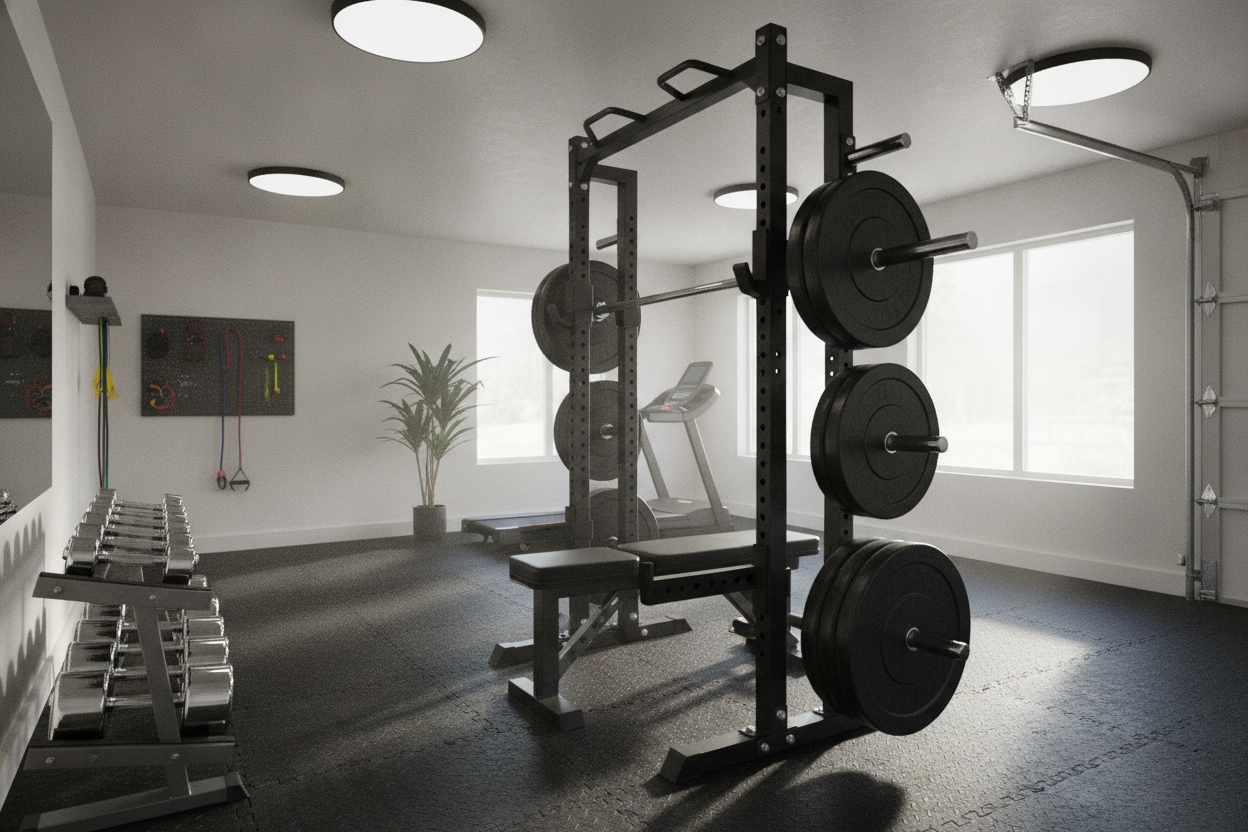
I remember my first 'big box store' bench. It was a flimsy thing I bought on a whim because the price was right. I was scrolling through listings at midnight, trying to save a buck, but the moment I put two plates on each side, the whole bench press weight holder started swaying like a palm tree in a hurricane. It is a terrifying feeling when you realize the only thing between you and a crushed sternum is a 1.5-inch piece of hollow steel. If you are training in a garage without a spotter, that wobble is not just annoying—it is a warning sign.
Quick Takeaways
- Cheap 14-gauge steel is a liability; look for 11-gauge for real stability.
- Independent stands allow for a custom grip width that fixed frames usually block.
- A quality J-hook with a plastic liner protects your bar's knurling and your safety.
- Moving racks are the best solution for multi-use garage spaces.
The Day My Uprights Failed Me Mid-Lift
I was testing a budget fixed bench—one of those 'all-in-one' deals you see on every discount site. I loaded 225 lbs for a quick triple, thinking I was safe because the manual said it could handle 300. On the second rep, as I went to rack the bar, the left weight holder for bench press literally groaned under the pressure. The steel buckled just enough to make the bar slide toward the edge of the hook. I had to dump the plates on the right side just to keep the whole thing from flipping over on top of me.
That was the last time I trusted a thin-walled bench press bar stand. I realized that I swapped my rack for adjustable weights and bench because I needed gear that did not make me second-guess my life choices during a heavy set. When you are pushing your limits, you need to know that the bench press weight stand is not going to fold like a lawn chair. Budget gear has its place, but the uprights are the one area where 'good enough' can get you seriously hurt.
Fixed Frames vs. Free Standing: Stop Buying Cages You Don't Need
A lot of guys think they need a massive bench press frame to be safe. While a full power cage is great, it is often overkill for a dedicated pressing station. The problem with many fixed frames is the width. If the uprights are too narrow, they get in the way of your natural grip. If they are too wide, you risk hitting them on the way down. This is where a free standing bench press rack shines. It gives you the freedom to move the uprights exactly where you need them for your specific arm length and shoulder width.
Biamechanically, a barbell bench press rack that is independent allows for a cleaner bar path. You are not fighting the equipment to get into position. Plus, if you are doing an outdoor bench press rack setup, independent stands are much easier to move in and out of the shade or garage. A fixed bench press rack and bench combo is usually harder to level on uneven driveway concrete, whereas individual stands can be shimmed or adjusted separately.
The 'J-Hook' Test: How to Spot Marketing BS
When you are looking for a barbell stand for bench press, ignore the shiny photos and look at the specs. If the manufacturer does not list the steel gauge, it is probably 14-gauge trash. You want 11-gauge steel—it is thicker, heavier, and will not flex under a 300-lb load. Also, look at the welds. A bench press rack cheap manufacturers put out will have 'tack' welds that look like beads of water. You want deep, consistent welds that wrap around the entire joint.
The J-hooks are your primary safety point. If they are just bent pieces of flat metal, your bar is going to roll. High-quality hooks have a deep pocket and a UHMW plastic liner to save your bar's knurling. Once you find a stand that passes the test, make sure you pair it with a heavy-duty Weight Bench. A rock-solid rack is useless if the bench underneath it slides around every time you try to use leg drive. I have seen guys spend $500 on a rack and then use a $40 bench that wobbles—it defeats the whole purpose of a stable pressing station.
Why Space-Starved Lifters Need a Moving Rack
If your gym doubles as a parking spot for the family SUV, you do not have room for a bolted-down cage. A bench press with moving rack is the ultimate compromise. These units usually have wheels on the back, allowing you to tilt and roll them into a corner when the workout is over. Portability does not have to mean a lack of stability. I have used moving racks that felt more solid than bolted-down units simply because they had a wider base and better weight distribution.
For those who want the absolute most out of a small footprint, something like the Weight Bench Chest Press Machine Independent Arms Z1 Pro is a solid alternative. It provides that locked-in, stable feel of a machine without the massive footprint of a separate rack and barbell. However, if you are a purist who needs a barbell in your hands, stick to high-quality independent stands that you can tuck away after your session.
Building the Ultimate Pressing Station
The final step is marrying your rack for weight bench with the right accessories. Do not forget about plate storage. A rack that has weight pegs at the bottom is inherently more stable because the plates act as an anchor. If your weight bench holder does not have built-in storage, you might find the uprights shifting slightly during a rough re-rack. It is a small detail that makes a massive difference in how the equipment feels during a max effort attempt.
Sometimes, an all-in-one unit actually makes sense if it is engineered correctly. If you are looking for a station that handles everything from chest to legs, the Weight Bench With Barbell Rack And Biceps And Leg Extension Curl Station Z3 is a rare example of a combo unit that does not feel like a toy. It integrates the rack and bench into a single footprint, which is perfect for lifters who want a 'set it and forget it' setup. Just remember: whether it is a combo or a separate stand, if it wobbles when you touch it, do not trust it with your life.
FAQ
Is a free standing rack safe for 300+ lbs?
Yes, provided it is made of 11-gauge steel and has a wide enough base. Most high-quality independent stands are rated for 500-1,000 lbs. Just make sure the floor is level so they do not tip.
What is the difference between 11-gauge and 14-gauge steel?
11-gauge is roughly 1/8 inch thick and is the standard for commercial gyms. 14-gauge is much thinner and lighter, often found in 'budget' home equipment. 11-gauge is significantly more stable and durable.
Can I use a squat stand for bench pressing?
Absolutely. Most squat stands are height-adjustable enough to work perfectly as a bench press stand. Just ensure the J-hooks can drop low enough for your bench height.
Share:
I Tested the Best At Home Exercise Equipment and Kept Exactly 3 Pieces
Is a 3D Jones Machine Actually Better Than a Power Cage?