
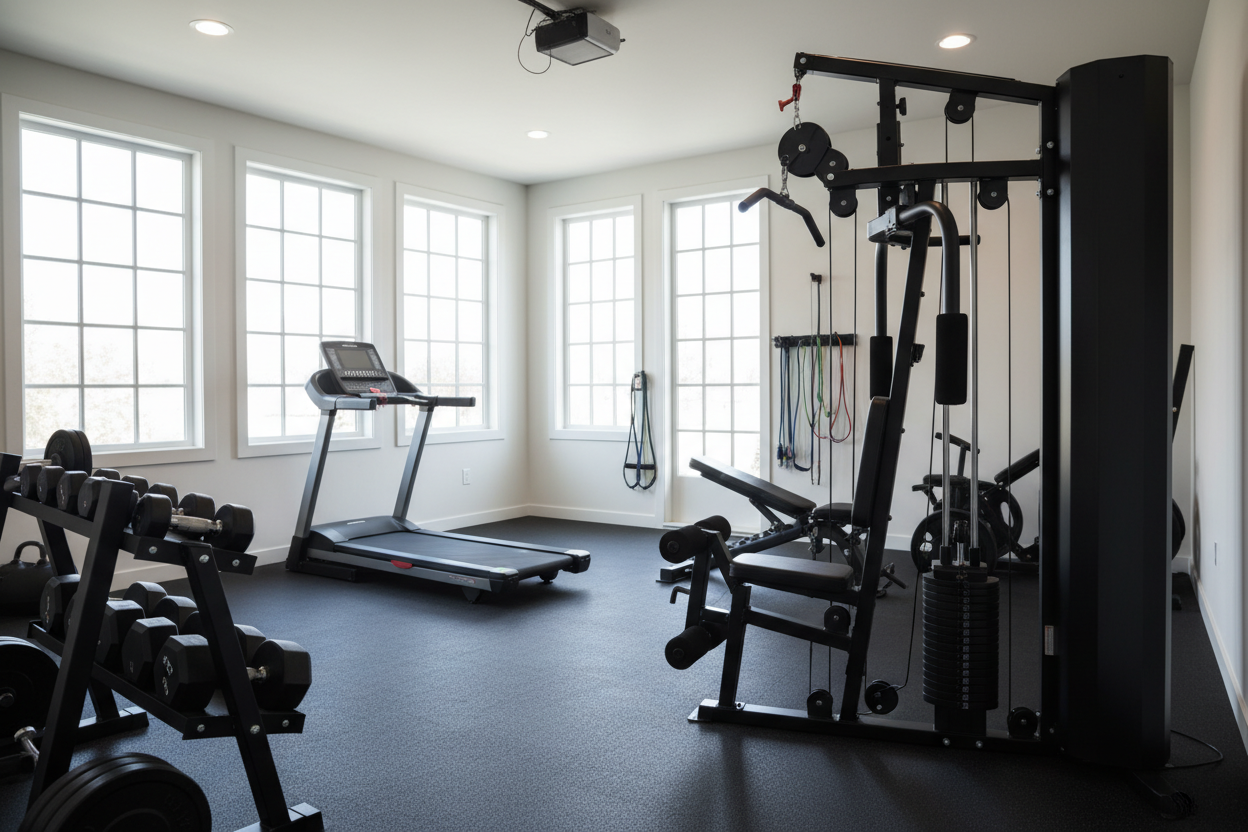
I spent years training in commercial dungeons before I finally pulled the trigger on a home setup. I remember scrolling through endless listings for an exercise machine home gym at midnight, trying to figure out why one cost $800 and another cost $3,000 when they looked identical in photos. I bought the cheap one first. Within three months, the cables were fraying, the frame groaned during every lat pulldown, and the whole thing felt like it was held together by hope and thin 14-gauge steel.
Don't be like me. Most of the stuff marketed to home users is built for a guest bedroom, not a garage where real work gets done. You need equipment that stays out of your way and lets you focus on the lift, not whether the machine is going to tip over during a heavy row.
Quick Takeaways
- If the machine weighs less than the person using it, it is a liability.
- Nylon pulleys are the industry standard for 'cheap'—look for aluminum.
- Static weight ratings are marketing fluff; look for dynamic durability.
- Fixed resistance curves ruin muscle activation; biomechanics matter.
- Ensure the unit allows for progressive overload via weight stack expansions or plate pegs.
Why 'Heavy-Duty' Usually Means Flimsy Trash
In the equipment world, 'commercial grade' has become a meaningless buzzword. Manufacturers slap it on any home gym machine with weights that isn't made of literal plastic. Real commercial equipment is built with 11-gauge steel and massive footprints. Most home units use 14-gauge or even 16-gauge steel—which is basically a glorified soup can.
When you see 'heavy-duty' in a product description, look for the actual steel specs. If they don't list the gauge, assume it's thin. Thin steel flexes under load, and over time, that flex leads to metal fatigue and cracked welds. You aren't just buying a tool; you're buying a frame that needs to hold hundreds of pounds over your head for the next decade.
Red Flag 1: The Machine Weighs Less Than You Do
Physics is a cruel mistress. If you're a 220-lb lifter trying to do a heavy seated row on a machine that weighs 180 lbs, guess what happens? The machine is coming to you. A quality weight lift machine at home needs mass to stay anchored. Why Most Compact Gym For Home Setups Snap Under Heavy Weight often comes down to this exact lack of structural integrity.
I look for a high shipping weight. Mass usually equals stability. If the unit doesn't have a bolt-down option and it’s light enough for you to slide across the floor with one hand, it’s going to wobble the second you try to push a set to failure. You want a frame that feels like it’s part of the foundation.
Red Flag 2: Cheap Plastic Pulleys and Thin Cables
The drive system is the heart of any strength machines for home. Cheap units use nylon pulleys with open bearings. These catch dust, hair, and grit, eventually developing 'flat spots' that make the lift feel jerky. It ruins the mind-muscle connection when you're fighting the machine's friction instead of the weight.
Demand aluminum pulleys with sealed bearings. They provide a buttery smooth travel that feels the same on rep one as it does on rep one thousand. Also, check the cable thickness. 1/8-inch cables are for clotheslines; you want 3/16-inch or 1/4-inch aircraft-grade cables coated in nylon to prevent fraying and snap-backs.
Red Flag 3: Inflated Max Weight Capacities
You’ll often see a universal gym machine for sale boasting a 1,000-lb weight capacity. This is almost always a 'static' rating, meaning they put a thousand pounds on it and it didn't collapse into a pile of scrap. That is not the same as a 'dynamic' rating, which is what the machine can handle while the parts are moving.
If you're serious about your progress, look for verified, high-capacity equipment in a reputable Home Gym collection. A machine rated for 300 lbs of dynamic weight is infinitely better than one claiming 1,000 lbs of static capacity. If the manufacturer is vague about how they tested those numbers, they're probably hiding a weak link in the chain or a thin bolt that can't handle the shear force of a heavy drop.
Red Flag 4: The Resistance Curve Feels Off
Have you ever used a workout weight machines for home where the weight feels heavy at the start but then totally disappears halfway through the rep? That’s a garbage resistance curve. It usually happens because the pivot points are poorly engineered or the cams aren't shaped correctly. It’s a waste of time because your muscles aren't being challenged through the full range of motion.
I prefer machines that mimic natural human movement. For example, a Weight Bench Chest Press Machine Independent Arms Z1 Pro uses independent arms to ensure the tension stays on your pecs rather than shifting to your joints as you lock out. If the machine feels 'light' at the top, it’s a red flag that the geometry is wrong.
Red Flag 5: You Can't Grow With It
The biggest mistake I see is people buying a body weight machine for home or a selectorized unit with a 150-lb stack, thinking that’s plenty. Six months of consistent training later, they’re maxing out the stack on every exercise. If you can't add more weight, the machine is dead to you.
Look for home gym units that offer weight stack expansions or have integrated plate pegs so you can add Olympic iron to the stack. This is Why I Traded Free Weights for a Full Body Workout Machine at Home—I found a unit that actually let me push my limits without hitting a ceiling. If the machine doesn't allow for progressive overload, you're just buying a very expensive clothes rack.
The Final Verdict: Buy Once, Cry Once
Quality costs more upfront, but it’s cheaper than buying a budget machine twice. If you want a setup that avoids all these pitfalls, a Smith Machine Home Gym Station is usually the gold standard for safety and versatility. Check the steel, check the pulleys, and for the love of your floor, check the weight.
Personal Experience: The Wobble of Regret
I once bought a budget lat pulldown because it was on sale for $250. It looked great in the photos. But the first time I loaded it with 200 lbs, the vertical upright visibly bowed toward me. I had to have my wife sit on the base of the machine just so I could finish my sets without the whole thing tipping. I ended up selling it for $50 on Craigslist two weeks later. Now, I don't even look at a machine unless it has at least an 11-gauge steel frame and a footprint that doesn't move when I kick it.
FAQ
Is 14-gauge steel okay for a home gym?
It’s fine for light accessory work or if you’re a beginner, but if you’re planning on lifting heavy or want the machine to last a decade, you really want 11-gauge. 14-gauge flexes too much under serious load.
Are aluminum pulleys really better than plastic?
Yes. Plastic (nylon) pulleys wear down, develop grooves, and create friction. Aluminum pulleys with sealed bearings are smoother, quieter, and won't need to be replaced every two years.
How much space do I actually need for a home gym machine?
Always add at least two feet to the manufacturer's dimensions on all sides. You need room to load plates, adjust pins, and move around the unit without hitting a wall or your shins.
Share:
I Bought a Second Hand Smith Machine. Here's How to Avoid My Mistakes.
Why the Numbers on Your Gym Machine Weight Plate Are a Lie