
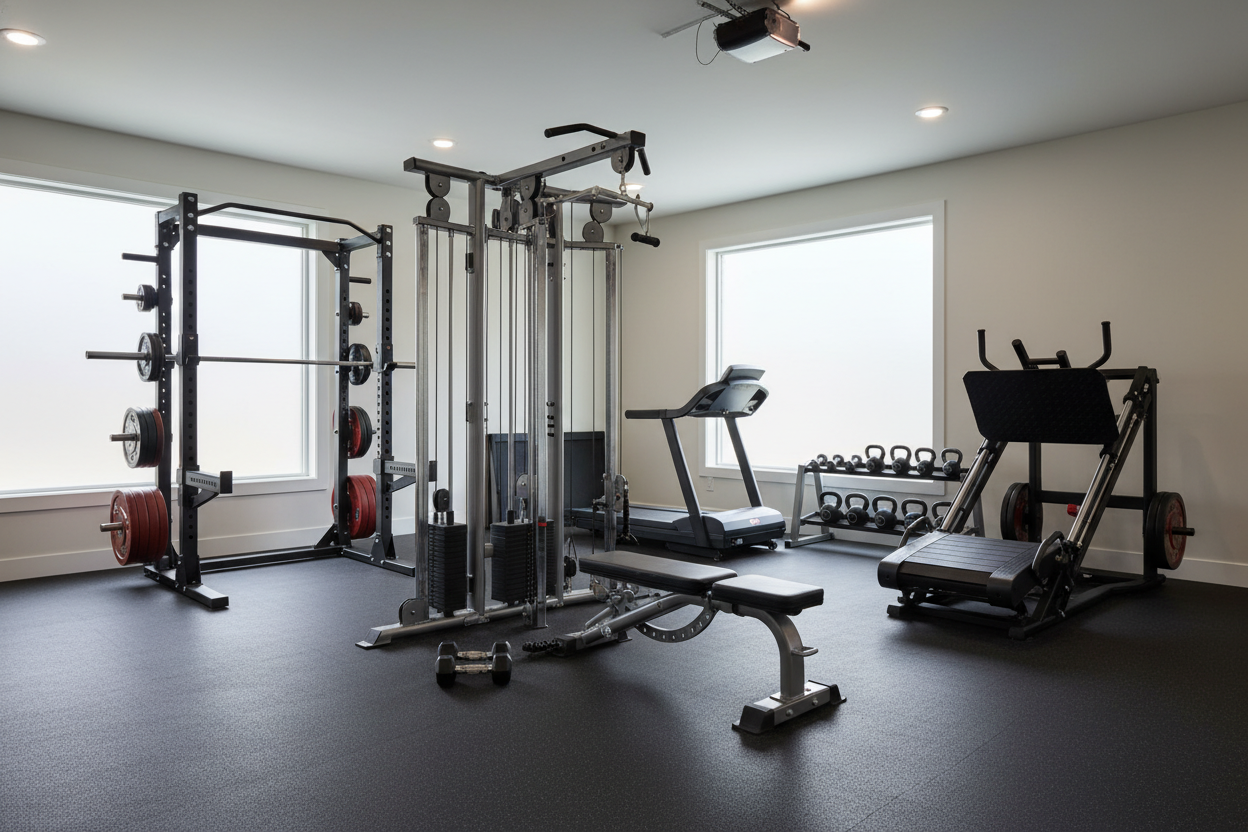
I remember measuring my garage for the fourth time, trying to figure out if I could squeeze a pec deck between my power rack and the water heater. It is the ultimate lifter’s dilemma: you want that deep, isolated burn you get at the local powerhouse, but you only have about 250 square feet to work with. Choosing the right bodybuilding machines is not about recreating a commercial floor; it is about maximizing mechanical tension per square inch.
If you are tired of your workouts feeling ‘incomplete’ with just a barbell and a bench, you are not alone. But before you drop three grand on a piece of steel that only does one thing, you need to be ruthless about utility. Here is how I filter the noise to find the rigs that actually build mass without making my garage unnavigable.
Quick Takeaways
- Cables are the king of constant tension and versatility.
- Combo machines, like a Leg Press/Hack Squat, save roughly 30 square feet of floor space.
- The Smith Machine is a hypertrophy tool, not a 'cheating' tool.
- Avoid single-joint, standalone machines unless you have a literal warehouse.
The Real Cost of Chasing Commercial Gym Pumps at Home
Most muscle building machines are designed for 50,000-square-foot commercial hubs where space is infinite. In a home setting, every machine has a 'rent' price. If a rig takes up 15 square feet but only lets you do one specific curl variation, the ROI is abysmal. You end up tripping over steel just to get to your pull-up bar.
When planning a home gym, I tell people to look for 'force multipliers.' You want gear that allows you to train to absolute failure safely. In a commercial gym, you have a spotter or a sea of machines. At home, you are usually solo. The right machines provide the stability you need to push those final two reps where the real growth happens, without the risk of getting pinned under a heavy bar.
The Functional Trainer: Your Unfair Isolation Advantage
If I could only keep one piece of equipment for muscle building besides a rack, it would be a dual-cable functional trainer. Dumbbells are great, but their resistance curve is flawed—there is no tension at the bottom of a lateral raise and none at the top of a chest fly. Cables fix this by providing constant tension throughout the entire range of motion.
A good functional trainer usually fits in a 5x3 foot footprint, though you need room for the arms to swing. I prefer a 2:1 pull ratio because it allows for finer weight increments, which is vital for small muscle groups like the rear delts or long head of the triceps. Being able to adjust the pulley height in seconds means you can transition from cable crossovers to face pulls without losing your pump.
The Leg Press & Hack Squat Combo Rig
Training legs to failure is a mental battle, but a 2-in-1 combo machine makes it a lot more manageable. This is easily one of the best machines to use at the gym to gain muscle because it removes the balance bottleneck. I love the muscles worked in the Bulgarian split squat, but let’s be honest: sometimes your balance gives out before your quads do.
A combo rig allows you to switch from a 45-degree leg press to a hack squat by just flipping a backrest. This gives you the ability to hammer your vastus lateralis and medialis with massive volume and zero spinal loading. Look for one with a heavy-duty carriage and linear bearings; if the movement feels 'crunchy' or hitches, it will ruin your mind-muscle connection.
Why You Need to Stop Hating on the Smith Machine
The old-school 'free weights only' purists are wrong about the Smith Machine. For pure muscle gain equipment, the fixed path is a feature, not a bug. Because you don't have to stabilize the load, your brain can focus entirely on driving the weight with the target muscle. This is why pro bodybuilders use them for incline presses and behind-the-back shrugs.
In a tight space, a Smith machine home gym station that integrates into a power rack is the ultimate space-saver. You get the safety of the fixed path for high-rep squats or calf raises, plus the ability to use the outer uprights for your standard barbell work. It is the most underrated tool for hypertrophy because it allows for 'intensity techniques' like rest-pause sets and slow eccentrics that are dangerous with a free barbell.
The Single-Use Junk You Should Absolutely Avoid
I have seen too many guys buy a standalone preacher curl bench or a seated calf raise rig only to sell them on Marketplace six months later. These are low-ROI muscle building equipment pieces. They take up too much room for what they offer. You can do preacher curls with an adjustable bench and a cable, and you can do calf raises on a deck wing or a block.
The only exception I make for a single-use rig is a dedicated hip thrust machine. If glute development is your primary focus, the setup time for a barbell hip thrust is a total buzzkill. A dedicated unit makes it easy to slide in, lock the belt, and go. But for 90% of lifters, if a machine doesn't offer at least three different exercises, it doesn't belong in your garage.
My Experience With 'Budget' Machines
I once bought a $300 plate-loaded lat pulldown from a big-box store. It felt fine for the first week, but as soon as I loaded more than two 45-pound plates, the frame started to flex and the plastic pulleys started to squeak. It was distracting and, frankly, felt unsafe. I ended up selling it for half what I paid and invested in a commercial-grade cable tower. The lesson: if the machine doesn't feel solid, you won't train hard on it. High-quality gym equipment for muscle building needs to be heavy enough to stay still while you're grinding out reps.
FAQ
Are machines better than free weights for building muscle?
Not necessarily 'better,' but more efficient for isolation. Machines provide stability, which allows you to reach muscular failure without your form breaking down or your stabilizer muscles giving out first.
How much floor space do I actually need for a functional trainer?
Plan for a 5-foot wide by 4-foot deep area for the machine itself, plus an extra 3 feet of clearance in front and to the sides so you can extend the cables fully during flys or presses.
Can I build a pro-level physique with just a Smith Machine?
You can get remarkably close. Many top-tier bodybuilders use the Smith Machine for 50% of their pressing and squatting movements because the fixed path allows for safer, heavier loading and better mind-muscle connection.
Share:
Why Most Home Gyms Lack the Right Bodybuilding Equipment for Growth
Why I Stopped Caring About the Equipment and Facilities in Gym Chains