
I remember the exact moment I quit my big-box gym. I was standing in a line three people deep for a cable crossover machine while staring at a row of empty, high-tech tanning beds. I realized I was paying $80 a month for a spa that happened to have some weights in the basement. The equipment and facilities in gym chains are designed to dazzle you during the 10-minute sales tour, but they often fail you during a 60-minute leg day.
- Most amenities are designed to justify high monthly dues, not improve your PRs.
- Redundant machines create 'choice paralysis' and waste floor space.
- The quality of the barbell and the sturdiness of the rack matter more than the smoothie bar.
- Small, focused home setups can outperform 20,000-square-foot commercial clubs.
The Mega-Club Illusion (And Why We Fall for It)
Commercial gyms are masters of the 'wow factor.' They want you to walk in and feel like you're entering a professional sports complex. They fill the floor with shiny, brand-new machines that look like they belong in a sci-fi movie. But here is the secret: those machines are often there because they are easy for beginners to use without instruction, not because they are the most effective tools for building muscle.
You see 40,000 square feet and think 'value.' I see 40,000 square feet and think about the 10-minute walk from the locker room to the squat rack. We fall for the volume of gear because we equate quantity with quality. We think that having access to every possible machine means we’ll finally get the results we want. In reality, you only need about five basic movements to get incredibly strong, and most of that shiny plastic is just taking up space.
A Brutally Honest Look at the Typical Gym Facilities List
A typical gym facilities list often reads like a luxury hotel brochure. You’ve got the 'cardio cinema,' the 'wellness lounge,' and maybe a row of massage chairs. While these things feel nice, they have zero correlation with your strength or body composition goals. They are distractions designed to make the membership feel like a lifestyle purchase rather than a training commitment.
When you look at the facilities found in gym settings, you have to ask: 'Does this help me move more weight or move better?' If the answer is 'it helps me relax after a 20-minute walk on the treadmill,' you’re paying for a social club. There is nothing wrong with a social club, but let's call it what it is. A serious training environment prioritizes floor space for movement, not for furniture.
The Fluff: Saunas, Smoothie Bars, and Tanning Beds
I’ve spent plenty of time in gym saunas. They’re great for a sweat, but they aren't helping my bench press. Smoothie bars are even worse—they charge you $9 for a scoop of cheap whey and some frozen fruit that you could make at home for eighty cents. These facilities hike up the overhead of the building, and those costs are passed directly to you. You aren't paying for the iron; you’re paying for the electricity to keep the tanning beds running.
The Trap: 50 Treadmills and Redundant Isolation Machines
Walk into any Life Time or 24 Hour Fitness and you’ll see a sea of treadmills. Most of them sit empty except for Monday evenings. Then you have the isolation machines. Do you really need four different versions of a seated chest press? Probably not. Having twelve variations of the same movement leads to junk volume. You spend more time adjusting seats and pins than you do actually under tension.
The Only Facilities Found in Gym Chains That Actually Matter
Strip away the neon lights and the towel service, and a good gym only needs a few things. You need a floor that can handle dropped weights, a variety of heavy dumbbells that don't have loose heads, and racks that don't wobble when you re-rack a heavy bar. These are the core essentials that actually drive progress.
The cable section is usually the only place where commercial gyms have an edge. A high-quality, dedicated lat pulldown station or a functional trainer with smooth pulleys is worth its weight in gold. If a gym has three power racks and a solid cable setup, it’s a winner. If it has thirty treadmills and one rack with a line behind it, keep walking.
How I Replicated the Good Stuff Without the Monthly Fee
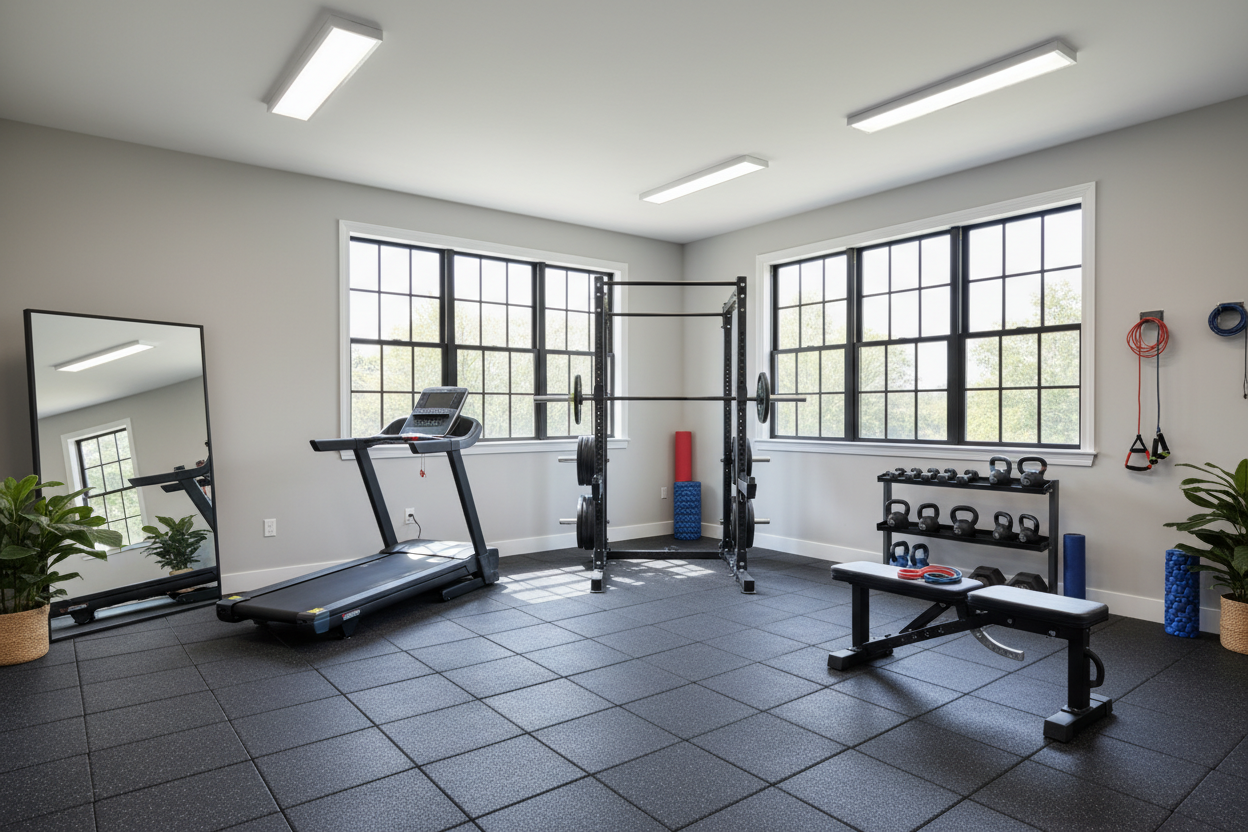
The best decision I ever made was building a functional home gym in my garage. I realized I was tired of the commute, the crowds, and the broken machines that stayed 'out of order' for three months. I started small—a rack, a bar, and some plates. I didn't need 50 machines; I needed the right ones.
I found that an all-in-one home gym could replace almost an entire row of commercial isolation machines while taking up a fraction of the space. It’s about efficiency. If you're training alone and want to push your limits safely, a Smith machine home gym station gives you the stability of a commercial facility without needing a spotter to bail you out.
My biggest mistake early on was buying a cheap, 'standard' barbell from a big-box sporting goods store. The first time I loaded 225 pounds, it kept a permanent slight bend. I learned the hard way that you buy once, cry once. Invest in a real Olympic bar with decent knurling. Your hands and your progress will thank you.
Final Thoughts: Don't Pay for What You Don't Use
Stop looking at the 'total square footage' or the number of locations a chain has. Look at the equipment you actually use during your 45-minute window of training. If you’re spending half your time dodging people or waiting for the one decent rack, you’re overpaying. Whether you stay at a commercial club or move to a home setup, prioritize the tools that build the body, not the amenities that soothe the ego.
FAQ
Is a gym with more equipment always better?
No. More equipment often means more 'filler' machines that take up space. A gym with five high-quality power racks is infinitely better than a gym with fifty mediocre machines and only one rack.
What are the most important facilities found in gym environments?
The essentials are a solid lifting platform or rubber flooring, heavy-duty racks, a variety of free weights, and a versatile cable system. Everything else—from saunas to cafes—is secondary.
Can I get the same results at home as a commercial gym?
Absolutely. Most people only use a handful of movements. If you have a way to squat, press, pull, and hinge with progressive resistance, you have everything you need to reach your goals.
Share:
Are Commercial Bodybuilding Machines Worth the Floor Space?
I Swapped Barbells for a Fit Home Gym (Here's What Happened)