
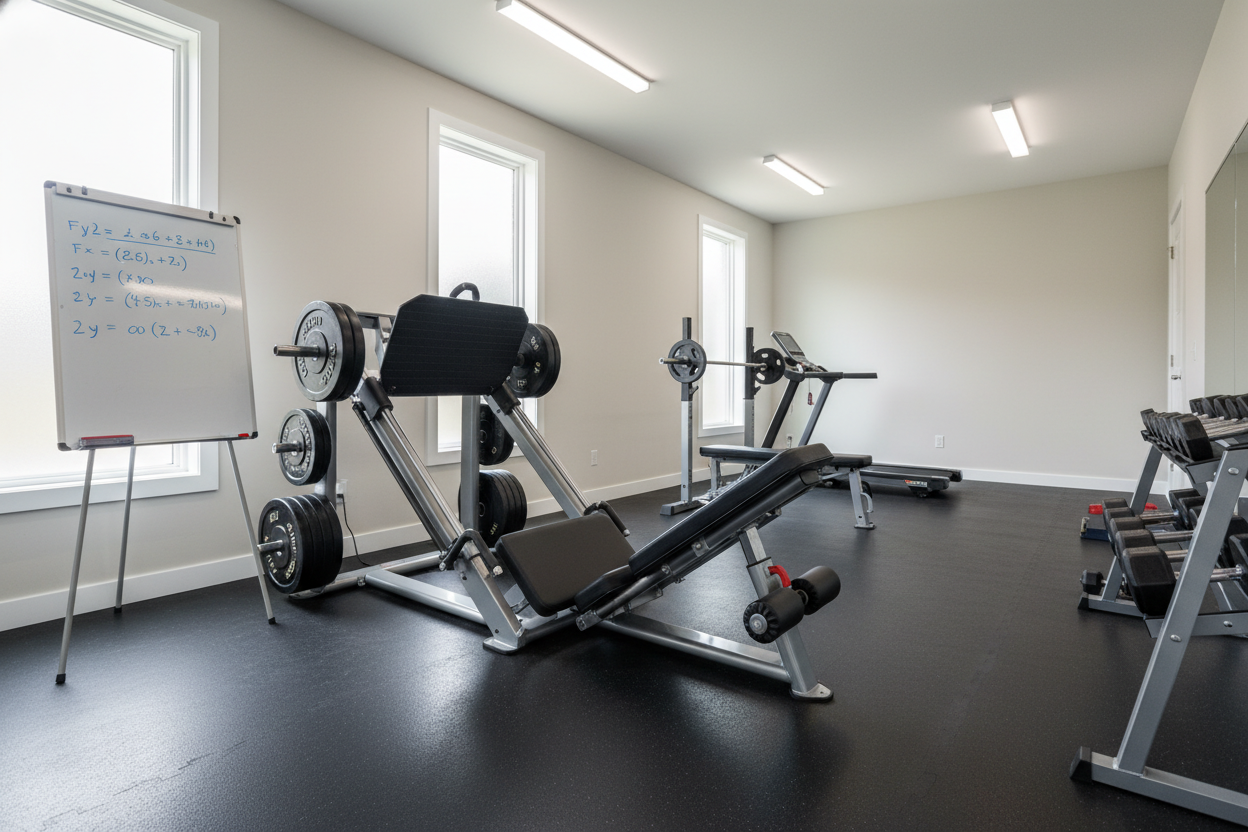
We have all seen that guy at the local commercial gym. He loads every 45-lb plate in the building onto the sled, lets out a primal scream, and proceeds to move the weight exactly two inches. He thinks he just moved 1,000 pounds. In reality, the physics of the weights on leg press machine setups means he did significantly less work than a guy doing a deep, paused squat with 315.
Quick Takeaways
- A 45-degree leg press only requires you to move roughly 70% of the actual plate weight due to the angle.
- Friction in the linear bearings or rollers can further reduce the effective load on your quads.
- 3 plates on leg press is a standard intermediate milestone for high-quality reps.
- Always account for the weight of the empty sled, which usually ranges from 75 to 125 lbs.
Why Your Leg Press Max Is Probably Fake
Comparing your leg press to your squat is a recipe for a bruised ego. Most leg presses are built on a 45-degree incline. If you remember high school geometry, you know that gravity only pulls straight down. Because you are pushing the sled at an angle, you are only fighting a fraction of that weight. The math works out to about 0.707 times the total weight on the sled.
Then there is friction. Even the smoothest linear bearings create resistance, but they also help you on the way down. If the rails are dirty or poorly lubricated, the machine is actually doing some of the work for you by resisting the downward slide. To get a real baseline, you need to read specs on a weight lifting machine to see what the manufacturer lists as the starting resistance. Some sleds are heavy-duty beasts, while others are light aluminum frames.
What Is a Good Weight to Leg Press, Actually?
Stop looking at the guy next to you and look at your own logbook. If you are wondering what is a good weight to leg press, a solid benchmark for a healthy, active male is 2 to 2.5 times your body weight for reps. For women, 1.5 to 2 times body weight is a fantastic target. These numbers assume you are going deep—bringing the sled down until your knees are near your chest without your lower back rounding off the seat.
The Realities of 3 Plates on Leg Press
Hitting 3 plates on leg press (315 lbs in plates plus the sled) is where things start to get interesting. This is generally the sweet spot for hypertrophy. At this weight, you have enough resistance to trigger serious growth without the sheer mass of the plates making the machine feel clunky. If you can do 3 plates for 12 deep, controlled reps, your leg development will show it. Don't be the person who adds a fourth plate just to cut the range of motion in half.
Hitting the Leg Press 6 Plates Milestone
When you reach leg press 6 plates per side, you are moving nearly 600 lbs of iron. At this 6 plates on leg press weight threshold, the mechanical stress on the machine and your joints is massive. This is where foot placement becomes a safety issue. High on the platform hits the glutes; low hits the quads, but too low puts your knees in the danger zone.
If you are training in a home gym, you also need to consider your foundation. A heavy weight leg press machine loaded with 12 plates total is a concentrated point of pressure. If you have a thin concrete slab in your garage and you slam the sled into the safeties, you might be looking at a floor repair bill along with your knee rehab.
How to Calculate Leg Press Machine Weight Increments
Progressive overload is the only way to grow, but jumping by 90 lbs (two 45s) is a trap. You wouldn't add 90 lbs to your bench press in one week, so don't do it here. The best way to handle leg press machine weight increments is to treat the sled like a barbell. Start with the empty sled weight, then add your plates.
If you find yourself stuck, stop reaching for the big wheels. Use smaller fractional weight plates to make 5-lb or 10-lb jumps. It looks less cool, but adding 5 lbs every week for ten weeks is a 50-lb gain. That is much better than trying to jump 90 lbs, failing, and getting discouraged. Small increments keep the joints happy and the progress consistent.
How to Safely Load Weights on Leg Press Machine Sleds
I have seen people load four plates on the left side and two on the right because they were too lazy to walk around the machine. Don't do this. Uneven loading puts lateral torque on the guide rods and linear bearings. Over time, this will bind the machine, score the metal, and ruin the smooth feel of the press. Always balance your leg press weights evenly side-to-side.
Also, pay attention to the storage horns. Most machines have a weight limit for the active sled and a separate limit for the storage pegs. If you are lucky enough to be maxing out the sled, make sure you aren't overloading the frame of the machine itself. A bent storage horn is a permanent reminder of a momentary ego trip.
Personal Experience: The Leg Press Reality Check
A few years ago, I was feeling pretty good about myself because I was 'repping' 8 plates on a commercial leg press. Then I moved my training to a different gym with a high-end, plate-loaded Pendulum squat and a more vertical leg press. I loaded up my usual weight and couldn't move it an inch. It was a massive wake-up call that leg press weights are relative to the machine. I had to swallow my pride, strip the plates back to 4 per side, and actually learn how to use a full range of motion. My legs grew more in the next three months than they had in the previous year of ego lifting.
FAQ
Does the sled weight count?
Yes. If you are tracking your total volume, you must include the sled. Most commercial sleds weigh between 75 lbs and 125 lbs. Check the manufacturer's sticker or manual for the exact number.
Is 45 degrees the best angle for a leg press?
It is the most common because it balances heavy loading with a manageable footprint. Vertical leg presses are more 'honest' regarding weight, but they can be hard on the lower back if you aren't flexible.
How many plates is a 'pro' leg press?
There is no official number, but most high-level bodybuilders are working in the 6 to 10 plates per side range. However, they are doing it with control, not bouncing the weight off the internal stops.
Share:
Does a Multi Gym Leg Press Actually Belong in a Serious Garage?
Why Everyone Tells You to Buy a Rep Fitness Bench