
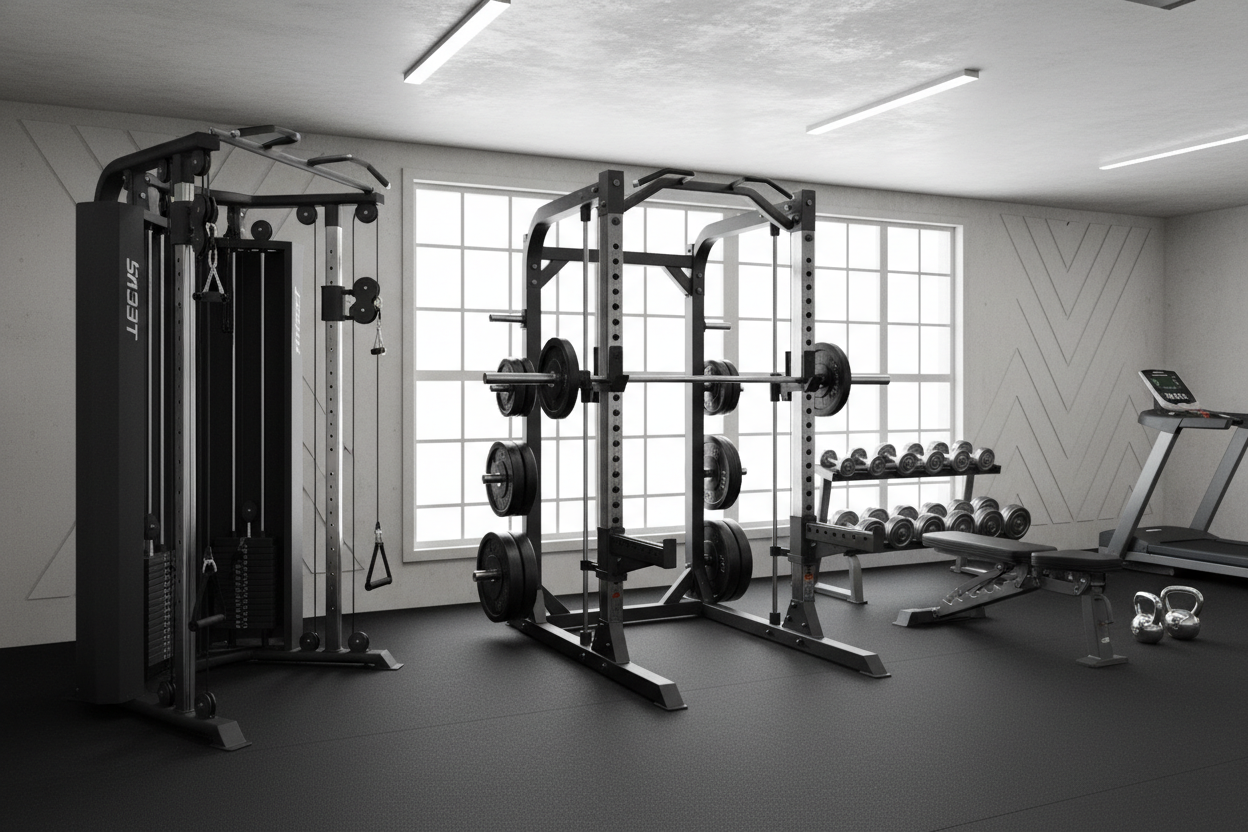
I remember standing in my single-car garage with a tape measure and a sinking feeling in my gut. I wanted the heavy-duty strength of a commercial gym, but I had the square footage of a walk-in closet. If you are currently scrolling through forums at 2 a.m. trying to figure out which exercise machine best suits your limited space, you are not alone. It is the classic home gym gamble: do you go for the fluid versatility of cables or the raw, locked-in power of a Smith rack?
Quick Takeaways
- Footprint: Cables usually require more width for crossovers; Smith machines need vertical clearance and depth for a bench.
- Safety: Both are safer than free weights, but the Smith machine is the undisputed king of solo heavy lifting.
- Versatility: Cables win for accessory and isolation work; Smith racks win for compound mass building.
- The Hybrid Option: Modern Smith racks often include integrated pulleys, solving the dilemma if your budget allows.
The 'I Only Have Room for One' Dilemma
The reality of garage gym life is that you simply cannot buy separate commercial isolation stations for every body part. I learned this the hard way after buying a dedicated pec deck that basically turned my gym into a storage unit with one seat. When you are restricted to a 10x10 or 12x12 space, every square foot has to earn its keep. You need the best machine for workout efficiency, something that hits your chest, back, and legs without requiring a 20-minute teardown between sets.
For most of us, the choice boils down to two heavyweights: the functional trainer (cables) and the Smith machine. These are the best gym machines for those who want to push their limits without a spotter. But they serve very different masters. One is built for the nuances of hypertrophy and 'feeling' the muscle, while the other is built for moving heavy loads through a fixed, safe path. Deciding which type of exercise machine belongs in your corner depends entirely on whether you prioritize functional movement or raw mechanical tension.
The Case for the Cable Crossover Station
If you have ever spent a session on a high-end functional trainer, you know the feeling of constant tension. Unlike a barbell, where the resistance profile drops off at the top or bottom of a lift, cables keep your muscles under fire through the entire range of motion. This makes them some of the most effective exercise machines for building shoulders and a back that actually looks like it belongs to a lifter. I personally find that for high-rep accessory work, cables are unbeatable. They allow for lateral raises, face pulls, and tricep pushdowns with a smoothness that iron plates just can't replicate.
However, cables have a ceiling. Most home-grade functional trainers come with a 160-lb or 200-lb weight stack. While that sounds like a lot, many of these machines use a 2:1 pulley ratio, meaning that 200-lb stack only feels like 100 lbs of actual resistance. If you are a seasoned lifter, you will max out the stack on lat pulldowns and rows within six months. I actually traded free weights for the machine exercise for a three-month hypertrophy block once, and while my joints felt great, I desperately missed the ability to load up 300+ lbs for a heavy press. Cables are perfect for the 'pump,' but they often struggle to provide the 'thud' of heavy compound volume.
Why the Smith Rack Usually Wins the Heavyweight Fight
The Smith machine gets a lot of hate from the 'functional training' crowd, but those people usually aren't training alone in a garage at 6 a.m. When it comes to what is the best workout machine for solo strength, the Smith rack is king. The fixed path allows you to push yourself to absolute failure on squats or bench presses without the fear of getting pinned under a bar. You just flick your wrists, and the bar hooks into the frame. It is the ultimate insurance policy for the home lifter.
Biomechanically, the Smith machine is a beast for leg development. Because the bar is on a track, you can place your feet further forward than you could with a free-weight squat, shifting the entire load onto your quads. If you are looking for a Smith machine home gym station, look for one with linear bearings rather than plastic bushings. Bearings provide that buttery-smooth travel that makes a 400-lb squat feel stable rather than jerky. For anyone asking what is the best fitness machine for pure mass, the ability to safely load three or four plates per side on a Smith rack usually tips the scales over a cable tower.
Don't Forget About Specialized Lower Body Rigs
I have a caveat for the lifters who already own a solid power rack and are just looking for that one 'finisher' piece. If your squat and bench are already covered by free weights, what is the best exercise machine to add next? You might not need a Smith rack. Instead, you might be better off with a dedicated unit that targets the hardest area to hit at home: the legs. Many lifters find that a leg press hack squat combo machine is actually the smarter play for a garage.
These combo units take up about the same floor space as a Smith machine but offer a much more intense stimulus for the lower body. I’ve found that as I get older, my lower back appreciates the supported nature of a hack squat over a traditional barbell squat. If your goal is strictly aesthetic or you’re working around a nagging injury, these specialized rigs are often what's the best exercise machine for your specific needs, rather than a jack-of-all-trades unit that does everything 'okay' but nothing 'great.'
The Ultimate Verdict: What is the Best Workout Machine for You?
So, what is the best fitness machine for your specific garage? If you are a bodybuilder or someone who loves high-volume accessory work and has a limited budget, the cable station is your best friend. It offers hundreds of movement patterns in a single footprint. But if you are a strength athlete who needs to move heavy weight safely without a spotter, the Smith machine is the clear winner. It provides the stability and loading capacity that cables simply cannot match.
In my experience, the best full body exercise machine for a serious home gym is actually a high-quality Smith rack that features integrated cable pulleys. It gives you the heavy-duty fixed path for your main lifts and the cable versatility for your curls and crossovers. It’s a bigger investment upfront, but it prevents the inevitable regret of wishing you had the 'other' machine six months down the line. Stop overthinking the 'functional' vs. 'fixed' debate and buy the tool that allows you to train the hardest without ending up in the ER.
Personal Experience: The 'Cheap Pulley' Lesson
I once tried to save $500 by buying a generic, off-brand cable tower from a big-box retailer. On paper, the specs looked fine. In reality, the pulleys were made of cheap plastic that squealed like a stuck pig, and the cable itself started fraying within three months of heavy use. Worse yet, the frame was so light that it would tip toward me during heavy seated rows. I eventually sold it for a third of what I paid and bought a proper Smith/Cable hybrid. The lesson? If you're buying what are the best exercise machines for your long-term health, don't cheap out on the moving parts. If it has a cable or a bearing, quality matters more than the price tag.
FAQ
Is a Smith machine better than a power rack?
It depends on your goals. A power rack is better for athletic development and 'real world' stability, but a Smith machine is superior for hypertrophy and training to failure safely when you're alone.
Can I build a big chest with just cables?
You can certainly build a defined chest, but for sheer mass, you'll eventually need the heavy loading that only a Smith machine or a barbell can provide. Cables are the best machine for workout finishers, not necessarily the primary builder.
How much floor space do I need for a Smith machine?
Plan for at least a 7x7 foot area. You need room for the bar width (usually 7 feet) and enough depth to slide a bench in and out for different exercises.
Share:
I Tried Every Exercise Routine for Home Gym Setups (And Kept This)
Why Your Angled Smith Machine Squat Feels Weird (You're Backwards)