
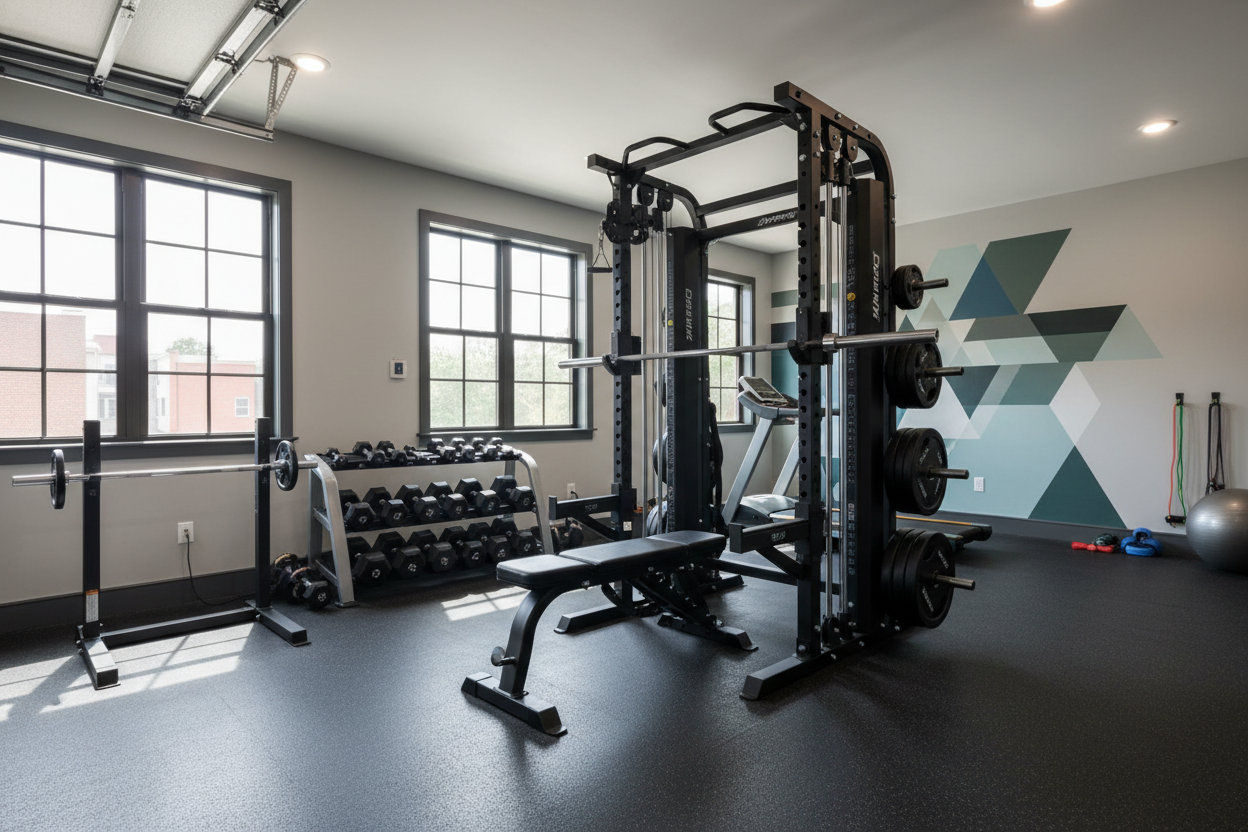
I've spent years scrolling through marketplace listings and gear catalogs, looking for that one piece of equipment that doesn't turn into a clothes hanger after three months. Most people start their search for the best full body exercise machine by looking at those folding 'total gyms' or resistance-band contraptions that promise a shredded physique in ten minutes a day. I've bought them, I've broken them, and I'm here to tell you they're mostly garbage.
If you're tired of your local commercial gym raising prices while their equipment stays broken, you're probably ready to build a sanctuary in your garage. But you don't have room for fifteen different machines. You need one rig that actually works.
Quick Takeaways
- Standard multi-gyms with fixed seats limit your range of motion and stop being challenging after six months.
- A Smith rack with integrated cables offers the safety of a fixed path with the versatility of functional trainers.
- Look for 11-gauge or 12-gauge steel; anything thinner will wobble when you start moving real weight.
- A 2:1 pulley ratio is the sweet spot for smooth, micro-adjustable cable work.
The Infomercial Trap: Why Most 'All-in-Ones' Fail
We’ve all seen the late-night ads. A guy with 2% body fat folds a machine out from under his bed and does a bicep curl. It looks convenient, but the reality is disappointing. Searching for the 'best whole body workout machine' usually leads you to products made of thin-walled tubing and plastic pulleys that feel like they're going to snap the moment you try a heavy row.
These machines rely on friction or elastic tension, which is notoriously inconsistent. You lose the 'eccentric' part of the lift—the lowering phase—because the bands just go limp. If a machine can't provide a smooth, heavy stretch, it's not building muscle. Most of these gimmicks max out at a resistance level that a moderately active person will outgrow in twelve weeks.
What Actually Makes a Rig the Best Full Body Exercise Machine?
To qualify as the top dog, a machine has to handle the 'Big Three' patterns: pushing, pulling, and squatting. It needs to feel as stable as the floor you stand on. If I'm doing a heavy chest press, I don't want to feel the frame swaying three inches to the left.
The gold standard involves three things: consistency, capacity, and safety. You need a weight stack or plate-loaded system that doesn't bind up mid-rep. You need a frame that can handle at least 500 lbs, even if you aren't lifting that much yet—that extra mass equals stability. Finally, you need safety catches. If you're training alone in a basement, those catches are the only thing keeping a failed rep from becoming a trip to the ER.
Why the Modern Smith Rack Killed the Traditional Multi-Gym
The old-school multi-gym was a cage of fixed handles. You sat in one spot, pushed a lever, and that was it. The modern Smith Machine has evolved into a completely different beast. It's no longer just a bar on a track; it's a structural hub.
By combining a Smith bar with a dual-cable functional trainer, manufacturers created a hybrid that does everything. You get the fixed-path safety for heavy squats and overhead presses, but you also get the 'free' movement of cables for flyes, crossovers, and face pulls. This combination effectively killed the traditional multi-gym because it offers more variety in half the footprint.
3 Non-Negotiables for the Best Total Body Workout Machine
Before you drop a couple of thousand dollars, check the spec sheet. First, look for linear bearings on the Smith bar. If the bar uses cheap plastic bushings, it will feel 'crunchy' and uneven. You want that butter-smooth glide that lets you focus on the muscle, not the friction.
Second, the steel needs to be heavy-duty. I look for 2-inch by 3-inch or 3-inch by 3-inch uprights. Third, the cable system needs a 2:1 ratio. This means if you have 100 lbs on the stack, it feels like 50 lbs at the handle, but you get twice the cable travel. This is non-negotiable for the best total body workout machine because it allows for the long-range movements required for sports-specific training. A prime example of this engineering is the Full Body Multi Training Station Smith Machine Dm01, which hits all these marks without taking up a three-car garage.
How I Program a Full Week Around One Machine
You don't need a sea of chrome to get results. I've found that a simple Push/Pull/Legs split on a cable-equipped Smith rack is the best machine for full body workout efficiency. On Push day, you've got Smith incline press and cable lateral raises. Pull day is all about Smith rack rows and high-to-low cable crossovers. Legs? Smith front squats and cable pull-throughs for the hamstrings.
The volume you can achieve is insane because transitions take seconds. You're not walking across a gym floor; you're just moving a pin. If you're coming from a bodybuilding background and hate the idea of 'machine-only' training, check out this guide on A Full-Body Matrix Machine Workout for Lifters Who Hate Machines to see how to keep the intensity high without a barbell.
Is the Best Full Body Workout Machine Worth the Floor Space?
Let's be real: a quality rig isn't small. It's going to take up about a 6x7 foot area once you account for plate loading. But compare that to a power rack, a separate functional trainer, and a leg press machine. You're saving about 60% of your floor space by going the hybrid route.
I once tried to save money by buying a cheap power tower and a set of adjustable dumbbells. Within six months, I was frustrated by the lack of stability and the 'clunky' feel. I ended up selling it all at a loss to buy a real Smith-cable hybrid. Buy once, cry once. A heavy-duty system is an investment in your house and your health that will actually last a decade.
FAQ
Is a Smith machine better than free weights?
It's not 'better,' it's different. It provides stability that allows you to push to absolute failure safely, which is great for hypertrophy. Free weights are better for stabilizer muscle recruitment.
Does this machine require a lot of maintenance?
Keep the guide rods clean and apply a little silicone lubricant once every few months. If it has cables, check for fraying once a year. That’s about it.
Can I do pull-ups on these rigs?
Almost all high-end Smith racks come with a multi-grip pull-up bar at the top. It’s the perfect way to start your workout before hitting the weights.
Share:
Stop Asking What Is Best Home Gym Equipment (Ask This Instead)
I Built My Entire Routine Around One Adjustable Dumbbell Set