
I remember the morning I couldn't tie my shoes without a sharp wince. I’d spent the previous night grinding out a heavy 5x5 squat session, and my lower back had officially filed a formal protest. That's when I realized my barbell purist ego was actually holding my quad development back.
I spent years thinking machines were for people who didn't want to work hard. I was wrong. Adding a thigh press machine to my setup allowed me to push my legs to absolute failure without my spine paying the price. If you are tired of your back being the limiting factor on leg day, it is time to look at the data.
- Total quad isolation without lower back fatigue.
- Safety pins mean you can train to failure alone without a spotter.
- Footprint is large; you need a dedicated 4x7 foot area at minimum.
- Combo units offer the best value for home gyms with limited square footage.
The Elephant in the Gym: What Does a Leg Press Machine Look Like?
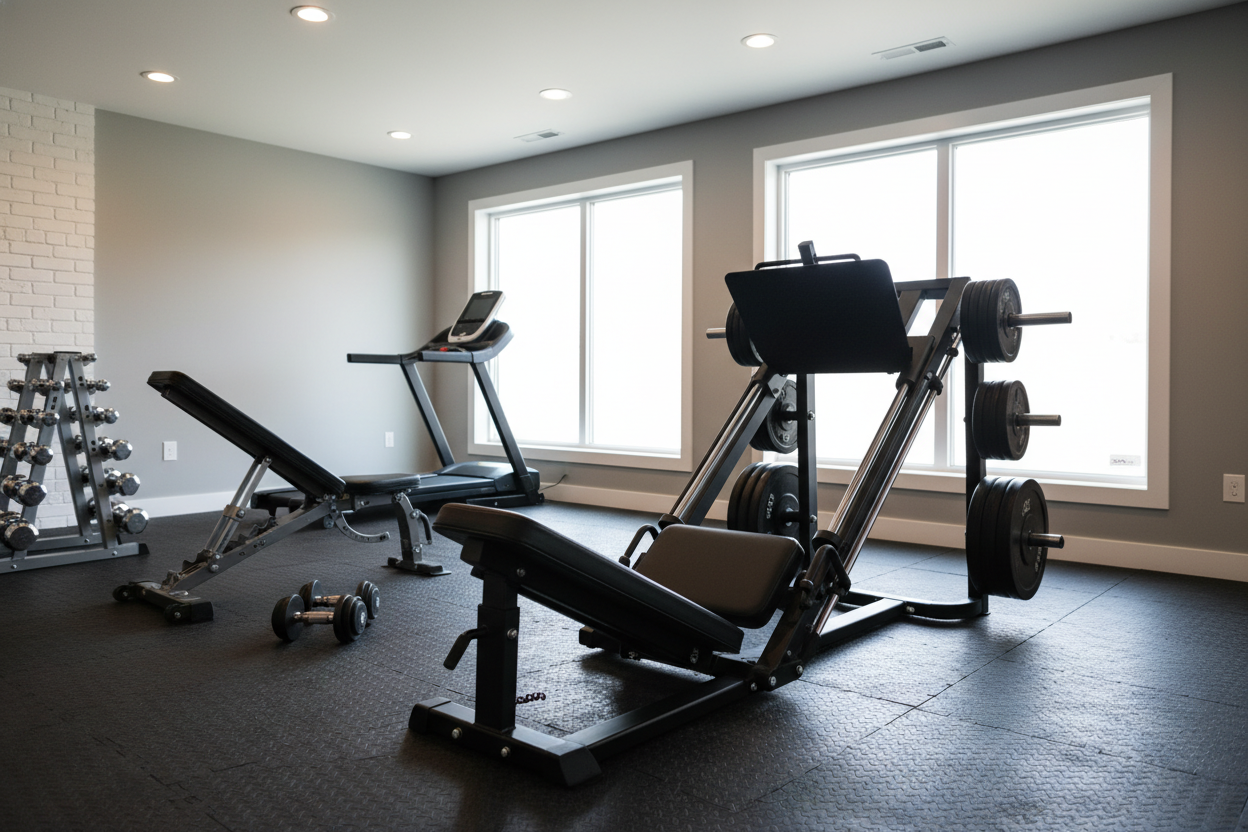
If you're new to the equipment world, the terminology can be a mess. You might hear people talk about a leg press bench or search for a leg press máquina, but they're mostly talking about the same thing. So, what does a leg press machine look like? Imagine a heavy steel frame with a seat and a large metal platform for your feet.
In most commercial facilities, you'll see seated leg press machines where you push the weight horizontally. In serious strength gyms, you'll find the 45-degree version where you lie back and push a sled upward. Both serve the same purpose: moving heavy weight with your legs while your back is supported by a thick, padded backrest.
Why I Finally Stopped Ignoring the Leg Press Machine in Gym Settings
For a decade, I believed if you weren't under a barbell, you weren't training legs. But as I hit my 30s, my recovery slowed down. My quads could handle more weight, but my erectors were fried. I started using the leg press machine in gym settings as a secondary movement and the growth was immediate.
The beauty of the machine is the lack of spinal compression. You can load up six plates on each side and crush your quads until they shake, and then just walk away. You don't have to worry about your core collapsing or your form breaking down into a dangerous 'good morning' squat. It’s pure mechanical tension on the muscle you're actually trying to hit.
45-Degree Sleds vs. Seated: Picking Your Poison
When you're shopping for your own space, the choice usually comes down to the 45-degree sled or a seated cable-based unit. The 45-degree version is the gold standard for heavy lifting, but it’s a total space hog. We’re talking about a piece of gear that can take up more room than a full power rack once you factor in the plate loading horns.
Seated leg press machines are often more compact but can feel a bit light once you get strong. If you're tight on square footage but still want that heavy sled feel, look for a compact 30 degree leg press. These use a shallower angle to save floor space while still letting you load up several hundred pounds of iron for deep, productive reps.
The 'Leg Press Máquina' Hype: Are Combo Units Worth It?
Space is the ultimate currency in a garage gym. Unless you have a massive warehouse, buying a standalone leg press and a standalone hack squat is a mistake. This is where the combo units come in. They allow you to flip a backrest or swap a footplate to switch between movements in seconds.
A solid 3 in 1 hack squat combo is usually the smartest investment for a home setup. It gives you the leg press, the hack squat, and often a calf raise option on a single footprint. Just be prepared for the setup time; it usually takes about 30 seconds to switch the configuration, which is a fair trade for the floor space you save.
My Verdict: Should You Give Up the Floor Space?
If you have the room and the budget, a dedicated leg press is the best accessory you can buy for lower body mass. However, don't go cheap. I once maxed out a cheap leg press from a big-box retailer and the carriage started wobbling so badly I thought the bearings were going to explode. If the machine uses thin 14-gauge steel, stay away.
If you're in a tiny 10x10 room, stick to Bulgarian split squats and save your money. But if you have the clearing and you want to actually grow your legs without destroying your back, pull the trigger on a high-quality combo unit. Your knees and your spine will thank you five years from now.
Is the leg press better than squats for muscle growth?
It is not better, it is different. Squats are better for overall athletic development and core stability. The leg press is superior for isolating the quads and pushing them to absolute failure without technical breakdown.
How much weight can a home leg press hold?
Budget models usually top out around 400 lbs. Quality residential units can handle 800 to 1,000 lbs. Always check the gauge of the steel and the weight rating of the linear bearings before you buy.
Do I need special plates for a leg press?
Most high-quality machines use 2-inch Olympic sleeves. If you only have 1-inch standard plates, you will likely need an adapter or a specific machine designed for smaller plates, though these are usually less durable.
Share:
Can a Bench Squat Machine Actually Replace Your Power Rack?
Does a Circular Dumbbell Actually Belong in a Home Gym?