
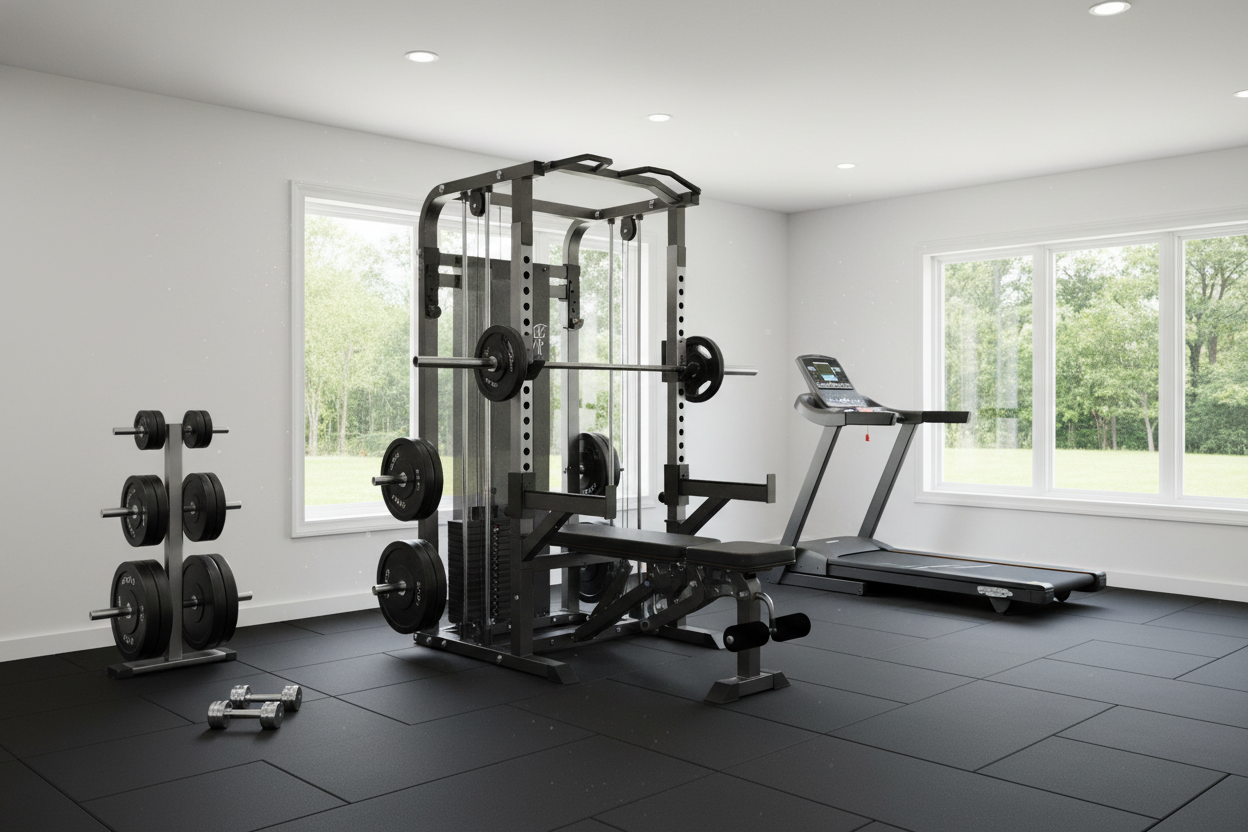
I remember standing in my garage with a tape measure and a heavy heart. My wife wanted to actually park her car inside, but I wanted a full 4-post rack, a dedicated bench, and enough room to move without bruising my shins. Something had to give. That is when I started looking at a bench squat machine as a potential space-saving savior.
We have all been there—scrolling through equipment sites at midnight, trying to justify a piece of gear that promises to do everything. The idea of a bench press and squat machine is intoxicating because it solves the biggest problem in home gym ownership: the footprint. But after years of loading plates and testing the structural integrity of budget rigs, I have learned that convenience usually comes with a tax.
Quick Takeaways
- Space Savings: You can reclaim about 15-20 square feet compared to separate stations.
- Stability: Most combo units lack the 3x3 steel beefiness of a dedicated power rack.
- Setup Time: Expect to spend extra time moving the bench and adjusting J-cups between lifts.
- Safety: Without full spotting arms, solo lifting at your limit becomes much riskier.
Why We All Secretly Want an All-In-One Rig
The math is simple. A standard power rack is 48 inches wide and often 50+ inches deep. Add a bench, and you are eating up a massive chunk of your floor. The rising popularity of the multi function bench press set is not just about saving money; it is about reclaiming the ability to walk through your own garage without turning sideways.
For the average lifter who just wants to stay in shape, these rigs are a godsend. You get your compound movements done in one footprint. If you are not trying to break state records, the versatility of a combined setup often outweighs the need for a massive cage that sits empty 22 hours a day.
The Brutal Reality of Footprint vs. Function
Here is where the honeymoon ends. Most combo machines are built on a 2x2 or 2x3 steel frame. While that is fine for a 225-lb bench, it can feel like a wet noodle when you are re-racking a 315-lb squat. The uprights are often narrower than a standard rack, which ruins your grip width on the bench.
Then there is the bench itself. In many cheap combo units, the bench is bolted to the frame. This is a nightmare for squats because the bench often sits exactly where your feet need to be for a wide stance. If you can not move the bench out of the way, you are stuck doing awkward, narrow-stance squats that feel more like a balancing act than a leg day.
Smith Machines vs. Free Weight Combos
If you are looking at an all-in-one, you have to choose between a guided track or a free barbell setup. I have spent a lot of time analyzing the smith machine bench press vs barbell bench press debate, and it really comes down to your goals. A Smith machine combo is undeniably safer for the solo lifter. You can lock the bar with a flick of the wrist if your triceps give out.
However, the fixed path kills your stabilizer muscles. Free weight combos give you that raw, shaky, 'I might actually die' feeling that builds real-world strength. The trade-off is that free weight combo racks rarely have high-quality safety spotters. If you miss a rep on a combo bench, you better hope you know how to roll of shame.
The Independent Arm Loophole
There is a third option that most people ignore: leverage systems. Instead of a barbell, these use plate-loaded arms. Using a chest press machine independent arms setup allows you to mimic the feel of a commercial gym without the massive footprint of a cable crossover.
These machines solve the 'bench in the way' problem because the arms move independently. You get the safety of a Smith machine but a more natural arc of motion. If you are training for hypertrophy rather than powerlifting, this is often the smarter buy. You can go to absolute failure without a spotter and without worrying about a 300-lb bar crushing your windpipe.
So, Should You Ditch Your Power Rack?
If you have the space, keep the rack. There is no substitute for 11-gauge steel and the security of four posts. But if you are working in a 10x10 spare bedroom or a crowded single-car garage, a high-quality combo unit is better than not lifting at all. Just do not cheap out. Look for units with a weight capacity at least 200 lbs higher than your current max.
The ideal candidate for a combo machine is someone who values 'good enough' over 'optimal.' If you are a 5/3/1 purist, you will hate the compromises. If you are a busy parent just trying to squeeze in a 45-minute full-body blast, you will love the efficiency.
My Honest Mistake
I once bought a budget bench-squat combo that had the J-cups welded to the uprights at fixed heights. I am 6-foot-2. The 'squat' setting was at my collarbone, and the 'bench' setting was so low I had to do a half-rep just to unrack it. I ended up selling it on Craigslist three weeks later for half what I paid. Always, always check the hole spacing and adjustability before you hit buy.
FAQ
Can I do pull-ups on a combo bench squat machine?
Usually, no. Most of these units lack a top crossmember for pull-ups to keep the footprint small. You will likely need a separate doorway bar or a wall-mounted pull-up station.
Are these machines safe for heavy squats?
Only if they have adjustable safety arms. Never squat heavy on a combo unit that only has J-cups. If you trip or fail, there is nothing to catch the bar but your floor (or your spine).
How much weight can a standard combo machine hold?
Entry-level units usually top out at 300-400 lbs. Higher-end leverage or semi-pro units can handle 600-800 lbs. Always check the static weight rating before loading your PR weight.
Share:
Your First Free Weight Set With Bench Doesn't Have to Suck
Can a Thigh Press Machine Actually Replace Barbell Squats?